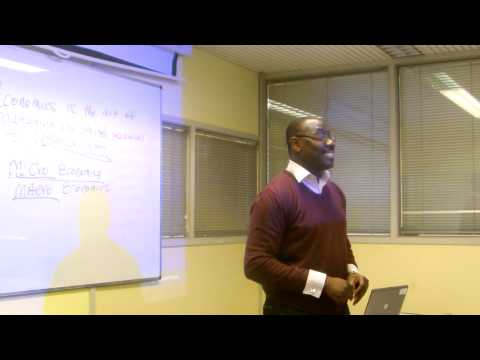
[0:02]Good morning everyone. Good to see you all. Good to see you all. Yeah, my name is Alfred Ajamon and I'll be taking you through this morning session. Uh, just before we go into this session, just a few uh, ground rules or house rules. Uh, just to let you know, we are not expecting any uh, fire drill today, so if you hear the fire alarm, it means that you have to literally uh, respond to it. The fire exit is just down in the corner there, our assembly point is just by the backless bank, just to put you in the picture. So if there's any fire alarm, please, it's not a drill that we do it, we're not expecting anything today, so it's, it must be real. Also, we have some, as you can see on your left hand side, we have the computers there which has some electric cables and things like that. Please, just be careful that you don't go too close to trip over it and stuff like that. Also, I believe from the reception you've been told where the toilet facilities and all those things are. So, uh, is the room temperature okay for everybody? Okay, that's great, that's great, that's what I love to hear. Today identify what falls under, can you pass it on to the gentleman, what falls under microeconomics and what falls under macroeconomics? So at the end of the lesson, we should have a knowledge of what microeconomics is and what macroeconomics is. And I believe on that basis, that list that I've just given you, you'll be able to categorize each one of them under each head. Okay? Have you been that? That. I believe we all, we all know what economics is because it's something that we do in our everyday life. We keep using the word, I'm economizing, I'm economizing. Why are we economizing? Can anybody tell me? Why are we economizing? To save money. To save money, yes. To plan for uh, future events. To plan for future events, yeah. Pardon me? Recession. That's a good one. Yes, we all, we all economize. And the reason why we economize, basically from an economist point of view is because we don't have everything. That is the reason why we are economizing. That is the reason why like he said, to save for the future. Why do you need to save for the future if you have everything? You don't need to. But you have to economize because the money or the resource or even the time that you have is limited. So we have to economize, so in our daily lives, is full of what? Economics. So naturally, we are all born economists, aren't we? Because it's something that we, we do on a daily basis. So, when we talk about economics, it shouldn't sound like, oh, this person is an economist, he's, he's a special guy. We all do it, we do it in our daily lives, it's part of our lives, even deciding on what to wear this morning. There was a bit of economics there. So our basic life is full of economics. But what I'm going to try to explain to you guys today, is for us to have a theoretical or an academic understanding of what economics is and try to identify the difference between microeconomics and macroeconomics. So based on the things that you people have told me, we can comfortably say economics is a science, or it's a study of how to what? Manage our limited resources, to get an optimum return. Does that make sense? We have to manage, because we, like we said earlier on, we have to economize. So economics is the art of managing the limited resources to be able to get the best out of the resources. So, we can say economics is the art of managing our limited resources to optimize return. So that can be our basic definition of economics. So by managing the resources, at the same time, we want to get the best out of it. You are not just managing for managing sake. At the end, you must know that the decision that you took, the reason why you spent money on your jacket instead of the perfume for the, for your wife, has been a good return for you.
[5:27]Only for me not for my wife. Only for you, not for your wife, so you're thinking only about yourself. Your wife can wait, maybe on her birthday or Valentine is coming soon, so that, that, that perfume can go in there for her. So your jacket was important and you maximize the return on that, okay? So we have talked about what economics is. But in economics, we have what we call microeconomics and macroeconomics. So what is, what do we mean by micro? It's, it's quite a word that we use all the time, isn't it? Micro. Minute. Minute, small, small. Yeah, small. And macro on the other hand, big, big. So having a knowledge that micro means small, how do we relate it to give an understanding of microeconomics? So we are talking about, if literally I can say, we're talking about small economics, am I right in saying that? Small economics. But, does that make sense when we say small economics? What goes into the small economics? Family economics, home economics. Yeah, they all coming, yeah, it's all part of it. Yeah, any ideas, sir? Things related with daily life. Daily life. Yeah, that's, that's good as well. Sir Francis. Yeah, it's on a smaller scale. On a smaller scale, yeah, yeah. All that you've said is right, but when we talk about microeconomics, microeconomics tend to examine the individual elements of the economy. So microeconomics deals with what? Individual elements, elements of the economy. So for instance, what individual element of the economy can we talk about? We're saying that micro is small. So micro deals with what? Individual, little parts of the economy. And and with microeconomics, it is examining the, let's say, the factors that influence the, the demand and supply of a particular commodity, like, uh, let's say fish. So when we talk about the demand and supply for fish, we are talking about what? A microeconomic idea. Because fish is just a small element of what is in the economy. So you understand where the, where micro comes from and how it fits in economics. Yeah. So we can talk about the fact that the price of fish has gone up, so now the demand for fish, all things being equal in economics we make a lot of assumptions. Normally we use the word, se'teres parabus, which means all things being equal. We assume that when the price of fish, let's say goes up, the demand for fish would what? Come down. And in vice versa, if the price of fish goes up, the demand for fish will what? Go, will, will go down, or vice versa. Am I making sense? So if you're going to buy this jacket and the jacket is let's say 20 pounds. If you go back and the jacket has gone up to 40 pounds, maybe your budget is 20 pounds. That means you can't afford the jacket anymore, so you cannot make that purchase. By you not making that purchase, it means that whoever is selling the jacket has lost one sale, so they are demand has what? Come down. We make sense? So, go, there are certain policies government takes into consideration when they're dealing with the economy and they normally group it under micro and macroeconomics.
[11:00]As we go along the, the session, we may come and talk about those individual policies. Macroeconomics. Are we all understanding what macroeconomics is?
[11:31]Okay, macroeconomics, we say big, we all said macro is big. So macroeconomics, look at the economy as a whole, the total uh, elements of the economy. For example, the level of unemployment in the economy, the inflation rate of the economy, interest rate of the economy. Those are big elements that comes into the economy. So when the government is talking about, especially around this time where unemployment is quite high, every quarter they have to release the figures on how many people are employed or how many people are not employed. That is a macroeconomic policy. So it is a big picture, it is a big element of macroeconomics. So the government have to put in place things that will change or reduce the level of unemployment. The government have to consider whether people are unemployed because they are enjoying benefit or people are enjoying benefit because they are unemployed. It's a chicken and egg problem which the government have to look into. So just on those bases, I've given you a list of certain, uh, things are on the list which you have to group them like I said at the early of the session, at the beginning of the session.
[13:17]You have to group them now that we have an idea of what micro and macroeconomics is, I believe we can be able to group them as well. Is there any questions that we want to ask in terms of what we've just talked about? Can you have some more example of macroeconomics? The big one. The big one. Yeah, foreign exchange, exchange rate. Budget. What about budget? National budget, is it? Yeah, the national budget is a macroeconomic policy but national budget involves everything. So it talks about unemployment, it talks about all the things involved there, but we can pick up the even in the budget, we can categorize it, so budget is a macroeconomic thing that we do. Fiscal and monetary policy will fall under micro. Uh, fiscal and monetary policy comes under macroeconomics. Yeah. So we're talking that, that's a whole taxation and things like that. That will get into as we go along the course. You guys are very clever, I like, I'm going to enjoy this class. Well done. Yeah? So if you can quickly finalize the list and can have a look at, at, at them.
[14:55]Okay? So, can you tell me sir what microeconomics is? It's all about fish because I'm hungry. That's very good. Yeah, fish is an individual element of the economy, so yeah, that's very well done. Mr. Francis, any idea microeconomics? Well, microeconomics, you know, deals with uh, you know, with the economy on the large scale. On a large scale, yeah, yeah, big picture, big picture, the government, the government policies and what it do, and maybe how those actions affect us. That's very well answered. Yeah.