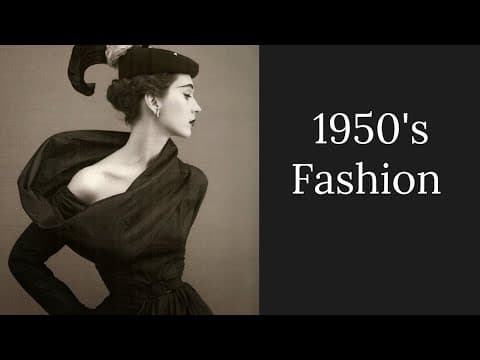
[0:03]One of the most glamorous periods in fashion history, the 1950s react in opposition to the austerity of the years of war. Fashion became hyper feminine, colorful and glamorous. O returned to the market finding in America its savior and creating some of the most iconic pieces in fashion history. I'm Estella Mendez, welcome to Fashion History Sessions.
[0:36]Life in the 1950s can somehow be compared to life in the 1920s. A post-war world wanting to move forward and forget about the years of sadness. In this decade, the United States became prominent in the Western world, both economically and culturally. There was great technological and industrial development. The 1950s were all about being modern, at least in the mod cons of daily life. With the end of war, men and women reassumed their original roles in society. Men returning to the workforce and women to the home. Though many women maintained their careers, others returned to their home making role. Fashion reflects this by becoming ultra feminine, reminding of the 50s of the previous century. Fashion doesn't change on the 1st of January of 1950. The changes have been in the making. With the launch of Dior's new look in 1947, the nipped in waist and full skirt became the most popular silhouette until the mid-1950s. In order to attain this silhouette, like in the previous century, underwear would contribute to achieve the shape. Girdles would create the very small waist and hold the hips in a slim shape. The 1950s had more than one silhouette that would exist simultaneously. The slim silhouette would also require the girdles, a very tight mini length skirt with a jacket cinched in the waist. From the mid-1950s, a more straight and boxy style will become fashionable, providing more comfort. Perhaps the most famous example of this style is the Chanel suit. Though designers like Balenciaga and Givenchy would be famous for this silhouette. Though colors like black, navy, whites and beiges were a staple, the 1950s fashion is very colorful, oscillating between pastel colors and saturated ones.
[2:51]In the 1940s, women opted for a long hair, as they did not have much to play with during the years of war. In the 1950s, they will opt for shorter hair, a long bob haircut styled with curls or shorter styles like the Italian cut popularized by Sophia Loren, or the pixie cut by Audrey Hepburn. In the mid-1950s, we see the buffon hairstyle emerging, becoming a staple in the following decade. During the 1950s, hair dye will be available at home, and more women would dye their hair. It was estimated that one in four American women would dye their hair in the US. Blond was the preferable color. This decade is very joyful, and many women would temporarily dye their hair in silver, red or blue to match their clothes and accessories, all made possible by color spray. Color would continue in makeup, with violet, blue, green or silver eyeshadow with the eyeliner going upwards. Eyebrows were thick and with a high arch, and bright lipstick would often match the nails. As for shoes, we see the birth of the stiletto, and ballerina shoes will also become very popular. But formal clothes were not the only times. More informal leisure wear becomes popular. Women would wear capri pants and cardigans with sandals and ballerina shoes. Men, who were constantly in suits, would take a break on weekends, wearing shorts and polo shirts, not too crazy though. Until the 1950s, there were children's clothes and adult's clothes, but now we see the clothes for teenagers. The baby boomers are in. In the 1950s, there were more young people in the US than ever before, creating a new demographic, a new market. Teenage girls' clothes were very similar to their mothers', but a bit more infantilized with cartoons and prints. As for boys, a more sports style with their leather jackets was fashionable, when they were not wearing the formal suit. But not all teenagers and young people would conform. The rebels start to express themselves through fashion. Jeans, leather jackets and many other items of clothing would make the style of various groups like the greasers, the teddies or the bitniks. Depending on the country and also the social and economic background, counterculture will walk its first steps. The style icons of this era were Elvis with rock and roll and the actors James Dean and Marlon Brando, often portraying the angst and rebellion of these young people in the silver screen. As for women, movie stars continue to be influential, like Marilyn Monroe, Elizabeth Taylor and Audrey Hepburn. Towards the end of the 1950s, we also see Europe producing its own stars. Julie Cco, Sophia Loren and Brigitte Bardo will start to shift the culture back to Europe. The 1950s are the age of glamour, a 20th century version of the time of the Belle Epoque. But the need for profound change allied with great technological development, will push the fashion creators into a whole other level, experimenting not only formally with the construction of clothes, but also sourcing their inspiration somewhere else. The 1950s created the foundation for what the revolutionary 60s would bring.


