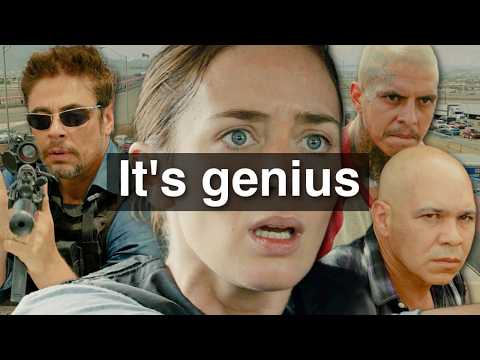
[0:00]What if I told you Sicario's border crossing sequence is a masterpiece, not just for the tense final standoff, but because of the hidden messages Denis Villeneuve seems to put into many of the shots.
[0:11]For instance, this shot of the Mexican-American border where each side looks like a mirror image of the other. What does that mean?
[0:19]I have a few theories which I'll talk about in a second.
[0:22]In this analysis of this 15-minute border crossing scene, we'll go shot by shot, analyzing the hidden meaning present in each of them to get an idea of how Denis Villeneuve constructed one of the most electrifying and meaningful sequences in movie history.
[0:36]The sequence starts with a couple overhead shots of a typical American neighborhood. Houses are divided by fences and laid out in neat little rectangles, and in this second shot, we see this oasis of neat, pleasant American homes suddenly meet the desert.
[0:53]A line is drawn along the edge of the neighborhood, separating them from the wilderness.
[0:57]Denise is doing a couple important things here.
[1:00]For one, he's anchoring us in a pleasant setting to give extra contrast to the hell that is Juarez later on.
[1:07]Second, he's playing around with the idea of borders, borders between the houses and borders between the houses and the desert.
[1:15]Sicario has played around with borders, i.e., separation, a lot so far.
[1:20]For instance, we learned that Kate's divorced or separated from her husband.
[1:24]Do you have a husband? Divorced.
[1:29]In this scene where she meets Josh Brolin's character, a glass wall separates them at first so she can't hear what they're saying.
[1:36]In this moment where she steps into that room, Kate herself separates Josh from the rest of the group visually in frame.
[1:43]And what about the house at the start of the film? In between the walls, i.e., the separators between rooms, they find dead bodies in plastic bags.
[1:53]When you think about Sicario in general, Kate wants to follow the rules and do things by the book.
[1:59]But what she realizes is that there are no rules out here in this country.
[2:04]There is no line to cross. Moving on, Denis does a great job representing the ruthlessness of this country with aerial shots in the sequence, and also in the scene when Kate's on the private jet a little earlier.
[2:17]This land feels desolate, dangerous, and intimidating.
[2:22]It adds enormously to the tension of this sequence because we really feel we're going into the belly of the beast here.
[2:28]My favorite shot of this entire sequence though, is this one.
[2:33]It's the thumbnail of my analysis I did on Sicario three years ago because it visualizes the underlying sameness between the cartels and the United States.
[2:41]At the end of the film, the cartel boss says to Alejandro,
[2:45]Do you think the people that sent you here are any different? Who do you think we learned it from?
[2:52]There's a paved two-lane highway on the United States side of the fence and a dirt two-lane road on the Mexican side of the fence.
[3:00]They're mirrored perfectly, implying sameness, visualizing what the mob boss later tells Alejandro.
[3:07]Mirrors are actually really prominent in Sicario.
[3:11]Denis framed shots through them all the time, and I can't help but think this was done to hint at the sameness between the United States and the cartels.
[3:19]Perhaps the border is actually a metaphorical mirror, and that our side is more like the cartels than we originally thought.
[3:27]For instance, Alejandro tells Kate to not trust the state police in Mexico because they're not always the good guys.
[3:34]Keep an eye out for the state police. They're not always the good guys.
[3:39]But later on, Kate's nearly killed by Ted, an American police officer.
[3:44]For a film about borders, this movie really does a good job blurring the lines between both sides, showing underlying sameness.
[3:53]Finally, we get a rising aerial shot revealing Juarez off in the distance.
[3:58]It literally sprawls as far as the eye can see.
[4:02]Already, the audience is taking a collective gulp.
[4:05]Denis angles the camera down at the road in this next shot before panning up to see these five black trucks driving in unison.
[4:12]Speed is a big part of this sequence.
[4:15]We feel that the Americans want to get in and out of there as quickly as possible, which gives Juarez an added sense of danger and creates even more tension in the scene.
[4:24]The whole sequence changes once we get inside Kate's car.
[4:28]We get a lot of shots from Kate's point of view now, like this one from her perspective looking at Juarez through the border wall, or her watching Steve tell the story about President Taft.
[4:38]It's a technique that Denis continues to utilize throughout the scene that makes us feel like we are Kate and that we're part of this mission.
[4:46]The inside of the car also acts like a safe space for Kate.
[4:50]It's as if the windows and doors are a border between this safe space and the danger of Juarez.
[4:55]It's here that we get a stunning shot that heightens the danger of Juarez even further.
[5:00]As these five black SUVs cross the border, we see an endless line of cars trying to get into the United States.
[5:07]Meanwhile, on the American side, there's basically nobody trying to get into Juarez.
[5:13]It sends a subliminal message that everybody's trying to get out of Juarez while nobody is trying to get in.
[5:19]Denis cuts this aerial shot briefly to show how fast and close these SUVs are driving to each other before coming back to this tight aerial shot again, which zooms out now to show all of Juarez in the distance.
[5:33]Here we go. Federal police are lined up in this shot here, and the camera's mounted on the back cage, giving us the perspective of one of these policemen.
[5:41]They come up alongside Kate here, and we get a closer look at what they're packing.
[5:46]Look carefully. This shot is framed inside Kate's SUV.
[5:50]So is this next one where we see Alejandro's hands resting on his gun.
[5:55]On his right hand is a watch, which possibly ties back into this famous line of,
[5:58]Ah, you're asking me how a watch works. For now, let's just keep an eye on the time.
[6:05]It's here we arrive at this shot of a few men playing racquetball. It makes us feel like a local watching this operation play out.
[6:12]Seeing how the men barely pay attention to what's going on speaks volumes about how accustomed they are to all this.
[6:18]It reminds me of this moment at the end of the film where residents play a game, i.e., soccer, and hear gunshots off in the distance.
[6:26]Everyone pauses for a moment before getting back to playing their game.
[6:30]Let's ask a key question for a second. Why does Denis Villeneuve frame this shot here specifically? Why not at a bus stop or a gas station or anywhere else?
[6:40]Why set up the camera here where men are playing racquetball?
[6:45]We just saw the border wall displayed prominently at the start of this sequence, and racquetball is literally played against a wall.
[6:53]We've also discussed the recurring motif of borders, which connects to games like soccer and racquetball, which have clear out-of-bounds lines.
[7:02]At one point in the film, Kate's told, So if your fear is operating out of bounds, I am telling you, you are not.
[7:10]If Denis is in fact using games as a subtle motif to reinforce Sicario's themes of rules, boundaries, and the underlying lawlessness of this country, it sure makes a lot of sense to me.
[7:23]Now we arrive at the famous scene where Kate sees mutilated bodies hanging from the overpass.
[7:28]I'll blur out the bodies for this video. The way we first see the bodies are from Kate's point of view here from inside the car.
[7:35]It makes witnessing this horror feel more real since we're seeing it from a space we're used to and normally associate with safety and comfort.
[7:43]We already feel like we're part of the mission, so this reveal feels more dangerous and horrifying.
[7:49]Moments later, after the caravan stops and starts moving again, Kate looks up at the urban sprawl.
[7:56]We get the sense that we're lost inside this sprawling beast of a city, and then Denis, master of aerial shots, shows us a few mountains in the distance.
[8:05]One has a message that reads La Biblia es La Verdad, Leela, which means "The Bible is the truth, read it."
[8:13]A desperate message from above to the corrupt city down below.
[8:17]Then we get this zoomed-in shot of the urban sprawl that's one of my favorites of the entire sequence.
[8:22]It's hell, it's extreme poverty, it goes as far as the eye can see, almost like a maze that Kate's currently trapped in.
[8:30]Let's skip ahead to this scene where Kate and company drive through this narrow road.
[8:35]This setting feels very claustrophobic.
[8:38]It feels like danger is tightening its grip on Kate's caravan a little bit.
[8:42]Remember, right after this, they get stuck in traffic trying to get past the border, which is even more claustrophobic.
[8:49]So this feels like an appetizer to that. As Kate's caravan gets stuck in traffic, their velocity comes to a sudden halt.
[8:56]One thing that grabs my attention in this moment are the windows.
[8:59]They feel like a border between the safe space of the car and the danger outside.
[9:05]The cartel members, if you notice, have all their windows down already.
[9:09]They are 100% ready for a fight. Steve rolls down his window here, and Alejandro tells Kate to roll down her window.
[9:16]The border between safety and danger are deteriorating.
[9:20]A pitbull barking in the car here acts as a metaphor for this scene.
[9:25]The two sides are like two dogs barking at each other on opposite sides of a fence.
[9:30]We continue to hear the barking for the next few minutes, an audio queue that builds tension in the scene even more.
[9:36]What are the rules here? Permission to get out of the vehicle and set a perimeter.
[9:40]Kate's team asks about the rules of engagement and whether they can set a perimeter, which I take as more callbacks to this running theme of boundaries and borders in Sicario.
[9:50]Take a look at this shot of Alejandro pointing his gun behind Kate's head.
[9:54]I do not think this was done on accident. In my view, it gives a sense that Kate's got a gun to her head and has no choice in what's about to happen or how she'll have to react to it.
[10:04]Three shots later, we get the reverse angle of this where we see Alejandro's gun barrel cutting through Kate's skull as she plugs her ears with her fingers.
[10:14]Visually, all of Kate's sense of control has eroded.
[10:18]I want to highlight one thing in this standoff that shows the depth filmmakers really go to in framing shots.
[10:24]Take a look at the mirror here in this car. Alejandro is framed inside it perfectly, something that's consistently done among various angles.
[10:33]Right after, we get a shot inside Kate's car.
[10:37]In the rearview mirror, we see the blue car with the second cartel team framed inside of it.
[10:43]For me, it sends a subconscious message that danger is everywhere, lurking from all angles.
[10:48]Then, all hell breaks loose.
[10:52]This is a hard scene to watch, but Denis framing this violence from inside this red vehicle was brilliant.
[10:57]We feel like we're the ones getting killed for a second, and it jolted me from my seat in my first viewing.
[11:04]This second wave of killing with the blue car is framed differently.
[11:07]We don't get any angles from inside the car, and Denis opts to keep the shot wide, showing us the civilians in their cars surrounding this act of violence, giving us a sense of how much this team put innocent civilians in danger.
[11:20]What I love about this ending scene is that it happens on the bridge that's kind of a limbo zone between the Mexican and American borders.
[11:28]It's not really Mexico, but it's not really America either, representing the blurred lines, the unclear roles of this brutal war.
[11:38]What did you notice in this sequence? Let me know in the comments down below. If you like this breakdown, consider subscribing to my channel. I do film analysis like this all the time, and you can find other film analysis videos in my catalog right here. Thanks so much for watching. I'll see you next time.


