[0:00]So, I used to get around 10,000 views per video. Then suddenly, one of my videos hit 500,000 views. And when that happened, I wanted to know why because I want to get more views and make more money. I thought maybe it was the thumbnail. So, I spend more time working on my thumbnails. Didn't work. Maybe it was the editing, so I spend more time editing my videos. Still didn't work. That's when I realized I was looking in the wrong place. Because the thing that actually made my videos get more views was much smaller. Just like my All right, jokes aside, what actually made my videos get more views was the first 15 seconds of the video. Because the first 15 seconds decide if your video lives or dies. If people leave at the start, it's over. It doesn't matter how good the middle is, it doesn't matter if the ending is amazing. If the beginning is boring or confusing, most people will never reach the good part. And that's what people call a hook, which is the intro of your video. And in this video, I'm going to show you how to write hooks that actually make people stay, the kind of hooks that make viewers feel like they have to keep watching your video. But first, I need to tell you something. For a long time, I thought I already knew how hooks worked. I mean, I've been on YouTube for a while. I've been on YouTube since 2009. You know, sometimes I wonder what am I doing with my life? But what I'm trying to say is that I've watched tons of videos and I've watched tons of tutorials. And the advice for hooks was always the same: start with a problem, make a promise, show proof, add curiosity. Every guru said it, every tutorial said it. And it actually worked, but then something changed and it stopped working. I started losing viewers in the beginning of my videos. My retention graph looked like this: in the beginning, most of the viewers left. And I'm pretty sure your retention graph looks exactly the same. And that's because you're probably making the same mistakes I was making. So let me explain why the hook, the intro of my video, used to work and then it stopped working. And this was frustrating because I was using the same hooks everyone was using, but I was losing viewers. That's when I finally realized what was wrong. Listen, everyone started using the same formula. And then everyone started using AI to write it. You've seen this open ChatGBT, Claude, Gemini, whatever, and say, write me a better YouTube intro. It gives you something clean, something polished, something perfectly structured, something that sounds good. And here's the problem: now everyone sounds good. And when everyone sounds good, sounding good is not enough anymore. And I'll be honest, I didn't want to believe this at first, because I was using AI too. It's kind of embarrassing when your secret shortcut turns out to be everyone else's secret shortcut. But the numbers don't lie, right? So, I started watching videos from other people and I noticed something: the hooks were clean. The structure was perfect, the words were smooth. But I wasn't finishing any of them. I wasn't finishing any of the videos. I'd click on a video, watch for a minute, and leave, and I didn't understand why, but then it hit me. So, pay attention: these scripts are really good. The intros, the hooks, the scripts, they're really, really good, because you're probably using AI to write them. But they feel like they were written by nobody. And I want you to listen to that again. These scripts, these intros feel like they were written by nobody. So, what do I mean by that? I mean, you can hear the words, but you can't feel the person behind them. There's no real story, no real angle, no real reason to care. It's just clean words sitting on a screen, and when a hook feels like it could belong to anyone, the viewer has no reason to stay with you. This is where everything changed for me. I stopped trying to make my hooks sound better. I started trying to make them feel more real, more specific, more mine. What does that mean in practice? It means sometimes I start my videos by showing my own experience, like this video over here for me. Just listen to my intro. In the last four months, my YouTube channel gained over 70,000 new subscribers. These are my real analytics, and they matter because they prove that growth is still possible right now. But before these four months, my channel was stuck for almost a year. During that time, I barely grew at all. Almost every video I uploaded would stop at around 2,000 views. In the last four months, my channel gained over 70,000 subscribers, but before these four months, my channel was stuck. That's not a polished line from a marketing book. That's just me telling you what actually happened to me. Now, if you don't understand why this works, let me explain and show you why it works. First of all, instead of just me saying, here's how you can get 70,000 subscribers on YouTube, I say, here's how I got 70,000 subscribers on YouTube. It's the same topic, but with a different angle. Anyone can write the first hook. Anyone can say, here's how you can get 70,000 subscribers on YouTube, but only I can write the second hook because it's personal. And because it's personal, it builds a stronger connection with the viewer, and it also builds more trust. And these two things, connection and trust, will keep the viewer watching your video for longer. And here's the thing, a topic tells people what the video is about. An angle tells them why they should care. So if you start your video by saying, how to write better hooks, then you're just explaining a topic. But if you start your video by saying, I wrote 100 books, here's what I learned, the viewer instantly starts to build more trust with you. Now, by the way, I'm just sharing examples. I'm not saying you should lie. If you never wrote 100 books, you should never make a video about you writing 100 books. You should make videos about your own experience. Now, you might be saying, I don't feel like I have enough experience, so how can I share my experience if I don't have enough experience? Well, let me tell you how this works. Let's say you want to make a channel about history, and you don't even show your face. Let's say you want to make a video where you talk about Rome. Here's what you do. You go and read 10 books about Rome. And now, in the beginning of your video, in your hook, instead of just saying, here's why Rome failed, which is something anyone can say, now you can start your video by saying, I've read 10 massive books about Rome. And here's why it failed. It's the same thing, but now you're sharing your own experience about it and it just makes it more interesting. Because, at the end of the day, YouTube is called YouTube, right? So, that's the point, that's the secret. So many channels right now sound like they are this Netflix documentary channel. But there's one more thing that made my hooks even stronger. Even when I had a good angle, some intros still didn't work. The idea was good, the first line was good, the thumbnail was good, but people still left too early and I sat there confused. Then I realized something simple, something I had never thought about before: your hook doesn't start when you speak. Your hook starts when the viewer sees your thumbnail. Think about it from the viewer's side. They click because of your thumbnail, so when the video starts, their brain is asking one question: is this really the video I clicked for? And if the first few seconds feel disconnected from the thumbnail, they feel lost. They clicked on one thing, but the video starts with something else, that small moment of confusion is enough to make them leave. Or not trust you. So, here's the fix: whatever your thumbnail shows, show something similar in the first few seconds of your video. It doesn't have to be exactly the same. It just has to feel connected. It has to make the viewer think, okay, I'm in the right place. And this is where a tool like Higgsfield actually makes sense. And I use it to create my thumbnail and then transform that thumbnail into a visual I can use in the hook of my video. So, I'm not using it just to make a cool image. I'm using it to fix a retention problem. And here's how I do it: inside Higgsfield, I start by creating a rough version of the thumbnail, not the final image yet. I just type a simple prompt, something like, a person holding a giant hook above four people with hypnotized eyes. And then Higgsfield generates the images for me, and as you can see, I have a bunch of sketches over here. Then I just pick the one that fits the concept the best. I then go ahead and add a photo of myself and I ask Higgsfield to turn this sketch into a realistic image that would work as a YouTube thumbnail. And basically, once I have the image ready, I make a few small edits, I adjust the colors, add text, and make sure the main idea is clear. And just like that, I have a professional thumbnail for my video. But I don't just want the thumbnail, I want the first few seconds of the video to feel like the thumbnail came alive. So I take the thumbnail, I put it inside Higgsfield's video generator. I choose the model, which is Seedance 2.0. I click generate, and in just a few minutes, I now have a clip of this thumbnail. As you can see on the screen, the clip looks like this, which is amazing. And then I just add a few effects on the clip to make it look more cinematic and more like a motion graphic, and that's it. And this matters way more than people realize. Your thumbnail and your first seconds need to feel like the same moment, like the thumbnail is just the first frame of the story, and then the video picks up from there. Not only that, but there are so many more ways you can use Higgsfield. For example, throughout my video, you've seen these animations with these 3D figures. Believe it or not, I created these animations inside Higgsfield. Basically, I've generated the images with a very detailed prompt, which you can create yourself using ChatGBT or Claude or whatever. And then, using that image, I've transformed it into a video, and I used it as footage for my video, and I personally love it, I love how it looks. If you want to use Higgsfield to create thumbnails, hook visuals, and opening clips for your own videos, there's going to be a link down in the description where you can try it out for yourself. But now there's another mistake you're probably making in your hooks. You can have a perfect angle, strong proof, a thumbnail that connects, and the hook still won't work. Because there's one last thing that decides if the hook actually keeps the viewer watching. And that's the order. So, a hook is not one good sentence. It's a small chain. It's kind of like a website funnel, every sentence has to make the viewer want to hear the next one. So the real question isn't, what's my hook? The real question is, in what order do I reveal it? Give too much too fast and the viewer has no reason to stay. Wait too long and they get bored. You need to give enough to make them care, but not so much that the mystery disappears. And here's the chain that works for me. First, a clear promise, what does the viewer actually get if they stay? In this video, in my video, the promise is simple: I'm going to show you how to write better hooks, straightforward. But if that's all I say, it sounds like any other tutorial, so the promise needs a problem around it. That's number two, and that's tension. Tension is what makes the video feel important. The tension in this video, in my video, is that the old hook advice doesn't work the same anymore. And that's because everyone uses AI. So now, the viewer, my viewer, you, you are the viewer, you're probably thinking, wait, so what should I do instead? So the viewer, you, you are staying just a little bit more to find out if this video is really valuable to you or not. But the tension is not enough, you need proof. That's number three, and I know what you're thinking, you literally just told me that tension was the key thing. I lied, kind of. Tension gets them interested, proof is what makes them believe you. Proof tells the viewer, this is real, and the proof inside my video for this video you're watching was the fact that I changed my hooks, and my videos went from 10,000 views to 500,000 views. And then we have number four, which is the last one, and it's also super important. The viewer, you, are probably asking, why should I care about any of this? So, the stakes in this video, in my video, are pretty clear. If your first 15 seconds are weak, people leave, and you're losing viewers, and you're not growing on YouTube. So now, after you've went through those four things inside of my hook in this video, you probably feel like you have to watch my video, otherwise, you might never grow on YouTube. And that's exactly what a hook has to do. You understand? It's kind of like, whatcha! So everything you've just learned inside this video, try to adapt to your own channel, to your own niche, to your own audience. And if you want to learn more about YouTube, and if you want to learn how you can go viral with one single upload, you might want to watch this video over here for me because inside this video, I show you how some channels go viral with one single upload. So, you might want to click on this video if you want to learn more.
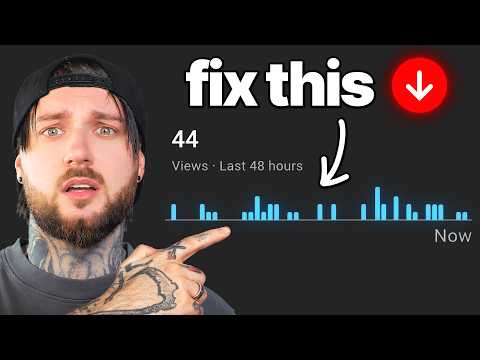
Why Your Views STOP After 24 Hours (learn how to fix it)
Danny Why
12m 26s2,477 words~13 min read
AI audio transcription
Transcript source
AI audio transcription
This transcript was generated from the video's audio because no usable YouTube caption track was available. The transcript below is server-rendered so it can be read, searched, cited, and shared without opening the original YouTube player.
Pull quotes
[0:00]And when that happened, I wanted to know why because I want to get more views and make more money.
[0:00]Just like my All right, jokes aside, what actually made my videos get more views was the first 15 seconds of the video.
[0:00]It doesn't matter how good the middle is, it doesn't matter if the ending is amazing.
[0:00]If the beginning is boring or confusing, most people will never reach the good part.
Use this transcript
Related transcript hubs
Watch on YouTube
Share
MORE TRANSCRIPTS


