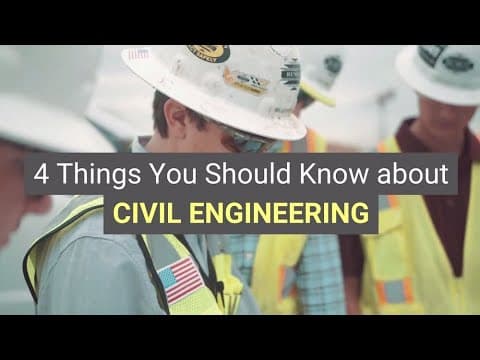
[0:06]Welcome to inro.org. In this video, I'll discuss the four things you should know about civil engineering.
[0:15]One, what is civil engineering? Civil engineering is a professional discipline that deals with the design, construction, and maintenance of the physical and naturally built environment, including public works such as roads, bridges, canals, dams, airports, sewage systems, pipelines, structural components of buildings, and railways. It applies the basic principles of science in conjunction with mathematical and computational tools to solve problems associated with developing and sustaining civilized life on our planet. It also deals with flood controls, landslide, air and water pollution, and the design of facilities to withstand earthquakes and other natural hazards. Two, what are the required subjects to take in civil engineering? The fundamental subjects you'll encounter in studying civil engineering are algebra, calculus, advanced mathematics, general chemistry, physics, computer-aided drafting and design, engineering mechanics, safety management, surveying, building design, geotechnical engineering, structural design, fluid mechanics, hydraulics and hydrology, water resources engineering, highway engineering, transportation engineering, construction materials and testing, and project management. Three, what do civil engineers do? Civil engineers prepare construction designs, specifications, plans, and schedules. They determine project costs by calculating labor, material, and related costs. They create feasibility study by analyzing engineering design, conducting environmental impact studies and assembling data. They collect and study reports, maps, drawings, blueprints, aerial photographs, and tests on soil composition, terrain, hydrological characteristics, and related topographical and geologic data. They confirm adherence to construction specifications and safety standards by monitoring project progress. Inspecting construction site and verifying calculations and placements. They maintain operations by enforcing project and operational policies and procedures. Civil engineers provide engineering information by answering questions and requests. They also maintain project database by writing computer programs, entering data, and completing backups. They coordinate with clients and other professionals of contractors and manage project budgets, resources, and deadlines. Four, where do civil engineers normally work? There are several subfields that a civil engineer can build his career. One of the specialization under civil engineering is construction engineering. Construction engineering is involved with planning and execution, transportation of materials and site development. It includes business-like transactions like reviewing contracts, evaluating logistical operations and monitoring prices of supplies. Second specialization you can pursue is geotechnical engineering. Geotechnical engineering studies rock and soil supporting civil engineering systems. Knowledge from the field of soil science, materials science, mechanics, and hydraulics is applied to safely and economically design foundations, retaining walls, and other structures. Third specialization you may consider is transportation engineering. Transportation engineering deals with moving people and goods efficiently, safely, and in a manner conducive to a vibrant community. It involves specifying, designing, constructing, and maintaining transportation infrastructure which includes streets, canals, highways, rail systems. Airports, ports and mass transit. Fourth specialization under civil engineering is structural engineering. Structural engineering deals with the structural design and structural analysis of buildings, bridges, towers, flyovers, overpasses, tunnels, offshore structures like oil and gas fields in the sea, aero structure and other structures. Last is water resources engineering. Water resources engineering deals with the collection and management of water as a natural resource. This area of civil engineering relates to the prediction and management of both the quality and the quantity of water in both underground like aquifers and above ground like lakes, rivers, and streams.
[4:22]Thank you very much for watching. See you on our next video.


