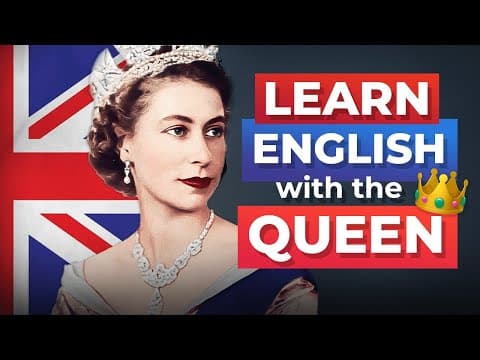
[0:00]Happy Christmas. 25 years ago my grandfather broadcast the first of these Christmas messages. I very much hope that this new medium will make my Christmas message more personal and direct. It's inevitable that I should seem a rather remote figure to many of you, a successor to the Kings and Queens of history. Someone whose face may be familiar in newspapers and films but who never really touches your personal lives. But now, at least for a few minutes, I welcome you to the peace of my own home.
[0:43]Hey everyone, you voted for it and so here it is. Today, we're learning English vocabulary and pronunciation with Queen Elizabeth II and her very iconic Christmas speech. In case you didn't know, every year on Christmas Day at 3:00 p.m. precisely, the Queen's speech is televised on the BBC. And today we have selected the first ever televised Queen's speech from 1957. So, you're going to be learning English with the original clip as well as the one from the series The Crown. Before we get into it, in case you're new here, I want to let you know that we help you to learn fast English without getting lost, without missing the jokes, and without subtitles. Just like Shahid who says that our channel is the best because you won't find it in books or academies. So don't forget to hit that subscribe button and the bell down below so that you don't miss any of our new lessons.
[1:53]Happy Christmas. 25 years ago my grandfather broadcast the first of these Christmas messages. Today is another landmark because television has made it possible for many of you to see me in your homes on Christmas Day. My own family often gather round to watch television as they are at this moment, and that is how I imagine you now. I very much hope that this new medium will make my Christmas message more personal and direct.
[2:35]It's inevitable that I should seem a rather remote figure to many of you, a successor to the Kings and Queens of history. Someone whose face may be familiar in newspapers and films but who never really touches your personal lives. But now, at least for a few minutes, I welcome you to the peace of my own home.
[3:09]25 years ago my grandfather broadcast the first of these Christmas messages. To broadcast means to transmit a programme or information by radio or television. The UK has a Christmas tradition since 1932 in which the King or Queen records a message, firstly through radio and after on television and the internet too. Since 1952 this message has been recorded by Queen Elizabeth II, because that's when she came into power. Let's look at a short fragment of last year's Christmas broadcast:
[3:52]As a child I never imagined that one day a man would walk on the moon. Yet this year, we marked the 50th anniversary of the famous Apollo 11 mission. As those historic pictures were beamed back to Earth, millions of us sat transfixed to our television screens as we watched Neil Armstrong taking a small step for man and a giant leap for mankind, and indeed for womankind. Okay, now let's continue with the 1957 speech. Today is another landmark because television has made it possible for many of you to see me in your homes on Christmas Day. A landmark is an event or discovery that marks an important stage in something. Queen Elizabeth refers to this event as a landmark because this was the first televised Christmas Broadcast. So TV allowed her to be present in millions of houses in the UK at the same time. Do you still struggle to understand fast speaking natives? Then I highly recommend our Fluent with Friends course. In this 48 week course you'll learn with the first two seasons of Friends. You'll receive PDF Power lessons every week, vocabulary memorization software, access to our Fluency Circle global community and so much more. And the best part is, you can try it right now absolutely free with our three-part masterclass. All you have to do is click up here or down in the description box below to learn more and sign up now. We look forward to seeing you there. My own family often gather round to watch television as they are at this moment, The phrasal verb gather round is a way of saying get everyone to come together. Do you know how else you can commonly hear this phrase?
[5:54]Gather up That's right, let's look at some examples of this phrase in different contexts. Do you know how to do an intervention? Hey! Shut up. Here we go. Everybody gather up! Everyone gather round. Let's have some mutual eye contact. I very much hope that this new medium will make my Christmas message more personal and direct. This is an interesting phrase. Do you know the difference between "I hope very much" and "I very much hope"? Both sentences are correct, but they vary in the degree of emphasis. In this sense, the second sentence, "I very much hope" is stronger in emphasis than the first one. Why won't someone tell us what's going on? Because you wouldn't understand it. I very much hope. A medium is a formal word used to describe a method of communication, such as television, radio or the internet. I very much hope that this new medium will make my Christmas message more personal and direct. Until this moment the Christmas speech was broadcast on radio, so the Queen is saying that television will allow her message to be more personal and direct, in other words, viewers will feel more connected to her words and feel closer than when they could only hear her speak. It's inevitable that I should seem a rather remote figure to many of you, a successor to the Kings and Queens of history. Something inevitable cannot be avoided or prevented. I alone should suffer the consequences of those choices, no one else and those consequences are coming. No more prolonging the inevitable. It's inevitable that I should seem a rather remote figure to many of you. This phrase is quite complex, so let's listen to it again and analyse its words one by one: A rather remote figure. Rather is a word commonly used in British English as a way of saying “to some degree.” In cases like this one the word remote means distant. The word figure can be used in certain contexts to refer to a person. A successor is a person that follows another. In the Monarchy sons and daughters succeed their parents. Queen Elizabeth's dad was the King and her first born son, Prince Charles, will succeed her and become King as well. So with this phrase Queen Elizabeth is saying that she knows that most people don't feel close to her. Someone whose face may be familiar in newspapers and films but who never really touches your personal lives. If someone looks familiar to you, you recognise them. Example, your face looks really familiar to me. Ok, now let's continue with this same speech but using the series The Crown instead of the original.
[9:09]That it is possible for some of you to see me today is just another example of the speed at which things are changing all around us. I hope that 1958 may bring you God's blessings and all the things that you long for. And so I wish you all, young and old, wherever you may be, all the fun and enjoyment and peace of a very happy Christmas. And we're off air.
[9:59]I hope that 1958 may bring you God's blessings and all the things that you long for. By saying this phrase Queen Elizabeth is saying that she wishes that they all have God's protection and a good 1958. I command you for your duty. Now God's blessings go with you. Do you know the meaning of long for?
[10:32]To desire something. That's right, the Queen is wishing that everyone has the year that they expect to have with everything they desire. And so I wish you all, young and old, wherever you may be, all the fun and enjoyment and peace of a very happy Christmas. By saying this the Queen wishes a very happy Christmas to every listener. She wishes them all the fun and enjoyment, which is another word for the feeling of joy. Ok, now we're going to take a close look at some of the Queen's pronunciation, as it's very distinctive! An interesting fact before we begin, is that in Britain, we call this accent the Queen's English. It's very similar to the RP (Received Pronunciation) or the BBC English, however the Royal family have their own style of this that's even more posh, as we say in Britain! Today is another landmark because television has made it possible. This word is interesting because there is some connected speech involved. Yes, believe it or not, even the Queen of England uses connected speech! In the middle of this word we have a consonant cluster, that is a group of consonants. When this occurs, one of the sounds often gets deleted, most commonly a t or a d. So we don't hear the Queen say land-mark, she says lanmark. This type of connected speech is called elision and natives speak this way as it's more natural and efficient. for many of you to see me in your homes on Christmas Day. when I say this word, you can hear the /y/ sound at the end, but not with the Queen. She opens up her mouth more and elongates the sound without the /y/ at the end. So I would say day and the Queen would say: for many of you to see me in your homes on Christmas Day. In British English, most people do not sound the /t/ in often, whereas in American English they do. This apparently dates back to Queen Elizabeth I pronouncing this word without the /t/! I very much hope that this new medium will make my Christmas message more personal and direct. Did you notice that she softly rolled the /r/ here? This is not usual for Brits, but very typical of the older members of the Royal family. but who never really touches your personal lives. here we hear the Queen say the first syllable in this word quite differently. She doesn't say 'really' like me, she opens up her mouth more and it has more of an '/air/' sound. but who never really touches your personal lives. Many people finds the Queen's English easy to understand. Is that the case for you? Let us know down in the comments below. If you'd like to learn more about British culture, then I highly recommend you check out this lesson that I made on our Real Life English channel where you can learn 33 weird and interesting facts about British life and culture. You can click up here or down in the description box below to watch that lesson next.


