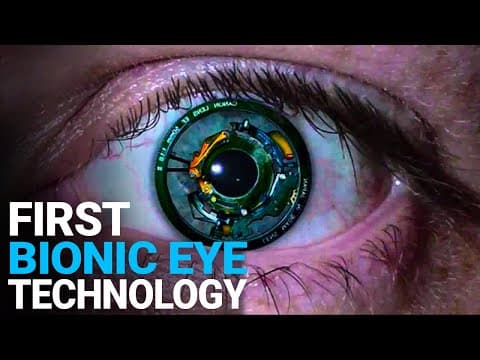
[0:06]The ability to see is something that most of us take for granted. Yet, there are almost 285 million visually impaired people in the world, with 39 million of them being completely blind. Blindness can reduce the quality of one's life by making them dependent on others, even for simple tasks. Thanks to advancements in medical science and technology, scientists and researchers are coming up with a novel way to cure blindness. And in today's video, we'll be taking an in-depth look into one of these technologies, the Bionic eye. But before we start, make sure you smash that like button and subscribe to our channel for more awesome videos like this. We've all seen the Bionic eye of RoboCop. Well, we're not quite advanced enough yet to have a completely Bionic eye, but we're getting there. Researchers across the world are attempting to restore vision for the visually impaired. And it seems like a team of researchers at the Monash University have made some incredible breakthroughs. The Gennaris Bionic Vision System has been developed by a collaboration between a team of researchers at the Monash Vision Group, situated in the Monash University. The Gennaris Bionic Vision System, or simply the Bionic Eye, is for blind people who have damaged optic nerves, which prevent the transmission of visual data from the retina of the eye to the visual cortex of the brain. In a nutshell, the Bionic Eye developed by the team at Monash University can bypass these damaged optic nerves by creating an alternate route for the visual data to travel from the retina to the visual cortex of the brain. Existing technologies are not yet able to do this, which is why the Bionic Eye developed by the Monash University is expected to be a modern-day scientific miracle. At present, the Bionic Eye will not restore complete vision. Instead, it will allow someone who's blind the ability to see a highly pixelated image that will help them move without any aid. Now, let's look at how the Bionic Eye will function to get a better understanding of how it will help the visually impaired. The Gennaris Bionic Vision System comprises of a number of items that will all work as a system together. Firstly, there's a piece of headgear. These are special glasses that have a camera in place of the glass lens. The camera captures whatever the person looks at. The camera sends visual data to the video processor, mounted on the side of the headgear. The vision processor takes the video input coming from the camera and simplifies it into a very basic pixelated form of video, and then sends the output to a wireless transmitter. The visual seen by the person will be in the form of a heavily pixelated image. So, where a person with normal vision would see a ball, a blind person wearing the Bionic Eye will see the ball represented as pixels arranged in a circle. The wireless transmitter will transmit the output from the video processor into a set of 9 mm thin tiles that have to be transplanted into the brain. There are almost 10 implants that will stimulate up to 43 points in the visual cortex. The tiles contain electric circuits that will convert the data from the wireless transmitter into electric impulses for the brain. The design process was particularly difficult because the developers had to make sure that the headgear and the implants were biomechanically comfortable, as well as precise and stable to enable smooth transmission from the wireless transmitter to the implanted tiles. Dr. Arthur Lowry, one of the researchers who was part of the team working on the Bionic Eye, said this. Our design creates a visual pattern from combinations of up to 473 spots of light, which provides information for the individual to navigate indoor and outdoor environments and recognize the presence of people and objects around them. The Bionic Eye has been tested successfully in initial trials that were conducted on sheep. The tiles were pneumatically inserted into the sheep's brain and they were tested for almost 200 hours. The sheep showed a positive reaction to the Bionic Eye without encountering any side effects. The team is now looking to conduct proof of concept demonstrations by conducting human trials for the Bionic Eye. If, and most likely, it will be successful, the Bionic Eye will be available for people suffering from blindness due to damaged optic nerves. Although it looks like a very simple system, it took almost a decade to perfect. But the good thing is that this is the first version of the Bionic Eye, and with future advancements, these systems are going to improve and become even better. There is a very great possibility that the 9 mm tiles can be reduced in size to become minimally invasive. Neuralink is already working on hair thin chips that can be transplanted with a robot to create a human machine interface. If that technology is used for the Bionic Eye, then in a couple of years, we can see improved and upgraded version of the Bionic Eye that can provide perhaps even greater viewing capacity. For now, the Bionic Eye is being held as a scientific miracle. The Monash Vision Group that developed the Bionic Eye is looking to develop this technology further to help patients with untreatable neurological conditions such as paralysis. Let's hope that this Bionic Eye passes the human trials and becomes easily available for the visually impaired who need it most. Although this is great news for those people who suffer from blindness, it's worth noting that the Bionic Eye system created by the Monash Vision Group is only for people with damaged optic nerves. Blindness, however, can occur due to a number of different reasons. In 2017, the Tufts Medical Center in New England became the first medical center to offer a Bionic Eye implant for blind people suffering from retinal damage. Damage to the retina is a rare condition that first attacks the peripheral vision and then eventually leads to complete blindness. With this condition, the light-sensitive tissue at the back of the retina breaks down and loses the ability to perceive light, and thus stops sending visual data to the visual cortex. Researchers and doctors from an organization called Second Sight came up with their own Bionic Eye system that's very similar to the one being worked on by the Monash Vision Group.
[6:56]The Bionic Eye of Second Sight is called Argus 2, and it comes with an implantable electrode that has to be surgically inserted under the white part of the eyes. The electrode receives visual data and then stimulates the light-sensitive tissue at the back of the retina to send visual data to the visual cortex. The electrode receives visual data from a wireless transmitter connected to a video processing unit that takes data from a camera. Just like the Bionic Eye of Monash Vision Group, Argus 2 does not restore full sight, but it allows the wearer to perceive light and reflections of light. To date, over 350 people have received Argus 2 implants, which is exciting, as this could inspire other researchers to develop the tech even more. And that's a wrap. What do you think about the Bionic Eye project? Are you excited to see this technology developed further? Let us know in the comments section down below. If you enjoyed this video and want to see more, don't forget to subscribe to the channel and press the bell icon to stay updated whenever we release a new video. Other than that, thanks for watching, and I'll see you in the next one.


