[0:01]understanding and being able to talk about things, does not necessarily cure things. It is helpful to understand why you react the way you do, but understanding doesn't mean that you can change. So in order to really change, you need to get input to rewire or reorganize your perceptual system in your brain, and in order to get better, in order to change these habits of the mind, basically, you need to actually create new habits and you have to do that by acting and moving and having experiences that are different. You cannot do it abstractly, but giving your body experiences of feeling met, seen, safe, in sync is really very helpful. And what's become clear to me is that trauma is really about loss of synchronization.
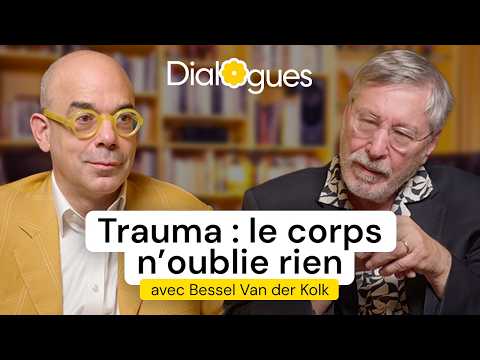
[1:05]One of the greatest breakthroughs in my life, that has changed my understanding of existence, is the research and discoveries made in the last 20 years about trauma. It is disconcerting because it is like we had not seen what trauma was despite it being the cause of so much suffering. Trauma doesn't only happen because of war, abuse or accidents. Today, we understand that many people suffered developmental trauma in their childhood, which led them to conditions that resemble PTSD. Something is stuck and one remains in a state where he doesn't feel fully alive. Understanding trauma is a revolution. It shows that almost all of psychology and psychoanalysis are inefficient in those cases. It shows that government policies do not understand what should be done. It shows that paths to alleviate those suffering exist but are under the radar of policy makers. To talk about all of that, I am proud to receive one of the greatest specialists of trauma in the world, one who has changed the face of therapy and science, Bessel Van der Kolk. I want to talk about Bessel Van der Kolk, you may know his best-selling book, The Body Keeps the Score. I am Fabrice Midal, philosopher, author and founder of Riza, the main meditation school in France. You will see, it is now, it is in dialogue and it is mind-blowing because what Bessel Van der Kolk says is completely stupefying. Hello Bessel. Yeah. I'm very happy to have you here, more than happy. I'm very it's very important because I found that your work and your knowledge change completely the vision we have of humanity suffering and society, and for me as a philosopher, reading your book, thinking about what you teach, uh I've been a very great change. You um try to understand uh the suffering of human being that we didn't really uh did for many years. I wouldn't quite agree with that. I'd like to talk about Pierre Janet, here in Paris who really spelled up much of what I talked about 100 years ago. So it's not for the first time that somebody wrote this. No, it's true, but unfortunately, um people weren't weren't reading Pierre Janet so much and by many sense, people were were reading more Freud. And uh even if Pierre Janet have some a lot of intuition of what you you saw. You in one sense reopen and work quite hard to to explore. So what is what is that we didn't saw except Pierre Janet, what about suffering that you that we can understand now about trauma? Well, the big difference between now and the time in the Salpetriere is that we know something about the brain. So I think people 100 years ago, 150 years ago, could see all the things we see and had probably some very good treatment methods, but today, we know something about neuroscience. And we also know something about attachments issues and how the mind develops in the process of the attachment system which people didn't do before. So the um before and psychiatry does still does it to some degree. You see people for their abnormal behaviors, and but people at Salpetriere already discovered is that these behaviors are shaped by experience. And what we have in addition to that today is now how the brain gets shaped by experience also and how uh people's perceptions and orientation of their mind is shaped by what happens to them. And that's really quite new, in a way, yeah. What Pierre Janet discover? Janet said, um he so the first book about trauma is called le Traumatisme psychologique, and he says, when you get traumatized, you automatically keep repeating it in sensations, thoughts, and actions. And that is really the essence of trauma is the the compulsion to repeat and to feel like it's not over and uh he and Bergson wrote about the issue of time. And how when you get traumatized, you lose your sense of time and the past becomes the present. And your mind is unable to move into the present, basically. And today we know something about the underlying neurobiology, but the basic observations were made uh here in Paris in the 1880s, 1890s, yeah. It's important. Yeah. Um, because that that make clear that when we suffer from a trauma, it's not with our brain that we can logically make it uh, fix or make it, we can can we can go better. Because of what you explain and that and that is a is a is a hard break. People in general, including very much, think that our minds are thinking, is in charge of ourselves, and uh that clearly is not the case. We are like animals in a thunderstorm. Uh, we have automatic reactions, uh, when we hear loud sounds, we startle, and when uh we get threatened, we move our bodies, and so, and we have somatic reactions of which we have no control over, basically. We have automatic reactions, beautifully described again by Charles Darwin, for example, who also beautifully wrote about these automatic behaviors that occur in response to stress. So, so it's not new, but new is that the world got sort of hijacked by people chose to to follow Freud. Why you chose to follow Freud, I never quite understood, uh, because his patients didn't get better. And it's a very interesting story here that Freud comes to Salpetriere, he studies with Janet. He actually his first book, he gives credit to Janet. He said I learned this from Janet, and then he says, oh, I'm the conqueror of unknown territories. I'm the first person to ever see them. He wasn't, and and then he gives up the seduction theory, and he has his case histories, which are very famous, beautifully written, but his patients don't get better. And it was fascinating, as long as he focused on trauma, his patients got better. The 1895 book, Studies in Hysteria, 13 cases, everyone gets better with trauma therapy. And why the world chose to not go that way is a very puzzling thing, actually. What Freud propose and why that doesn't work for trauma.
[9:07]What the proposition of Freud to cure trauma and why that doesn't work. Uh, no, it's not that it did work, that he said you you if you really deeply go with people and talking about their trauma and feeling it and experiencing, they get better. The difference is that Freud was quite un not skeptical about his treatments and so in his first case history books, he says all of them got better. He's not sure if they did. Janet was the better clinician who used hypnosis and used people put people in alternative states of of mind, and when you read Janet's case histories, you go like, his patients really got it, and they got better. And what we do today is not all that different from what Pierre Janet did back 100 years ago. But you said that the people that Freud, the approach of Freud, doesn't work for trauma, his passion didn't get better. And why this approach doesn't work for trauma, why talking with a psychoanalysis when you are a trauma is not helpful. Because understanding and being able to talk about things, does not necessarily cure things. It is helpful to understand why you react the way you do, but understanding doesn't mean that you can change. So in order to really change, you need to get input to rewire or reorganize your perceptual system in your brain, and in order to get better, in order to change these habits of the mind, basically, you need to actually create new habits and you have to do that by acting and moving and having experiences that are different.
[10:55]That's very impressive. You you mention in your book what happens after September 11, and I was completely for me, I was completely shocked by what you described. So after September 11, there was a commission of experts to see what will help all these people who get so intense trauma. Maybe you can tell the story, because I think he is really uh, illuminate illuminate what is trauma. Yeah.
[11:49]That's it, there is two Pavlov stories. The first Pavlov story is the dog, and the salivation and he justified, he got the Nobel Prize for that in 1904 because it's a fantastic discovery, and it is the essence of trauma, it's the conditioned response.
[12:32]And the second story, uh, later on in 1924, there was a flood in Pavlov's laboratory in St. Petersburg, and I see water came into the lab, and all the dogs stood in ice water for a little while, and then they pumped it out, and none of the dogs died, but when they opened up the cages, the dogs were behaving very strangely, would would lie down and bite people and do none of the experiments. And Pavlov, being a real scientist, and I really honor him for that, said that, that's interesting, let's study that, but most people would say, oh, my dogs are messed up, let's get some new dogs and continue with our experiments, but Pavlov thought something happened to my dogs and I wonder why. And so Pavlov came to the conclusion that uh these dogs got traumatized because they were unable to move, and what he says, and I really buy that, until somebody else proves something else, uh he says, is that the natural reaction for all creatures, animal and men, is to activate your fight flight response when something scary happens.
[13:58]Uh, if there's an accident, if I can run, uh, like sometimes you show when you you teach, uh, people running from the uh September 11, and people, and you ask what people see and people say, people are terrifying, and you're saying, which I find very helpful, no, people are running, and if they're running, they'll they'll have less trauma. The trauma is in one sense, we are caught, we we freeze because the situation don't allow us to be, don't know what to do. But I was a medical student, and I, as you go to medicine, you see horrible things, but what they teach you as a doctor is to do something.
[15:08]Uh, so I remember vividly as a young doctor, having a baby, an infant, three-year-old kid bought it with third-degree burns of her all over his body. If we would see that today, we'd all be horrified, but as a medical student, I knew how to put in a catheter, put put fluids into his body, how to cover his wounds. So I knew what to do, and because I knew what to do, it didn't become a trauma. That's true with the policemen, and it comes to, so if you get trained to do something, you can put off a lot of very dangerous stuff, but if you don't know what to do, you get traumatized by it. It is why when we are a child, trauma is so difficult because we can't we can't do anything. We are we have no power when we are two, three, four. And we have our parents who do it for us, and we get said, wow, something bad happens to me, somebody will take care of it, and so you become a more secure person. Because you have seen that bad things can happen and somebody is there to take care of it, but it's even better if you don't know how to do it yourself. Why once again, you said, it's true the body that I can learn again to feel more subtle things and and go back in life. Yeah. Uh, but I think knowing that here cognition does come in to say, oh, that's a problem I have.
[16:47]To become aware of that, I only can turn on to violent people. Maybe I can start changing, make some changes in my life, as long as you stay in that habitual mode, you just do your habits.
[17:15]So therapy might be quite helpful, actually, to make you aware that maybe I should rearrange my life in different ways. And maybe I should explore martial arts and see if I can get a kick out of martial arts, instead of people being people up or, you know, to do some other thing with your body, so your body can get what it needs at that particular point. Once again, you said, it's true the body that I can learn again to feel more subtle things and and go back in life. Yeah, I think basically needs to be a sensory motor experience, yeah. One of the amazing things of what you're explaining is that not only help how to cure people, but also change the way we should organize our society. The way we should help our society, the way we should, and it's very when I read what you said, I feel there is a you have a a very large vision now to help our world to have a to be less caught. Yeah.
[56:59]Thank you for watching this episode of Dialogues. It's really a big thank you because it's very precious that you watched this episode until the end, that it speaks to you because I do this for you. So it's really an exchange and I really realize today that around dialogue there is really a community of people for whom taking care of the world, taking care of oneself, taking care of others matters a lot, and it's really wonderful to see that we are, we are a community. So don't hesitate to share, to like. It seems like nothing but it's really very important. It is part of a kind of happy contagion that our world desperately needs. Well, I hug you and I thank you again.


