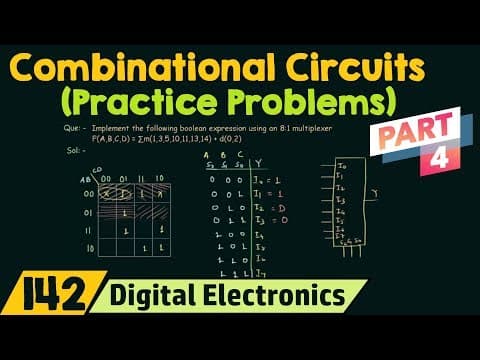
[0:05]Welcome to the fourth part of practice problems on Combinational circuits. After this, we are going to start a new series in which we will talk about the sequential circuits. In this part, I'm having two problems. The first problem is for me, I'm going to solve it, and the second problem is for you. You can consider it as your homework. I will just give a small hint and tell you how to approach for the solution, and you will solve it, post your answer in the comment box so that everyone can take help of it. And that's all for the second problem. Now we will move to the first problem, which will be solved by me. In this, it says, implement the following Boolean expression using an 8:1 multiplexer. A very simple problem we have already done this when we were studying the multiplexers, and it's a kind of revision for you. The function F is there, having the four variables A, B, C, D. The min terms are given, as you can see, and also the don't care. The don't care is 0, 2, and the min terms are 1, 3, 5, 10, 11, 13, and 14.
[1:10]Now, what is the step number one? The step number one is to make the K map depending upon the number of variables. I'm having a 16-cell K-map. I have made it already because I want to save the time. And the step number two is definitely filling this map with this min term and the don't care. After doing this, we will make an 8:1 multiplexer. We will assign randomly the variables as the selector variable in them, and then the one variable, the left variable will act as the input. These are all the steps that we have to follow to get to our answer. Now let's fill this map with the min terms. The min term is 1, 3, 5, 10. So 0, 1, 2, 3, 4, 5, 6, 7, 8, 9, 10, 11, 12, 13, 14, and this is 15, which is definitely not in our min terms. And the don't cares are 0 and 2. So 0 is my don't care, and 2 is my don't care. Now we have to make an 8:1 multiplexer. I will make an 8:1 multiplexer here. And the selector variables are three in this case. So these are my three selector variables. S0, S1, S2. The output is Y, and there are eight inputs. The first input is I0, I1, I2, I3, I4, I5, I6, and I7. Now, the important part comes, we have to assign these four variables as the input, and also as the selector variable. So I will take for the convenience, I will take S0 = C, S1 = B, and S2 = A. So this is what I have decided, and depending upon this, I will make a truth table. In which the input is S0, S1, S2. Three variables, so definitely eight combinations: 000, 001, 010, 011, 100, 101, 110, and finally 111. So these are the eight combinations, and the output is Y. When all the selector variables are 0, it means the output is going to be I0. Similarly, I1, I2, I3, I4, I5, I6, and I7. This is what we have learned from the multiplexers. Now I will use this K-map and try to find out the value of I0, I1 up to I7 depending upon the values of S2, S1 and S0. And as I have already made an assumption that S0 is C, S1 is B, and S2 is A, so we can use this K-map easily. Now let's see in this K-map when we are having A, B and C as 0. A, B is 0 for this entire row, but C is 0 for the first two cells. So I will take these first two cells. And in this, I'm having a don't care and 1. The don't care, I will take as 1 for the combination purpose, and you can see, overall, this cell is giving me 1. That's why I0 is equal to 1. Very simple. Similarly, we will see for the case number two, in which A, B is 00. It means this entire row, whereas C is 1. C is 1 for these two last cells. So I will take these two last cells, and these two last cells are also giving me 1. So I1 is also 1. When A, B is 01, it means this row, and C is 0. So again, the first two cells of this row, it gives me D because here I'm having 0, and 1 is there in this cell. And for this cell, the value of D is 1. It means I2 is equal to D. Now we will see when C is 1, whereas A, B is 01. It means this two cells. In these two cells, the values are 00. So I'm having I3 as 0.
[6:01]It's a very simple process to do the implementation using the mocks. You will find a very different process in the books, which is very, very inconvenient. I really don't like that method. You can follow this method, it's very easy. And let's see for this case when A, B is 10. It means this row. C is 0. Then again the first two columns of this row, and it gives us 0. Now we will check for this two cells, because C is 1 in this case, and I'm having I5 as 1. Now when A, B is 11 and C is 0, it means this column.
[6:40]I'm again having input as D. So I6 is D. We will check finally for the last case when all these three are 1. It means A, B, C are 1. And for this, we will see the last two cells, and D is 0 in this case. So I'm having D complement. So it's a very simple way to implement, and you can see we are having the implementation of this Boolean expression using an 8 cross 1 marks. This is C, this is B, this is A. And the first input is 1. The second input is 1 again. The third input is D, and the fourth is 0, fifth is 0, sixth is 1, seventh is D, and eighth is D complement. In this way, we have implemented this function and Y is F, this F. So this is all that we have to do in this problem. Now let's move to the problem number two that you have to solve. Let's first read what it says. Design a combinational circuit with three inputs X, Y and Z, and three outputs A, B, and C.
[7:54]Now let's see what it says. When the binary input is 0, 1, 2, or 3, the binary output is two greater than the input. It means when the input is 000, it is two greater, and the two greater of 000 is 010.
[8:21]Similarly, you have to see for this three cases also. And there is one more statement, it says, when the binary input is 4, 5, 6 or 7, the binary output is two less than the input. So if I say I'm having four, four is 100, it is two less than the four, so it should be two again, so 010. In this way, you have to fill all the values of your output, and then you have to use the K-map and minimize your function and implement it as your circuit. You can write down the minimized function in the comment section, and we will see whether it is correct or not. So this is all for this presentation. I hope you enjoyed it, and more than enjoyment, I hope you learned something. And if you have any doubt regarding any part of this presentation, you can ask in the comment section. This is all. I will end this here. See you in the next one.


