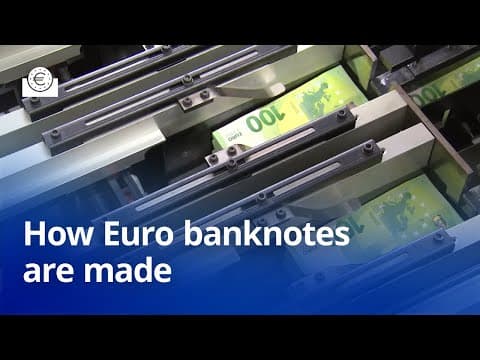
[0:01]Can you tell what that noise is? It's the sound of money being printed. To be precise, it's the sound of Euro banknotes being produced. It could be at any one of the 11 printing locations in the Euro area. Between 5 and 6 billion banknotes are printed each year to satisfy demand and replace worn out banknotes.
[0:29]This is a highly secure area and almost no one is allowed to go in. Here, every can of ink, sheet of paper and scrap of waste material is accounted for. The process starts with the production of a very special kind of paper. Euro banknotes are printed on paper made of pure cotton fibers. This gives the banknotes their special crispness and makes them resistant to wear and tear. At this stage, a watermark and a high-tech security thread are embedded in the paper. A metallic foil is applied to the paper using pressure and heat. At the end of the production process, the paper is cut into sheets and securely transported from the paper mills to the printing works.
[1:21]There are four stages to the printing process. The first stage is called offset printing. Here, a multi-colored background is printed simultaneously on both sides of the paper. This calls for extreme precision.
[1:44]Then comes the silkscreen printing when the emerald number is applied to the front of the banknotes. The shiny ink contains special high-tech pigments which allow the number to change color from emerald green to deep blue when the banknote is tilted. The number also displays an effect of the light that moves up and down.
[2:09]During the intaglio printing, ink is applied to the paper under high pressure. This creates high definition images and a relief structure that can be felt on the left and right edges of the banknote.
[2:30]The numbering press prints a serial number on the back of the notes. Each banknote is given a unique combination of two letters and 10 digits. The first letter in the serial number identifies the printing works where the banknote was printed. For instance, these banknotes were printed in Italy.
[2:54]The printed sheets are thoroughly inspected by both machines and humans. Individual sheets are selected at random during each production phase to ensure consistent quality and identify any misprints. The sheets are counted at each stage of the printing process.
[3:18]The printed sheets are then moved on to the finishing process. With surgical precision, cutting machines slice piles of 100 sheets into strips and then again into stacks of banknotes. The quality of the finished product is then checked in an automated process. This ensures that all Euro banknotes are identical regardless of where they have been produced. The notes are checked and counted once more before being wrapped in self-sealing plastic film and neatly stacked in cardboard containers slightly bigger than a shoebox. Each box is made to fit 10,000 banknotes. The freshly printed Euro banknotes are either stored in high-security vaults or shipped via road, sea or air across the world, ready to enter circulation.
[4:18]To find out more about Euro banknotes, visit our website.


