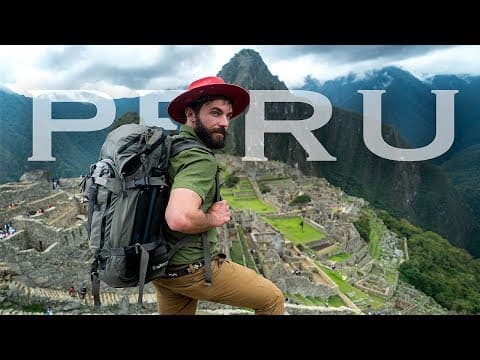
[0:00]What's up? You're watching Vaga Brothers, and this is Peru.
[0:25]What's going on, Vagabuddy's? Welcome back to the channel. Right now, we are in Lima, Peru. It's our first time coming to this country, and we are super excited to be here. Got a lot of things to tell you. We're in Peru because we're part of a program at YouTube to make four virtual reality videos, and we're going to make a VR tour of Machu Picchu. But, we didn't want to come all the way down here for just a couple of days. So, we arrived a little bit early to explore Cusco and Lima as well. To capture the experience better, we're bringing along our friend and colleague, Carlos Mason, the cinematographer behind East of Eden, and our virtual reality mentor DJ to help us capture Machu Picchu the best we possibly can. It's going to be an awesome adventure. We're going to eat well. We're going to meet some Peruvian friends. We're going to explore the culture, the history, all of that jazz. But, first things first, here's what you got to know about Peru.
[1:20]Peru is a land of contrasts. Both ancient and modern, indigenous and European, and with over 90 microclimates, it's one of the most biodiverse places on Earth.
[1:34]The coast has great surfing. The Andes are the largest mountain range in the world after the Himalaya, and Lake Titicaca is the highest navigable lake in the world, and the largest South America. Plus, just fun to say. Titicaca. Peru was home to the Inca Empire, known as Tawantinsuyu or the Empire of the four cardinal points. Its golden era only lasted around 100 years until the Spanish arrived in 1532, and Pizarro captured, ransomed, and murdered their emperor Atahualpa before ransacking their capital Cusco. Pizarro then moved the capital to Lima, which he called the City of Kings. It became the capital of and most important city in the Viceroyalty of Peru, which was essentially all of Spanish Latin America. Today, Lima is still the capital. It's home to about a third of Peru's 32 million people, and it's the driest capital on Earth, except for Cairo. Peru has more shamans than any other country in the world, thanks to the Amazon, where the local drug Ayahuasca has been used as a medicine for thousands of years. Meanwhile, in the Andes, locals use Coca leaves, the basic ingredient for cocaine, to combat hunger and altitude sickness. Don't worry. It's not addictive, but it does make your tongue go kind of numb. Today, 45% of Peruvians are indígena, making it one of the most indigenous countries in South America. 15% are criollo, or Peruvian-born Spanish, and 37% are mestizo, or mixed. Peru is also home to a small but active Japanese community, which came here in the 1800s to escape the Shogun Wars and left their mark through Peruvian-Japanese fusion cuisine known as Nikkei. Peruvian food has had a massive impact on global cuisine. Italy would not have the potato. America would not have corn, and there would be no Indian curries without chilies from Peru, all brought overseas by Portuguese and Spanish traders. For some reason, Peru's national dish, the cuy, didn't catch on. In English, we call it the guinea pig, because sailors who used to go from Lima to London would stop in West Africa, and merchants thought that's where it came from.
[3:37]Lima is one of the best foodie cities in the world, and it's the only city to have two restaurants in the global top 10, including Central, the best restaurant in Latin America, which was recently featured on Season 3 of Chef's Table. That's a big cactus. Ready to book your ticket? Here's what you need to know before you fly. The currency in Peru is called the Nuevo Sol, and there's about three soles to a dollar. Peruvian power outlets are 220 volts, and they take both US style and European style plugs. That's two for one. Beyond Spanish, there's two main languages in Peru: Quechua, the ancient language of the Inca, spoken in the Andes, and Aymara, one of the oldest languages in the world, spoken in the Lake Titicaca region. Not to mention 27 other languages in the Amazon. So, if you're a linguist, if you like speaking languages, this is the country for you. Budget-wise, Peru is a mid-level destination. You can easily get by on less than $50 a day, or even 40, which makes it cheaper than Chile but more expensive than Bolivia. Peru is near the Equator and can be visited all year long. June to August is the dry season, it's great for hiking the Inca Trail. December to March is the hot season, perfect for the beach. And you can save money in the shoulder season, September to November or March to May, when the weather is still pretty good and there's not that many tourists. From the ocean to the Andes, Peru has tons of different climates, so it's super important to pack in layers. A waterproof shell is essential, it rains a lot up here. As is a stuffable jacket, because it does get cold. Or you could just pick up a nice alpaca sweater from one of the many markets for like $10 US. Peru is a rugged country, so make sure you have the right footwear. Even if you're just planning on walking around Machu Picchu, bring solid hiking boots. It rains a lot, it's muddy, and it's slippery.
[5:51]All right, so I'm stoked. We have never been to Peru before. This is the home of the Inca Empire. It's really a place that we've wanted to visit for a super long time, so we're very excited to be down here, to be filming.
[6:05]You said that it's part of the Inca Empire, but the Inca Empire was really the most recent of many. There were tons of civilizations here, uh, including here in Lima, which, although it is a Spanish colonial city, uh, it's named after the Lima people. So, we're on our way to go see some of the remains of that civilization from about 400 AD. And then, we're going to get food, because supposedly, there's really, really good food in Lima.
[6:42]So, first stop here in Lima and our first stop here in Peru is Huaca Pucllana. These are the remains of a temple from the Lima people who were the original inhabitants of the city before the arrival of the Spanish. Unfortunately, it's closed today, so we're not allowed to go up there, and you can only do guided tours. But, um, you can see behind us, it's just this crazy pyramid, full of basically adobe bricks. And it's in the middle of the city. And I think it just goes to show the contrast between old and new here in Peru. You have some of the oldest, most advanced civilizations in all the Americas right in the middle of a bustling metropolis. Honestly, though, it's just mind-boggling that this entire complex is made of individual bricks. There has to be hundreds of thousands, if not millions of bricks. And the pyramid just over there has so many different layers. It must have been quite the task to excavate this place archaeologically speaking. So, yeah, total bummer that we can't go explore more, but we're going to go see the more modern layer of Peruvian history here, that of the Spanish.
[8:02]Okay, so we've just arrived to the Plaza de Armas, just in front of us here. And like we said, Peru is playing Colombia tonight. Their national football teams are facing off. So, we didn't know that the game was going to be happening when we planned this day. Uh, we came here because this is the center of old Spanish Lima. When the Spanish conquered the Inca, they moved the capital from Cusco to Lima. They built all their houses right here. Anyways, the game's about to start, so let's just go jump in there and see what happens.
[8:59]We finally found a quiet spot so I can explain why the Spanish built this city here. It's because of this river. Basically, the river connects the mountains all the way down to the port of Callao, and the Spanish built a city on the coast. They were a seafaring nation in order to take the silver and gold from the Inca and ship it off to Spain. This was the capital of the Viceroyalty of Peru. There were three viceroyalties at the time. One in Mexico, one in Lima, and the other one in Hispaniola, the first island the Spanish colonize. And the whole thing was about shipping gold back to Spain. So, pretty much all of Spanish South America was controlled from this city. It became very, very powerful, and, uh, the old Inca capital of Cusco kind of faded into history. The Conquista, the Spanish Conquista of Latin America was one of the most brutal periods of history. They destroyed some of the most incredible indigenous cultures, uh, including the Inca and the Aztecs, and it it is a part of history. It's not a pretty one, but, um, it's just kind of interesting to see how all of this stuff blends 500 years later.
[10:11]Ciao. Gracias, amigo. So, we're in the neighborhood of Pueblo Libre at Taberna Querolo. It was basically founded by Italian immigrants who came here to grow Pisco. Pisco, you might have heard of, uh, from a Pisco Sour, but it's actually a grape liquor. Uh, the story is that during colonial times, the Spanish would not let locals grow their own wine because they were importing it from Spain. So, the locals made a liquor from grapes instead of making wine. That's Pisco. These guys came from Italy to grow the Pisco, and, uh, they still do. So, I've ordered a Pisco Puro, which is just pure Pisco. And Alex and Carlos got a Pisco Sour. All right. Salud. Here's to a good week here in Peru. This is actually my first Pisco Sour ever.
[11:10]We've had a realization. As we are almost the only people in this room, and everybody else is in the other room watching football. It's insane to see how important it is globally, when the World Cup happens, like national fever is expressed in a competitive, but collaborative way. And I think that America is just so self-centered with our sports. We're so wrapped up with the NFL and with Major League Baseball. The World Series is not a World Series. It's cool to come abroad and to see people so excited about football. But, just to correct you, you said you're American, whereas people here would also say that they are Americans too because in Spanish, America is one continent, not two. So, although you're United you're a Estadounidense. Soy Gringo.
[12:17]We have made it back to the hotel. Good job, Peru. Good job, Colombia. You guys tied in the game, but we have just begun our time here in Peru, and I think watching a football match, especially that we didn't know it was going to happen, was a pretty good way to kind of get right into the local local way of doing things. I would say it's like diving directly into the deep end. It's been sweet and Pisco Sour. So, we're going to sign off the vlog at this, and we'll see you guys tomorrow. We're going to be going all around Lima, which is one of the best foodie cities in the world, and we're doing it with some local YouTubers. So, we'll see you guys tomorrow. In the meantime, if you like this video, you know what to do. Give it a thumbs up, share with your friends, and subscribe to Bagab Brothers and turn on notifications if you have not already. And, as always, stay curious, keep exploring, and we'll see you on the road. Buenas noches. Hasta luego. Hasta mañana. Ciao.


