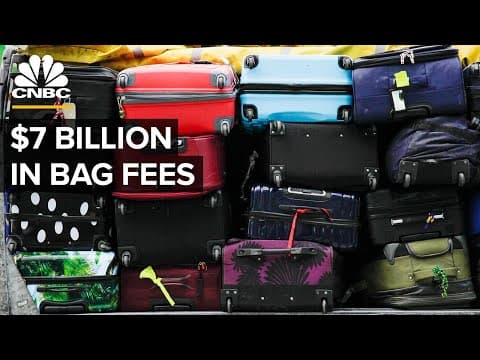
[0:03]US Airlines carried more than 470 million passenger bags in 2022. For decades, most bags flew for free.
[0:13]But in recent years, fees have surged, boosting the bottom line of the nation's carriers. Bag fee revenue for US airlines was more than $6.7 billion in 2022. The larger aircraft, I mean, those will have hundreds of bags. So, we'll have flights with up to 5, 600 bags coming off those flights in addition to cargo. To prevent lost luggage and ensure passengers are reunited with their bags upon arrival, a complex ecosystem has evolved. Yes, everything have changed. We have more people coming in, we see more bags. At Atlanta's Hartsfield-Jackson International Airport, more than 30 miles of conveyor belts, an army of 2,000 workers and a fleet of airport tugs ferry bags from the terminal to the aircraft. Well, it really pretty much just like driving out on the street, except you have to look out for planes. So this is kind of the heart of the operation. Um, right now everything is green, which is good, we like to see green, but on a very busy day, it can churn very quickly. In addition to the sheer volume of bags, the network also has to contend with external factors like weather. The reclaim belt 9 may be backed up a little bit because they got all the bags going up, but we're we're completely cleared right now. We have no fourth floor down. There's a lot of complexity behind what goes into ensuring that a passenger's bag arrives at their destination with them. The biggest challenge that we face, quite honestly, is the weather. Severe storms, along with a technical meltdown, forced Southwest Airlines to cancel more than 16,000 flights in December 2022, causing luggage to pile up at airports nationwide. When Southwest had this meltdown, probably the worst one that they have ever had in their history, they had bags all over the country. It took weeks for them to sort out this mess. There are few things more annoying with a trip than showing up at baggage claim and you're there, but your bags are not. US Airlines mishandled nearly 3 million bags in 2022. A mishandled bag is one that was lost, damaged, delayed, or stolen. So what steps do airlines take to prevent lost luggage and how does Delta Airlines move 100,000 bags a day through the world's busiest airport?
[2:32]Global bag fee revenue was estimated to reach $29 billion in 2022, almost 39% higher than a year earlier. American Airlines earned more than $1.3 billion in bag fee revenue in 2022, making it more than 2% of the carrier's full-year revenue. But charging passengers for transporting their personal belongings is a relatively new revenue stream for airlines. In the late 1970s, the first ultra low cost airline People Express actually started to charge people to check bags. That was it was five bucks a bag, but they were the only airline that did that at the time. An economic downturn and rising fuel prices forced carriers to search for new sources of income in the mid-2000s. And when jet fuel prices surged and on the brink of the financial crisis, the airlines pressed the panic button.
[3:25]American Airlines started charging passengers $15 for a check bag in 2008. Other airlines including United quickly followed suit. By the end of 2008, bag fee revenue for US airlines was $1.1 billion. And that revenue has continued to climb. If airlines weren't making money from checked bags, they wouldn't be charging. With the exception of Southwest Airlines, which allows two check bags for free, most carriers today charge for luggage. Your first bag at Delta, for example, costs $30. JetBlue charges $35. Baggage fee revenue at US airlines surged to $6.7 billion in 2022. Those bag fees have incentivized passengers to bring more of their belongings into the cabin, increasing boarding times and in some cases the turnaround time for the aircraft. So what people do now is bring pretty large carry-on bags onto the plane. And if you've ever tried to board a plane, you could see how maddening it is for the person trying to fit their bag in the overhead bin sometimes to everyone else watching them do it, including the flight crews. A longer boarding process means a plane is potentially missing out on valuable flying time. JetBlue flights, for example, sit at the gate an average of 76 minutes between flights, 12 minutes longer than its scheduled plan. Planes aren't making money on the ground, they're making money when they're flying. And it's not just check bags that airlines have started charging fees for. Low cost carriers like Allegiant, Frontier, and Spirit Airlines have customers pay to bring carry-on bags aboard the aircraft.
[5:02]With more than 80 planes taking off and landing every hour and more than 90 million passengers moving through its terminals annually, Hartsfield-Jackson Atlanta is the world's busiest airport. Along with those travelers comes millions of bags. On a busy day in Atlanta, Delta Airlines can handle as many as 100,000 pieces of checked luggage. The lines are getting longer and longer and longer. The volume has really, really picked up real real heavy and like I said, the bags are getting big. So at that point, using the self tag bag process, the passenger will then proceed to the counter. At that point, we'll, well, that's where I come into play. To help the airline and its passengers keep track of their bags, Delta, like other airlines, embeds each paper bag tag with RFID technology. So as you print out your bag tag when you check your bag in, there's an RFID in there that allows our system to understand all the information about where those bags are supposed to go. And the system will route those bags according to the destination and the time. Updates on Delta's app are sent as your bag goes through the baggage handling system, when it's on the plane, and when it has reached its final destination. Delta Airlines says it has a 99% success rate for bags arriving on time. We lose a bag practically never. It's a fraction of a percent of the time that a bag is lost. However, it's about 1% of the time that a bag may get delayed. And when it does, it's generally on the very next flight, but that last 1%, that's where we're we're fighting against every single day. Delta Airlines carried roughly 74.5 million bags on its planes in 2022. 410,000 bags were mishandled by the carrier. Southwest Airlines carried 121 million bags on its planes that same year and mishandled 655,000 bags. On domestic flights, US airlines are responsible for a lost luggage reimbursement of up to $3,800 per person. Weather is often a factor. We're looking at some rain outside the window right now. As you've got weather, you've got delays, it leads to gate changes, it leads to all sorts of operational difficulties. Lightning within close proximity to an airport, for example, can be hazardous to ground crew and may require suspending operations. Once that clears, it's just mass chaos because you have all these airplanes in the air that are holding in patterns, waiting to land. They're all landing at the same time, the customers are rushing at the same time, so it's just a mad dash to make sure the bag stays with the customer. Flight connections and last minute itinerary changes add another layer of complexity to the system. When you're taking a connecting flight, uh, obviously the risk of your bag getting lost literally doubles because you're not taking one flight, you're taking two. I got a bag down there, 593778, that re-routed for tomorrow and going tonight now to Mexico City. Gonna give you the tag gonna give you the tag number. The real difficulty, the tricky part is in the transfer bags. Those are the bags that fly in and have to fly out. About 75% of flights in Atlanta are connecting trips. For connections under an hour, Delta uses baggage tugs to drive luggage directly from one plane to the next. About 20% of our bags are transferred tail to tail every day and then 80% go through our baggage handling system. A lot of what we're doing is trying to keep up with passenger itinerary changes. So we try to be as customer friendly as possible, but the more convenience you offer to the passenger, the more complex our job becomes down here.
[8:35]With 35 miles of conveyor belts and roughly 2,000 workers who sort bags, offload planes, and ferry luggage to departing flights, Delta's Atlanta baggage operation is a 24/7 undertaking. Once in the network, bags are first screened by TSA agents using one of the department's 32 explosive detection machines. If an alarm sounds, an image is sent to determine if a hand inspection is required. TSA agents in Atlanta scan and sometimes hand search over 40,000 checked bags a day. Explosives are extremely rare, but it has happened, and so sometimes we find guns and bags that weren't declared. We found all sorts of strange things. Dead animals, bare heads, uh, car parts, lawn mower, you name it. Once cleared, Delta's control room agents monitor the miles of track looking for bag jams, belt tears and faulty motors. The control room sees an average of 20 to 30 jams per day. If a line goes down, something like that is very impactful to our operation. Screens in the control room are color coded. Green is good, purple indicates a problem and red means a stoppage. If a problem arises, technicians are dispatched to address the issue. Middle north, middle north, you have a missing bag jam, NB 111. The response time is measured in minutes and jams are even measured in single minutes. If a bag is thrown out oversized or all awkward angle and it creates a jam, we'll go out and make sure the jam is broken up and the bag is re-scanned as possible. Bags with a connection time of three hours or more are sent to Delta's cold storage area. In the bag room, luggage is loaded onto carts and into containers. Um, my job here in this bag room here is to make sure no bags left behind. You'll see anywhere from 800 to 1,000 bags that will drop during a shift that'll be managed by about three to four people. Tugs are used to transport cargo, mail, and luggage to the planes. The planes always coming in different directions. So you have to be on your Ps and Qs. You have to stay on your A game at all times. Wide body aircraft, like this Boeing 767 en route to LAX, can hold roughly 260 people and typically has about 200 checked bags. Those bags get loaded into containers. Each container, called cans, holds about 35 to 40 bags. Load agents are responsible for making sure bags and cargo are in their proper position. Narrow body planes are loaded and unloaded by hand by a three or four man ramp crew. Each aircraft is packed differently, based on the number of passengers, where they sit on the plane, and the number of bags. If the plane's too heavy on the front, we have an issue. If the plane's too heavy on the back, we have an issue. So we want to balance that airplane just perfectly. In addition to baggage, cargo has also become an important component for airline revenue. So we've got a very robust cargo business. We move a ton of US mail. We move vaccines, we move lots of uh of medical and pharmaceutical freight. Delta had cargo revenue of more than $1 billion in 2022, 39% higher than 2019. US Airlines carried 853 million passengers in 2022. I think a lot of people see what I refer to as the Ant Hill. It looks like you've kicked over an ant hill and there's just a lot of activity. Once you've got a nose for it, once you've been in the operation for a while, you don't see ants swarming. You see what I call the ballet.


