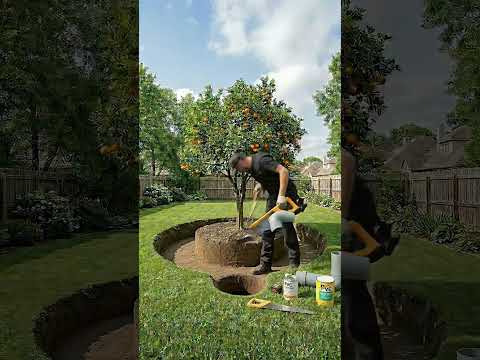
[0:00]The project begins with clearing the grass around the orange tree. Then, the removed turf is loaded into a wheelbarrow. A white line is painted to mark the outline of the future fountain. This line guides the next step of the process. The grass is removed along the painted line. The removed turf is placed into the wheelbarrow, ensuring a clean working area. The ground is excavated in a circular trench, carefully preserving the tree's root ball. This creates the foundation for the new structure. Further excavation deepens the circular trench and creates channels for the fountain's plumbing. This ensures proper water circulation. The channels are dug to specific dimensions, preparing them for the installation of the drainage pipes. Accuracy is key at this stage. A larger, deeper pit is dug to accommodate the main drainage system. This ensures efficient water removal from the fountain. The drainage pipes are cut and assembled in the excavated channels. These pipes will manage water flow within the fountain. Gravel is poured into the trench, forming a stable base for the fountain. This layer is crucial for drainage and structural integrity. Concrete is then poured over the gravel, forming the base of the fountain's inner ring. This creates a solid, watertight foundation. The concrete is leveled and smoothed, preparing the surface for the next layer. This ensures a uniform and aesthetically pleasing finish. Concrete blocks are carefully placed to form the inner and outer walls of the fountain. These blocks define the shape and structure. More concrete is poured to fill the gaps between the blocks, securing them in place. This reinforces the structure of the fountain. A protective coating is applied to the interior surfaces of the fountain, ensuring waterproofing and durability. This extends the lifespan of the structure. Additional layers of concrete are added to create a smooth, tiered effect. This enhances the visual appeal and functionality of the fountain. The top edges of the fountain are sealed and smoothed, completing the main structure. This provides a polished and finished look. A final coating is applied to the outer walls, giving the fountain a uniform and appealing appearance. This concludes the construction phase. The fountain is filled with water, and decorative rocks are carefully placed around the tree's base. This adds natural beauty and charm. Stone slabs are laid to create a walkway leading to the fountain. This provides easy access and enhances the overall landscape design. The area around the tree is landscaped with fresh soil and plants, completing the garden's transformation. This adds greenery and vibrancy. Lights are installed around the fountain, creating a stunning visual effect at night. The illuminated fountain becomes a focal point of the garden.
DIY Circular Reflecting Pool with LED Lights (Full Build Timelapse)
RenovaTime
1m 3s449 words~3 min read
YouTube auto captions
Transcript source
YouTube auto captions
This transcript was extracted from YouTube's auto-generated caption track. The transcript below is server-rendered so it can be read, searched, cited, and shared without opening the original YouTube player.
Pull quotes
[0:00]The ground is excavated in a circular trench, carefully preserving the tree's root ball.
[0:00]Further excavation deepens the circular trench and creates channels for the fountain's plumbing.
[0:00]The channels are dug to specific dimensions, preparing them for the installation of the drainage pipes.
[0:00]Concrete is then poured over the gravel, forming the base of the fountain's inner ring.
Use this transcript
Related transcript hubs
Watch on YouTube
Share
MORE TRANSCRIPTS


