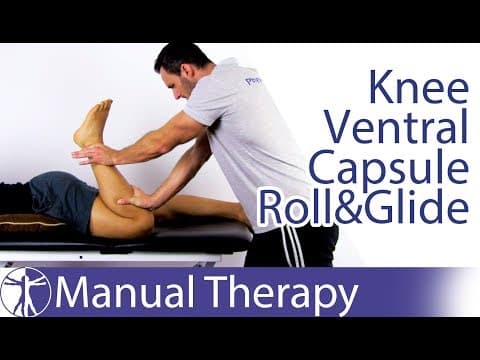
[0:00]In this video, you're going to learn how to do kinematic assessment and treatment for the capsule of the knee joint.
[0:14]Get our very own assessment ebook and mobile app. Links are in the video description. Hi and welcome back to tutors. The aim of roll glide assessment is to gain information on activity of the joint and of course articular problems such as capsular limitations. To assess the ventral capsule and severe limitations from 10 to 90 degrees of flexion, have your patient in sitting position with the towel underneath his femur and the tibia hanging freely. The condyle of the femur are the convex joint partner and the tibia is concave, so we're moving the tibia we have to roll and glide into the same direction. Now, induce a dorsal roll with one hand above the patient's ankle and add the gliding component with the other hand on the patient's proximal tibia into dorsal and increasingly proximal direction perpendicular to the tibia.
[1:17]For moderate limitations from around 90 to 100 degrees of flexion, there are two options. Have your patient in sideline position with the leg to be examined, position in a way that the femur rests on the bench and the tibia is hanging freely.
[1:41]An alternative, which can be performed into maximal flexion is in prone line position with the patient's hip in slight flexion to prevent stretch on the rectus femoris. In this position rolling glide into proximal and increasingly dorsal direction perpendicular to the tibia. In case of minimal limitations of knee flexion, have your patient in supine lying position. Then place both of your hands over the patient's knee and intertwine your fingers. While one hand stabilizes the femur, the other hand induces a dorsal proximal glide with the base of your hand and the roll with the forearm.
[2:35]This technique can be modified, so a distal glide of the patella is added. In this case, the fixating hand on the femur glides the patella into caudal direction, while the tibia is rolled and glided into dorsal cranial direction. For all techniques assess for movement quality during roll and glide, possible pain provocation and end feel. For end feel assessment, roll and glide to end range, then assess if further gliding is possible or not. In a hyper mobile joint, the glide is reduced relative to the roll component, so no further gliding is possible. If you feel that the end feel or movement quality is abnormal, you can directly move further from assessment to intervention, as the techniques are identical. When used as an intervention, make use of the Made land grades for mobilization to dose your techniques according to your goals. Check the video in the top right corner to learn more about that.
[3:40]Okay, you've reached the end of this video and if you like, you can check out more videos on manual therapy in the playlist to my left. Again, check the info icon in the top right corner for the featured videos and also take a look at the links in the video description down below. At last, subscribe to our channel if you haven't yet and hit the bell icon next to the subscribe button. This will let you know when we release new videos. As always, this was for tutors. I'll see you next time. Bye.