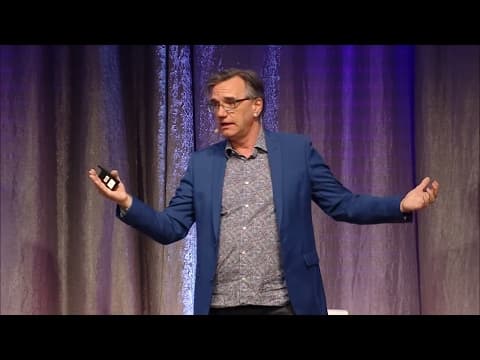
[0:15]Hello everyone. Uh I'm here to help you design your life. We're going to use the technique of design thinking. Design thinking is something we've been working on uh at the D school and in the School of Engineering for over 50 years. It's an innovation methodology. Works on products, works on services, but I think the most interesting design problem is your life. So that's what we're going to talk about. Um I want to just make sure everybody knows uh see my buddy Dave Evans's face. Dave and I are the uh co-authors of the book, and he's the guy who helped me um co-found the life design lab at Stanford. So what do we do in the Life Design Lab? Well, we teach the class that helps you figure out what you want to be when you grow up. Now, I'm going to give you the first reframe, designers love reframes. How many of you hope you never grow up and lose that childlike curiosity that drives everything you do? Raise your hand. Right. Who wants to grow up? I mean, we've been talking about curiosity in almost every one of these talks. And so I'd like to reframe this as we say we teach the class that helps you figure out what you want to grow into next, as this life of yours, this amazing design of yours, unfolds. So design thinking is what we teach and it's a set of mindsets, it's how designers think. You know, we've been taught probably in the in the uh university to be sort of skeptical realists, rationalists. But that's not any that's not very useful as a mindset when you're trying to do something new, something no one's ever done before. So we say you start with curiosity and you lean into what you're curious about. We say you reframe problems because most of the time we find people are working on the wrong problems and they have a wonderful solution to something that doesn't work anyway. So, what's the point of working on the wrong thing? We say radical collaboration, because the answer's out in the world with other people, that's where your experience of your life will be. We want to be mindful of our process. There are times in the design process when you want lots of ideas. And there are times in the design process where you really want to converge and test some things, prototype some things, so you want to be good at that. And the other is, um, bias to action. Now, you know, I'll I'll say that uh we think no plan for your life will survive first contact with reality. Reality has a tendency to throw a little things at us that we weren't expecting, sometimes good things, sometimes bad. So we say, just have a bias to action. Try stuff. Why? Why did we start this class? Well, I've been in office hours for a long, long time with my students. I've been teaching here for a while. Dave as well, he was teaching over at that uh Community College in Berkeley for a while. And uh And what we notice is, I'm sorry, I'm sorry, it's a it's a Stanford TEDx. what we notice is that people get stuck. People really get stuck and then they don't know what to do and they don't seem to have any tools for getting unstuck. And designers get stuck all the time. I mean, I signed up to be a designer, which means I'm going to work on something that I've never done every day. And I get stuck and unstuck and unstuck all the time. But we also noticed as we went out and we talked to um folks that not just our students, but people in mid-career and on core careers, that people have a bunch of beliefs, which psychologists label dysfunctional beliefs. Things they believe that are true that actually aren't true and it holds them back. I'll give you three. First one is, what's your passion? Tell me your passion and then I'll tell you what you need to do. Now, if you actually have one of these things, these passions, you knew at two you wanted to be a doctor, you knew at seven, you wanted to be a clown at Circ de Solay. And now you are one, that's awesome. But, you know, we're sort of research based here at Stanford. So we went over to the the Center for the Study of adolescence, which by the way, now goes up to 27. And met with Bill Damon, who's one of our colleagues, he's a fantastic guy. He studied this question, and it turns out less than 20% of the people have any one singular identifiable passion in their lives. So we hate a methodology that says, okay, come to the front of the line, you have a passion? Oh, you don't? Oh, I'm sorry. Go to the back when you have one come on back and we'll help you with that. It's terrible. Eight out of 10 people say, I I have lots of things I'm interested in. So this is not an organizing principle for your search or your design. The second one is, well, you should know by now, right? Don't you know where you're going? If you don't know, you're late. Now what are you late for exactly? I'm not quite sure. But people have, you know, there's a meta narrative in the culture and my when when I was growing up. 25, you were supposed to have, you know, maybe have a relationship, maybe have gotten married, starting to get the family together. When I talked to my students, my millennial students, they'll say, oh, that's got to be like um 30 or something, because they can't imagine anything past like 22. But 30's a long way out. Uh but we know that nowadays people are forming uh their lives uh much more fluidly. They are staying in a lot more dynamic, uh motion between about 22 and 35. And so this notion that you're late is really kind of it's not only is like, well, you should be figure you should have figured this out by now. Dave and I don't should on anybody in the in the book or in the class, we don't believe in should. We just think, all right, you are wherever you are. Let's start from where you are. You're not late for anything. But the one we really don't like is, are you being are you being the best possible version of you? I mean, because you're not settling, are you for something that's less than the best because this is Stanford, obviously, we all want to be the best. Well, this this implies that one there's a singular best, two that it's a linear thing and life is anything but linear. And and three, there's this old it's a kind of comes from the this business notion, there's an old business saying, um, good is the enemy of better, better is the enemy of best. And you always want to do your best in business. But if there isn't one singular best, then our reframe is the unattainable best is the enemy of all the available betters. Because there are many, many versions of you that you could play out, all of which would result in a well-designed life. So I'm going to give you three ideas from design thinking in the way or five ideas, excuse me. It says five, doesn't it? Yeah, five ideas from design thinking. Um, and uh that things that uh people have written back to us, who've read the book or taken the class and said, hey, these were the most useful, these were the most doable, they were the most helpful. And we're human centered designers, so we want to be helpful. The first one is this notion of connecting the dots. The number one reason people take our class and and we hear read the book is they say, you know, I want my life to be meaningful. I wanted it to be purposeful. I wanted it to add up to something. So we looked in into positive psychology literature and in the design literature and it turns out, that there's who you are, there's what you believe and there's what you do in the world. And if you can make a connection between these three things, if you can make that a coherent story, you will experience your life as meaningful. The increase in meaning-making comes from connecting the dots. So we do two things. We ask people write a work view, what's your theory of work? Not the job you want, but why do you work? What's it for? What's work in service of? Once you have that, 250 words, then, this one's a little harder to get short, what's the meaning of life? What's the big picture? Why are you here? What is your faith or your your view of the world? When you can connect your life view and your work view together in a coherent way, you start to experience your life as meaningful. That's idea number one. Idea number two. People get stuck and one of the one and you got to be careful because we can reframe almost anything, but there's a class of problems that people get stuck on that are really, really bad problems. That we call them gravity problems. Essentially, there's something you cannot change. Now, you have not you, but I know you have a friend and you've been having coffee with this friend for a while and they're stuck. They don't like their boss, they don't like their partner, they don't like their job. There's something they don't like, but nothing's happening, right? Nothing's happening with them. If Dave were here, he'd say, look, you can't solve a problem you're not willing to have. You can't solve a problem you're not willing to have. So, if you've got a gravity problem and you're simply not willing to work on it, then it's just a circumstance in your life. And the only thing we know to do with gravity problems is to accept. In the design thinking chart, you start with empathy, then you redefine the problem, then you come up with lots of ideas, and you prototype and test things. But that only works if it's a problem you're willing to work on. The first thing to do is accept. And once you've accepted, it's a gravity problem, I can't change it. You know, this is a company that I and the company the company is a family run company, and the name of the of the founder is on the door, and if you're not in the family, you can't be the president. You're right. You can't. So, now you have to decide what do you want to do? Is that a circumstance that you can reframe and work in, or do you need to do something else? So be really careful about gravity problems, because they're pernicious and they really get in the way. But back to this idea of multiples. I do a little thought experiment with my students. And I say, you know, the physicists up at Slack have kind of demonstrated this multiverse thing might be real. You've heard of this, right? That there are multiple parallel universes, one right next to each other. And I said and I said, you know, I can we'll do a thought experiment. Let's say you could live in all the multiverse simultaneously. And not only that, but you would know about your life in each one of these in each one of these instances. So you could go back and be the ballerina and the scientist and the CPA and whatever else you wanted to be. You could have all these lives in parallel. And when I ask them how many lives are you? How many lives would you want? I get answers from three to 10,000. But, you know, we've we've sort of done the average, it's about seven and a half. Most people think they have about seven and a half really good lives that they could live. And here's the deal, you only get one. But it turns out it's not what you don't choose, it's what you choose in life that makes you happy. Nevertheless, we reframe this, we say, great, there's more lives than than than one in you. So let's go on an odyssey and let's really figure out those lives. And we ask people to do some design. In the ideate bubble, it's about having lots of ideas. So we say, let's have some ideas. We're going to ideate your future, but you can't ideate just one. You have to ideate three. Now, there's some research from the School of Education that says if you start with three ideas and you brainstorm from there, you get a much one range, a wider range of ideas. The ideas are more generative and they lead to better um better uh solutions to the problem, rather than just starting with one and then brainstorming forward. So we always do three, there's something magical about threes. We have people do three lives, and it's transformational. We give them this little rubric. One, the thing you're doing, the thing, the thing you're doing right now, whatever your career is, just do it. And you're going to do it for five years and it's going to come out great. So, I mean, in design we're we're sort of values neutral, except for one thing. We never design anything to make it worse, right? I have been on some teams that made some pretty bad products, but we weren't trying to, we were trying to make it better. So, thing one, your life, make it better. And also put in the bucket list stuff. You want to go to Paris, you want to go to the Galapagos before the guy with the ice thing before it's all underwater and we we can't see it anymore. So that's your that's plan one, your life now goes great. Plan two, I'm really sorry to tell you, but the robots and the AI stuff, that job doesn't exist anymore. The robots are doing it. We don't need you to do that anymore. Now what are you going to do? So, what do you do if the thing that you've got goes away? And everybody's got, you know, everybody's got a side hustle or something that they can do to make that work. And three is, what's your wild card plan? What would you do if you didn't have to worry about money? You got enough. You're not fabulously wealthy, but you got enough.
[12:24]And what would you do if you didn't if you had enough money and you didn't care what people thought.
[12:49]Anything from I'm going to go study um butterflies to I want to be a bartender, you know, in Belize. What would you do? And people have those three plans. Now, what happens when they do this, is one, they realize, oh my gosh, I could actually have imagined three completely parallel lives, they're all pretty interesting. Two, they rarely go become a bartender, you know, in Belize. But a lot of times the things that come up on the other plans were things that they left behind somehow. In the busyness of life, they forgot about those things. And so they bring them back and they put them in plan one and they make their they make their lives even better. Sometimes they do pivot. But mostly they just use this as a method of ideating all the possible wonderful ways they could have a life. Now, you could start executing that, but in our model, the thing you do after you have ideas is you build a prototype. We have met people who've like quit their job and suddenly done something else. It hardly ever works. You kind of have to sneak up on it, because uh in our model, we want to set the bar really low, try stuff, have some success, do it again. So when we say prototype in our in our language, what we mean is a way to ask an interesting question. What would it be like if I tried this? A way to expose the assumptions. Is this even the thing I want, or is that just something I remembered I wanted when I was 20? I got to go out in the world and do this, so I'm going to get others involved in in in prototyping my life, and I'm going to sneak up on the future. Because I don't know if this is exactly what I want. The um two kinds of life design prototypes. One we call a prototype conversation. Um, you know, William Gibson, the science fiction writer has a famous quote, the future is already here, it's just unevenly distributed. So there is someone who's a bartender in Ibiza, she's been doing it, he has been doing it for years. I could go I could go meet him and have a conversation. Here, she, somebody else is doing something else I'm interested in. All these people are out there, they're living in my future today. They're doing what I want to do today. And if I have a conversation with him, I just ask for their story, and everybody will tell you their story. If you buy him a cup of coffee, they'll tell you the story, and if I hear something in the story that rings in me, we have this thing we call narrative resonance. When I hear a story that's kind of like my story, something happens. And I can identify that as a potential way of moving forward. The other one is a prototype experience. I was working with um Dave and I were working with a woman, sort of mid-career, in her 40s. And um very successful tech executive but wanted to move from money-making to meaning-making. I wanted to do something more meaningful. Thinking of going back to school, getting an MA in education, working with kids. But she's like, you know, I don't know, I'm 45, going back to school. Is that going to work? And then I heard about these millennials, they're kind of mean and they don't like old people. You know, what am I going to do, Bill? I said, well, you you just have to go try this. You know, it turns out, I sort of send her to a a seminar class and to a a large lecture hall class. Um, by the way, you just put on a t-shirt that says Stanford, you walk into a class, nobody knows. Um, she wasn't registered, but everybody, you know, she went and she went to the classes and she came back and she said, you know what? It was fantastic. I walked into the lecture hall, I sat down, my body was on fire. It was interesting. I'm so interested in the way the lecture was going, and then I met these millennials, it turned out they're pretty interesting people. I had I've set up three prototype conversations, and they think I'm interesting because I'm coming back to school and I'm 45. So I had a she had a felt experience, because we are more than just our brains. She had a felt experience that this might work for her. So those are two ways you could prototype your way forward. The last idea, you want to make a good decision well. So many people make choices and they're not happy with their choices because they don't really know how do they know what they know, right? It's a hard thing, particularly nowadays when we have so many choices. So we have a process. Again, it comes from the positive psychology guys, gather and create options. Once you get good at design, you're really good at coming up with lots of options. You got to narrow those down to the a working list that you can work with. Then you make the choice, you make a good choice. And then of course you agonize that you did the wrong thing. All my students have what is called FOMO, fear of missing out. What if I didn't pick the right thing? I want I had someone came into my office and said, I'm going to declare three majors and two minors. And I said, do you plan on being here for a for a few years? It's not going to happen, right? So, we don't say that. We say, you want to let go and move on. And all these have some psychological basis in them. Let me tell you about, once you get good at gathering and creating ideas, you also want to make sure you leave room for the good the lucky ideas, the serendipitous ideas. This is a guy named Tony Shay, he's a was the CEO of Zappos, he sold it to Amazon. But he had a a before you uh became an employee at Zappos, he had to take a test, and the test was, are you lucky? One, two or three, I'm not very lucky. I'm not sure why. Seven, eight, nine, 10. I'm very lucky. Great things happen to me all the time. I'm not sure why. Uh, he wouldn't hire anybody that was not lucky. I think is probably illegal, but, but it was based on, but it was based on a piece of research, where a psychologist did the same thing, rate yourself from lucky to unlucky. And then they had people read a New York Times, the front section of the New York Times, 30, 30 pages, lots of articles. And the the the graduate students said, please count the number of either uh headlines or photographs, depending on the test. And if you get the right one, you get the when you get the whole thing read and you count the number of photographs, just tell the person at the end and if you got the right number, you get 100 dollars. Of course, you all know that when a graduate student tells you what the experiment is, that's not the experiment. So, inside this thing that looked like a New York Times, 30 pages, front page, inside all the stories were little pieces of text that said, if you read this, the experiment's over, collect an extra $150. People who rated themselves as unlucky, by and large, got the right answer, 36 headlines, whatever it was, got the 100 dollars. People who had themselves as lucky, seven, eight, nine, or 10, 80% of the time, noticed the text, got the extra 150. It's not about being lucky. It's about paying attention to what you're doing and keeping your peripheral vision open. Because it's in your peripheral vision that those interesting opportunities show up, right, that you were not expecting. So you want to get good at being lucky. Narrowing down, this is quite simple. If you have too many choices, you go into what psychologists call choice overload, and then you have essentially no choices. Here's the experiment. This was done at Stanford. You walk into a grocery store and there's a nice lady with a she's got a table and on the table she has six jams, and you come over and try the jams, have a sample, buy some jam. Six jams, about 30, 30 people who will go buy, pick a jam or stop and test something, and about a third of those actually buy a jam. That's the baseline. Next week, you walk in, 24 jams. Jalapeno, strawberry, banana, whatever, all sorts of jams. Well, guess what happens? Twice as many people stop, look at all these jams, it's so interesting. 3% of the people buy it. When you have too many choices, you have no choice. What do you do when you have too many choices? Just cross off a bunch of choices. The psychologists tell us we can't we can't handle more than five to seven. I'd say five. If you've got you've got a bunch of choices, cross them all off, just pick the five and then make your decision there. Oh my God, what if I pick the wrong ones? What if I cross off the wrong ones? Right? Well, you won't, because it's the pizza or Chinese food thing. You're at the office and everybody says, hey, let's go out to lunch today. That sounds great. What do you want to do? Pizza or Chinese food? I don't care. Okay, everybody gets together and half way, you know, in the elevator, on the way down, someone says, let's get Chinese food. Then you're going to know, I want pizza. You won't make the decision until the you won't decide how you feel about the decision till the decision's made. That's a piece of research, it's been done again and again and again. So just cross them off, if you've crossed off the wrong one, you'll have a feeling somewhere in your stomach that you did the wrong thing. Choosing, this is about that feeling in your stomach. You cannot choose well if only if you choose only from your rational mind. Um, this is Dan Goman, who wrote the book on emotional intelligence. He's done a a lot of research on this, a lot of brain science. There's a part of your brain that way down in the base brain, the basil ganglia, that summarizes emotional decisions for you. I did something, got good emotional response from that, good, check, did something else, ooh bad emotional response to that. It summarizes all of the emotions that you have felt and how your decisions were veiled, positive or negative and emotion. Problem with that part of your brain is it's so early in the brain, it doesn't talk to the part of your brain that talks. There's no connection to the prefrontal cortex or anything else. It's only connected to your GI tract and your Olympic system. So it gives you information through felt sensations, a gut feeling. Without that, you can't make good decisions. And then the letting go and moving on. This is the hardest part for me, but this is um also the work of uh Dan Gilbert. Who is a distinguished scientist at Harvard, despite the fact that he's doing insurance commercials now. Um, and he's been studying decision making and how do you make yourself happy. So you walk in the another psychology experiment, the the um the postdoc is got five Monet prints, five pictures from Monet, on the and you rank them from best to least. I like this one the most. I like this one the least. Number one, number five. Thank you very much. The experiment's over. Oh, by the way, as you're walking out the grad student says, you know, I kind of screwed up and I bought too many of number two and three. So if you want to take one home, you can just have it. Two conditions. And one case, take it home and have it but don't bring it back because I'm kind of embarrassed and just keep it. You can't you can't exchange it. Second condition. I got lots of these. If you don't like the one you picked, you can come swap it back and pick another one. And of course, everybody picks number two, it's a little better than number three. Bring people back in a week later and say rerank the stimuli. Which one did you like now? The people who are allowed to change their mind, don't like their painting, they don't like their don't like the print. They don't like the other one anymore. They don't like any of them anymore. In fact, they don't like the whole process and they have destroyed their opportunity to be happy. The people who were told, you pick it, it's yours, you can't return it, love their print. They typically rank it's number one. And don't think the and think the rest of them suck. If you make decisions reversible, your chance of being happy goes down like 60 or 70%. So let go and move on. Make the decision irreversible. And by the way, as a designer, that's no problem because you're really good at generating options. That's what you're you're great at ideation. You're really good at prototyping to get data in the world, to see if that world is going to be the world you want to live in. So you have no fear of missing out. It's just a process, mindful of process. Collect, reduce, decide, move on. That's how you make yourself happy. So, the five ideas, connecting the dots to define meaning through work and life views. Stay away from gravity problems because I can't fix those, and neither can you. Reframe those to something that is workable. Do three plans, never one. Always do three of everything. Three ideations for any of the problems you're working on to make sure that you've covered, not just the ideas that that you had when you started, but all the other ideas that are possible. Prototype everything in your life before you jump in and try it and choose well. There's no point in making a good choice poorly. Choose well, and you will find that things in your life are much easier. And you can do this. We know you can because thousands of students have done it. Two PhD studies have been done on the class that demonstrate higher self-efficacy, lower dysfunctional beliefs. It's a fascinating process to watch people who don't think of themselves as creative, go through this class and walk out saying, you know what? I'm a pretty creative person. What David Kelly calls creative confidence. So, we know you can do it. Thank you very much. It's simple, get curious, talk to people, and try stuff. And you will design a well lived and joyful life. Thank you.


