[0:00]Hello, and welcome to this video called Reasonable foresight, the third in Iosh's Health and Safety fundamentals series. I'm Duncan Spencer, Head of Advice and Practice at IOSH. A note before we start. While reasonable foresight is a legal test in British law, in many other countries it is not. Nonetheless, in my personal experience of teaching people to use this concept in other countries, it has given me first-hand experience of how this concept can be helpful for all organizations wherever they may operate in the world. In this video, we will build on our understanding of competency and how it supports reasonable judgment and consider reasonable foreseeability in more detail. Fundamentally, reasonable foresight is about predicting the future. This is more than just guesswork, it is a skill that uses experience and knowledge built up over time and uses it to rationalize what might happen in the future. For example, we know from experience on construction sites that people overreaching when climbing a ladder are likely to lose their balance and fall. It is reasonably foreseeable. Note that what we are predicting is different to suggesting what is foreseeable. Anything is foreseeable. There are no boundaries to pure foreseeability. It is foreseeable that a herd of cows could wander down your street and into your garden. If you lived in the middle of a town or a city, that would be a bizarre event, it would be fanciful. Even in the countryside, unless your house is between the milking dairy and the field, it would still be a bizarre event. It is common knowledge that farmers look after their valuable livestock and fence them in effectively. Predicting what is reasonably foreseeable introduces some rules to follow. Firstly, the judgment of what is reasonably foreseeable must be made in context. Is it reasonably foreseeable that in a modern office, a worker suffering from a minor cut from the edge of a piece of paper, it would lead to blood septecenior and death. No, because it is a relatively clean environment. Many people around the world receive paper cuts in the office daily. We're not experiencing office workers dying in droves from such a trivial injury. We never have. But if we change the context to that of a pathology laboratory, handling diseased human tissue, a minor fresh wound is much more concerning as it provides a possible route of entry into the body for pathogens being handled. So, let's test the idea of reasonable foreseeability out a little more. Imagine a goods yard, busy with many lorries and vans moving around at speed. There is a need for pedestrians to walk across this yard when going from building to building. There isn't any pedestrian and transport segregation, neither are vehicle speed controls in place. What do you think would be reasonably foreseeable? A pedestrian would be struck or run over by a lorry or a van. Vehicles could collide in vehicle traffic accidents. Let's try a second scenario. Imagine a spillage of oil in the aisle of a busy supermarket full of shoppers. What is reasonably perceivable? A customer will not see it while focusing on their shopping list and the contents of the shelves, they could slip unexpectedly and fall into the hard tiling and fracture a bone. A third example. Imagine a poorly designed machine guard getting in the way of the operator and slowing down the operation. Supervision is poor and the pressure for improving production rates is increasing. Workers are reporting the problem and managers are doing nothing about it. What is reasonably foreseeable? Workers may take matters into their own hands and remove the guard, thereby placing themselves at greater risk. Recognizing what is reasonably foreseeable in each of these scenarios means that to do nothing would be negligent. In the Donnahue versus Stevens case mentioned in the last video, the judge said, liability can only arise where a reasonable man would have foreseen and could have avoided consequences of his acts or omissions. Beware of hindsight. What about hindsight? Hindsight can provide a clarity that may not have been known at the time. While asbestos was widely used in construction in industry in general, it wasn't until the 1950s that the link between that and mesothelioma was proven. From this date of knowledge, it became reasonably foreseeable that worker exposure to asbestos dust would eventually develop this disease. Perhaps there may be hazards that people are exposed to in the workplace today that we have yet to realize will cause long-term ill health effects. It's just another justification for why it is so important for occupational safety and health professionals to maintain their continued professional development. It provides a reason for reviewing the content of risk assessments after an accident to note any significant learning made about the risk. If so, the risk assessment can then be updated. Reasonable foresight and significance. So, how do you know if what you predicted by reasonable foresight is significant? In the year 2000, guidance on the management of health and safety risk from the United Kingdom's health and safety executive, stated that insignificant risk can be ignored when identified through reasonable foresight. This begs the question. What is the difference between significant and insignificant risk? To answer this question, we can draw from what we have learned from applying reasonable foresight. We can exclude those things we predict that can be classed as bizarre or trivial. We must also consider the context of the activity too. If the activity we are examining is within the realms of everyday normal human life and activity, we can regard it as being trivial and therefore insignificant. For example, making yourself a cup of coffee, walking up and down a well-maintained stairway. However, as soon as we change the context of these activities, like a barista making hundreds of cups of coffee an hour, or workers carrying large heavy boxes up and downstairs, these activities take on a different perspective and may be regarded as significant and incidents reasonably foreseeable. A final note on reasonable foreseeability. Managers are usually very good at predicting how workers may be harmed when using a machine. A meat slicer at a delicatessen counter has a sharp spinning blade, so a guard is fitted to protect the workers' fingers. This is not the end of the story. Reasonable foresight must extend to cleaning and maintenance activities with machinery too. We must ask more searching questions. For example, what happens if the blade needs cleaning and replacing? The answer is usually that the guard needs to be taken off. So when considering reasonably foreseeable risk with machinery, remember to consider cleaning and maintenance operations too. In summary, reasonable foresight is competency dependent. Reasonable foresight is context dependent. Beware of hindsight, but act when it provides you with better clarity over what might happen again. In the next video in the series, we will build on our understanding of reasonable judgment and consider how it applies to the decisions of reasonable practicability. How far should we go in controlling the risk? When can you stop? To become a member of IOSH and for more information about occupational health and safety topics, please visit IOSH.com.
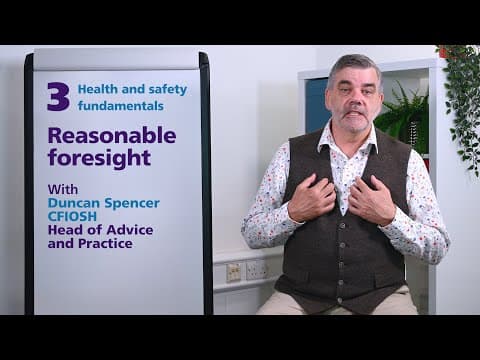
Episode 3: Reasonable foresight
IOSH
8m 9s1,207 words~7 min read
YouTube auto captions
Transcript source
YouTube auto captions
This transcript was extracted from YouTube's auto-generated caption track. The transcript below is server-rendered so it can be read, searched, cited, and shared without opening the original YouTube player.
Pull quotes
[0:00]Hello, and welcome to this video called Reasonable foresight, the third in Iosh's Health and Safety fundamentals series.
[0:00]While reasonable foresight is a legal test in British law, in many other countries it is not.
[0:00]In this video, we will build on our understanding of competency and how it supports reasonable judgment and consider reasonable foreseeability in more detail.
[0:00]This is more than just guesswork, it is a skill that uses experience and knowledge built up over time and uses it to rationalize what might happen in the future.
Use this transcript
Related transcript hubs
Watch on YouTube
Share
MORE TRANSCRIPTS


