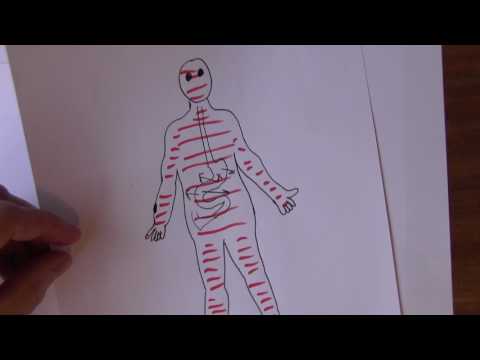
[0:00]In this talk we're going to be thinking about routes of drug administration. How do we give drugs? So we start off with a drug here. But of course, we need to do something with it. We need to get it into the body to have some effect. Now, to begin with, we can think of two ways that we give drugs. The first is systemic. We can give drugs systemically, or we can give them locally. So all forms of drug administration are either going to be systemic or local. And of course, whenever we give drugs, we must give the right dose of the right drug to the right patient at the right time, via the correct route. More of which later. Let's think about this idea of systemic and local. Now, I remember when I was a student, not understanding what systemic meant. So here we have, um, a person. Now, if we give a drug systemically, it means it will go to all the systems of the body. So in the body, we've got the respiratory system, we've got the cardiovascular system. We've got the gastrointestinal system, we've got the nervous system. We have the different systems of the body. So if a drug is given systemically, it will go into all body systems. In other words, if we give a drug systemically, it's going to go into the bloodstream. And that means that the drug will distribute to the toes and to the legs. Because the blood circulates around those areas, we're giving it into all body systems, and it'll go to the fingers. And the arms, of course. I think you get the idea. It will go to the whole body.
[2:07]So a drug which we give systemically, will go to all or potentially all tissues of the body. It will be circulating in the blood. But a drug that we give locally will only affect one part of the body. It will only get to that one area of the body, wherever that particular area of the body happens to be, could be an eye, for example. But it will only go to that certain area. It's a local administration. So systemic means all over. All body systems. This is what we mean by systemic. Now, if we think about things that we give systemically, we'll leave local aside for now. But if we think about things that we give systemically, there's two ways we can do this. One is enteral, and the other is parenteral. Now if we give a drug enterally, enteral means to do with the gastrointestinal tract. So that's going via the gastrointestinal tract, if we give this drug enterally. Parenteral, and you can see there that the word there is enteral. Just with a P-A-R in front of it. P-A-R means beside. So enteral is via the GI tract, gastrointestinal tract. Parenteral literally means beside the gastrointestinal tract, but that is parenteral means that we're giving a drug, but it's not going via the gastrointestinal tract, but it's still going to all the systems of the body. So what we're saying is there's two ways we can get a drug into all the systems of the body. One is via the gastrointestinal tract. That we know is there. So one is via the gastrointestinal tract. The drug will go into the gastrointestinal tract and be absorbed from some part of the GI tract into the blood. From there, it will circulate around all tissues of the body. That's one way. That's enteral. Now, I think if we start off with enteral, enteral, giving drugs via the gastrointestinal tract. How is this going to come about? Well, the most obvious way is oral. We can just give a drug orally, and the patient will swallow it, sometimes P.O., per oral, route of drug administration. Typically, the drug will be absorbed through the stomach and the duodenum once it's been swallowed. But there's other components to the gastrointestinal tract as well, and another way we quite often give drugs is sublingual. Sublingual. Now, sublingual means under the tongue, under the tongue. Now, if we give a drug into the stomach, first, that drug will have to be absorbed into the veins that drain the stomach, into the capillaries and the veins. And the veins that drain the stomach will go into the hepatic portal vein to go through the liver. So, drugs given orally will have to go through the liver first, and that slows things down a bit and the liver breaks down some of the drug. So if we give that sublingually, then the mouth is not drained into the liver directly, it's just drained into the systemic circulation. So it tends to go into the circulation more quickly and less is broken down the first time the drug goes through the liver. So, for example, nitroglycerin to relieve angina can be given sublingually and can work very effectively. We can also give drugs into the mouth, sometimes we call this buccal. Administration. It's sometimes called sublabial as well.
[6:40]We normally call it buccal administration, or just into the mouth. And here we give the medicine in between the cheek and the gums. So for example, after someone's had a myocardial infarction, we might want to give buccal aspirin. We'll ask the patient to take 300 milligrams of aspirin, put it into their mouth, but not swallow it. And again, it will be absorbed more quickly through the mucosa in the mouth, than it will be through the mucosa in the stomach, and it won't go through the liver first. So sublingual is below the tongue, buccal is between the cheek and the gums. And also, we can give drugs per rectum. Through the anal sphincter, P.R. administration. Leaving the drug in the rectum, for example, diazepam can be given this way, and it will absorb through the rectal mucosa. The rectal mucosa again has a good blood supply. So things can be absorbed into the rectal mucosa, and from there on into the blood. And once in the blood, it will circulate around the whole systemic circulation. So that's the enteral route of drug administration. Now, as well as that, to give drugs systemically, if we want to give drugs systemically, we can give drugs via the parenteral route. So let's think now about parenteral drug administration. So that's the enteral. We're now thinking about parenteral. Parenteral drug administration. Giving drugs, remember we're still on the systemic here. So we've looked at giving drugs. We're talking about systemic. We've considered the enteral systemic. We're now considering the parenteral systemic. So we're on this parenteral route beside the gastrointestinal tract. So how are we going to give these? Well, the most famous are the injection routes, so injections can be intravenous. Intravenous, giving it directly into a vein. We give the drug directly into the venous circulation. Not into an artery, into a vein. And when we're giving drugs intravenously, we can use central veins. In high dependency situations, we often have central lines in, or we can give it via peripheral cannulas.
[9:52]Peripheral lines in peripheral veins. Still intravenous, but this one's going to go into a central vein. Such as the jugular vein, or a line into the superior vena cava, for example. Whereas this goes into a peripheral vein in the arm, such as the basilic vein or the cephalic vein, or the median cubital vein in the arm. Now, still thinking about these intravenous administration, sometimes we'll give a bolus, and sometimes we'll give an infusion. So if we give a bolus, we give an injection fairly quickly, typically intravenously over a few minutes. We don't give any very quickly typically. Normally over three, four, five minutes, sometimes it can be quicker, other times it's slower. IV bolus is also called an IV push. Not a particular term I like a bolus is more descriptive, but IV push is the way it's often described. Whereas an infusion, it'll go in more slowly. We can either put it in via a drip. When we add it to a solution such as, um, normal saline, 0.9 saline, or we can also use volumetric.
[11:17]Devices, such as syringe drivers and things that will put the infusion in at a fixed rate for us. So that's intravenous administration. Intravenous is good, works very well, very quickly. We get complete absorption. But just in the same way that the beneficial effects will be quickly enjoyed, any adverse effects will also be rapidly experienced. So allergic reactions can manifest very quickly. Seconds, seconds to a minute. Same with intravenous antibiotics, the allergic reactions can develop very quickly.
[12:12]Or there can be adverse effects that can develop quickly as well. For example, if we give a dose of intravenous morphine, there can be respiratory depression or even respiratory arrest, and again, that will develop quickly. So very good method of administration, but also needs to be done in a controlled environment by a suitably qualified professional. Because the effects will be rapid. Another classic one is intramuscular. Directly into a muscle. So we can use the deltoid in the arm. The top of the arm. We can use the thigh. The middle outer aspect of the thigh into the vastus lateralis. Muscle, for example, or we can give injections into the gluteal muscle. The upper outer aspect of the buttock into the into the, um, the muscle into the gluteal muscle. Gluteus maximus muscle. Injections can also be subcutaneous. This is just under the skin. So under the skin we have the hypodermis, typically an adipose rich layer, and we can inject into those. Insulin, for example, will typically give via subcutaneous injections. And this can actually be given in any part of the body. Very often we use the the abdomen, but, um, it can be, it can be given anywhere, subcutaneous injections. So, they're the classic injection routes. But also, parenteral is not via the GI tract, so that can include inhalation. Inhalation of a drug, you might think, for example, of anesthetic agents, which are given via inhalation. But will circulate around all of the body. Or occasionally, we can give drugs into the bronchial tree. Normally only in emergency situations where a patient is intubated, and drugs can be injected directly into the bronchial tree. Not typical, but we do use it from time to time. Again, in some emergency situations, we can go via the intraosseous.
[15:02]Into the osseous, osseous is bone, into the bone. Intraosseous, fairly barbaric. You've got to go through the cortical layer of the bone. Typically into the, um, the sternum, or into the proximal tibia. But again, that's very much an emergency situation. But what we do use much more routinely is transdermal. Transdermal, trans means across, across the skin. So we might give, for example, nicotine replacement therapy via transdermal patches, or fentanyl patches for, um, for control of analgesia. Very often in the terminal care situation. So we see that we can give drugs systemically via the enteral or via the parenteral route.


