[0:00]So today, I'm going to teach you how to tune any car inside Forza Horizon 6 for grip and racing. Oh my God, there's a car. This works for front-wheel drive, rear-wheel drive, and all-wheel drive. Even if you know nothing about tuning, by the end of this video, you should have a good understanding of what to do to get more grip and more pace out of your car. Don't worry. I'm going to keep this super simple. Now, before we start, there is no magic tune that works for every car. Every car behaves differently, the goal of tuning is simple. If the car won't turn, fix the front. If the rear is sliding too much, fix the rear. And the secret to tuning, only change one thing at a time. So let's start with tires. Tire pressure changes grip. Lower tire pressure gives more grip, but can feel slower. Higher tire pressure gives more speed, but less grip. So here's the easy way to think about it. If the car is sliding too much in the corners, lower tire pressure slightly. If the car feels too slow or sluggish, raise it slightly. For all-wheel drive race builds, I usually start around 28 PSI in the front and around 27 to 28 in the rear. Only make small changes here, though, half a PSI at a time. in gearing is quite simple. This changes acceleration versus top speed. Move final drive towards speed, higher top speed, but lower acceleration. Move it towards acceleration, faster acceleration, but lower top speed. The goal is to make your car just barely hit top speed at the end of the longest straight. If you're bouncing off the limiter too early, move it towards speed. If acceleration feels weak out of corners, move it towards acceleration. Now, as a base point, we just want to look at final drive and then the graph in the bottom right-hand corner, and we just want to move it so it's just touching the edge of the graph. That'll give you the best top speed to start with, and then we adjust from there. Camber is the angle of the wheels. Negative camber means the top of the tires lean inward. For racing, negative camber helps cornering grip. Too much, though, and braking acceleration suffer. For all-wheel drives, I usually start around -1.5 to -2 on the front, -1 to 1.5 on the rear. If the car won't turn in, add slightly more negative camber to the front. If the car feels loose, reduce negative camber on the rear. Toe changes stability and responsiveness. Front toe out can help turn in. Rear toe in can help stability. But honestly, for most race builds, keep this close to zero. Only make tiny adjustments if the car feels weird. Caster affects steering feel. Higher caster gives more stability and better cornering grip. Lower caster feels more responsive. For racing, I usually keep this fairly high, 5.5 to 7. Mainly around 7 and if it feels too much then I'll lower it a little bit. Anti-roll bars are actually quite simple. For all-wheel drive race cars, stiffer is usually better because it improves cornering and makes cars feel sharper. In fact, a lot of all-wheel drive fast car builds run max front and rear anti-roll bars. That's normally a really good starting point, but here's what happens if you lower them. If you lower the front bar, the front gets more grip. This can help if the car refuses to turn. If you lower the rear anti-roll bar, the rear gets more grip and stability. This can help if you keep sliding out on the rear. So the simple rule is, car under steering, lower the front. Rear unstable, lower the rear. But for most all-wheel drive race builds, try and max out the front and rear first. Springs control how stiff the suspension feels. Now, this might sound strange, but a lot of fast car race builds actually run very soft springs. In fact, many fast all-wheel drive builds run close to the softest settings on both front and rear. Why? Because softer suspension helps the tires stay planted and gives more grip. If the car feels bouncy or sloppy, you can stiffen them slightly, but soft is usually a good place to start. Now, ride height is simple. Lower ride height improves cornering, but too low, and the car can bottom out. For race builds, run it low, but not slammed. Damping sounds complicated, but I'll make this easy. First, here's a great starting point. For rebound stiffness, 18 in the front, 18 in the rear. For bump stiffness, 6 front, 6 rear. Now, what does this actually do? Rebound controls how quickly the suspension comes back up. Bump controls how quickly it compresses. If the car feels bouncy, increase rebound slightly. If the car feels too twitchy or harsh, lower rebound. If the front feels too stiff entering corners, lower front damping slightly. If the rear feels unstable, lower rear damping slightly, and usually rebound should stay much higher than bump. Aero is one of the easiest ways to gain grip. For the front arrow, you generally want to run it as much downforce as possible. This helps the car turn in better and improves cornering grip, but too much front downforce can slow the car down on the straight, so if the car feels slow, lower front arrow slightly. For the rear, you usually want to run as little rear downforce as possible for maximum speed. But if the rear keeps sliding out in the corners, increase rear downforce until the car feels stable. So, more arrow equals more grip. Less arrow equals more speed. For braking balance, a good starting point is around 10% more towards the front. This gives better stability under braking. Now, here's what brake balance actually does. More front brake balance, safer and more stable. More rear brake balance helps the car rotate into the corners, but too much rear and the car can spin out. Brake force is simple. High brake force means stronger braking, but easier to lock up. Lower brake force feels smoother and easier to control. I usually start somewhere in the middle. Differential settings scare a lot of people, but they're actually quite simple. Now, first, if you're driving rear-wheel drive, you'll only adjust the rear differential. Front-wheel drive, only the front differential. But all-wheel drive cars have both front and rear differentials to tune. For acceleration settings, you want to keep them as high as possible. This helps traction out of the corners, but if the car understeers too much when accelerating, lower acceleration slightly. For deceleration, you generally want this lower. But if the car feels unstable coming into corners, raise deceleration a little bit, and that is for the front and rear of an all-wheel drive car. If you're just doing a front-wheel drive car, you just do the front. If you're doing a rear-wheel drive car, you just do the rear. Now, center balance decides whether the car behaves more front-wheel drive or rear-wheel drive. More front balance, safer and easier to drive, but too much can cause understeer. More rear balance, faster and more aggressive, but too much can cause oversteer. For racing, I usually prefer slightly more rear bias. And that is how you tune any race car for grip and speed in Forza Horizon 6. Remember, don't just copy my settings, understand what the car is doing. If it won't turn, fix the front. If the rear is unstable, fix the rear. Make small changes, test the car, and you'll quickly learn what works. If this helps, drop a like, subscribe, and let me know what tuning guide you want next.
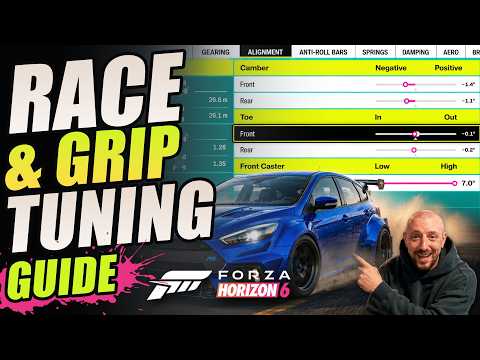
Forza Horizon 6 BEST Race Tune Guide – How To Make Any Car Faster
CRILLA18
6m 45s1,302 words~7 min read
AI audio transcription
Transcript source
AI audio transcription
This transcript was generated from the video's audio because no usable YouTube caption track was available. The transcript below is server-rendered so it can be read, searched, cited, and shared without opening the original YouTube player.
Pull quotes
[0:00]So today, I'm going to teach you how to tune any car inside Forza Horizon 6 for grip and racing.
[0:00]Even if you know nothing about tuning, by the end of this video, you should have a good understanding of what to do to get more grip and more pace out of your car.
[0:00]For all-wheel drive race builds, I usually start around 28 PSI in the front and around 27 to 28 in the rear.
[0:00]The goal is to make your car just barely hit top speed at the end of the longest straight.
Use this transcript
Related transcript hubs
Watch on YouTube
Share
MORE TRANSCRIPTS


