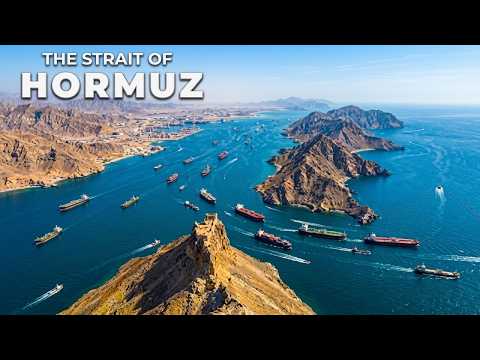
[0:04]Historically, the Persian Empire once ruled the world.
[0:14]A vast expanse of power stretching from the Aegean Sea to the Indus River, where 60 nations bowed beneath a single banner.
[0:28]But empires eventually crumble. Dynasties rise and fall, and that land, Iran,
[0:41]through thousands of years of conquest, reshaping, and renaming, has never ceased to be the epicenter of a power far greater than itself. Today, the entire weight of that historical tide converges upon a straight only 21 miles wide.
[1:11]It is almost inconceivable that a mere 21 miles of water carries nearly 20% of the global oil supply. More than just a geographical boundary.
[1:32]This is a fatal intersection where human ambitions for power and the violent tremors of the earth collide with immense pressure.
[1:47]In a space where every movement is scrutinized by the world's master strategists.
[2:03]Even the slightest fracture in its operation could trigger a catastrophe, turning the prosperity of nations into ash in a single moment of disruption.
[2:19]They call it the jugular vein of humanity.
[2:28]This is the straight of Hormuz.
[3:04]Positioned 5 miles off the coast of Bandar Abbas, at the threshold of the Strait of Hormuz,
[3:15]the narrow passage through which roughly a fifth of the world's traded oil moves each day.
[3:27]Hormuz Island commands a geography that makes it simultaneously one of the most strategically watched and geologically surreal places on earth.
[3:41]The island is a salt diaper, a 600 million year old mass of compressed salt and mineral rich volcanic rock, pressing upward through overlying sediment over the last 50,000 years, folding iron oxide, hematite, gypsum,
[4:06]and volcanic compounds into more than 70 distinct mineral shades. Deep crimson cliffs, silver black beaches ground from crystallized hematite,
[4:24]purple canyon walls and golden river beds carved dry since before recorded history.
[4:36]This landscape does not look unreal because it is untouched.
[4:46]It looks unreal because the forces that built it are still active, still reshaping the surface that 3,000 people have decided to call home.
[5:01]For those residents, mostly Sunni fishermen, whose dialect carries traces of Portuguese, Arabic, Hindi, and Dutch, absorbed across centuries of competing occupation.
[5:46]The Portuguese fort, built from that same red stone in 1507, still stands on the northern shore. Its walls dissolving back into the landscape they were quarried from. As if the island has always been in the process of reclaiming what empires attempted to fix in place.
[6:15]Today, warming Gulf temperatures bleach the offshore coral reefs, while a growing tourism economy gradually erodes the very geological formations that drew visitors here.
[6:33]A contradiction Hormuz has always understood. What is worth preserving is precisely what refuses to stay still. Places like Hormuz remind us that the most ancient materials on earth are not the most stable, and that the communities who learn to live with them understood something about impermanence that the rest of the world is only beginning to grasp.
[7:10]Somewhere beyond the northern cliffs, through the same 21 mile passage, Hormuz has watched across every century of its existence. 20 million barrels of oil move daily.
[7:30]A volume of extracted wealth so immense that its transit defines the geopolitical architecture of the entire modern Middle East.
[7:59]That absence is not incidental.
[8:06]The same salt diaper that folded 70 shades of mineral color into the surface also saturated the soil and ground water to the point of complete biological un-usability, meaning every liter of drinking water arrives by boat or desalinization plant.
[8:31]A structural dependency that functions as a permanent surcharge on the act of living here, one that no geological spectacle has ever canceled.
[8:46]The fishermen who work these inshore waters before sunrise understand a second arithmetic: the landscape does not advertise.
[9:02]The Gulf their fathers fished is not the Gulf they work now. Its stocks compressed by industrial trawling and by water temperatures that have shifted the seasonal catch beyond the reach of small boat households.
[9:21]The red ocher, the same Galac, ground into cooking pots before dawn, has been placed under extraction restriction.
[9:35]The intervention arriving not as protection, but as the removal of the last resource the island could sell without leaving it.
[9:50]By midsummer, the population drops by nearly half, not because of tourism, but because the working age residents have left for wages the island cannot generate. A departure that repeats itself each year with the quiet regularity of a tide, leaving behind the very young, the very old, and the landscape itself, which continues producing its colors indifferently, requiring nothing from anyone, as it has for 600 million years.


