[0:00]Question number one. Who is known as the father of microbiology?
[0:11]The right answer is option B, Antonio van Leeuwenhoek. Question number two. The main method of reproduction in bacteria is:
[0:28]The right answer is option A, binary fission. Question number three. Which structure helps bacteria move?
[0:44]The right answer is option B, flagella. Question number four. Which of the following processes kills all microorganisms, including spores?
[1:01]The right answer is option A, sterilization. Question number five. The bacterium that causes tuberculosis is:
[1:17]The right answer is option B, Mycobacterium tuberculosis. Question number six. Bacteria that can survive without oxygen are known as:
[1:36]The right answer is option B, anaerobes. Question number seven. The Gram stain differentiates bacteria based on:
[1:51]The right answer is option C, cell wall composition. Question number eight. Who discovered penicillin?
[2:05]The right answer is option C, Alexander Fleming. Question number nine. The function of the bacterial cell wall is:
[2:21]The right answer is option B, to protect and give shape. Question number 10. The smallest microorganism among the following is:
[2:37]The right answer is option C, viruses. Question number 11. The process where bacteria acquire DNA from their environment is called:
[2:53]The right answer is option A, transformation.
[2:59]Question number 12. Eukaryotic microorganisms include:
[3:08]The right answer is option C, fungi.
[3:14]Question number 13. An autoclave is used to:
[3:23]The right answer is option A, sterilize equipment.
[3:30]Question number 14. Which bacteria commonly causes food poisoning?
[3:40]The right answer is option D, Escherichia coli. Question number 15. Multicellular fungi are known as:
[3:56]The right answer is option B, molds. Question number 16. The temperature that kills most pathogens is:
[4:10]The right answer is option C, 100 degrees Celsius.
[4:17]Question number 17. Microorganisms that cause disease are called:
[4:28]The right answer is option A, pathogens. Question number 18. Which virus causes AIDS?
[4:42]The right answer is option B, HIV. Question number 19. The term “sterile” refers to an environment that is:
[4:58]The right answer is option B, free from all living organisms. Question number 20. The main cause of antibiotic resistance is:
[5:16]The right answer is option C, antibiotic overuse.
[5:23]Question number 21. What structure protects bacteria in harsh conditions?
[5:33]The right answer is option B, endospores.
[5:39]Question number 22. Which of the following organisms is NOT considered a microorganism?
[5:50]The right answer is option D, plants.
[5:56]Question number 23. In which part of the body do gut bacteria primarily reside?
[6:07]The right answer is option C, large intestine.
[6:13]Question number 24. The first antibiotic discovered was:
[6:22]The right answer is option D, penicillin.
[6:28]Question number 25. What type of microorganism causes malaria?
[6:38]The right answer is option C, protozoa.
[6:44]Question number 26. Which staining technique is primarily used to identify Mycobacterium tuberculosis?
[6:58]The right answer is option B, acid-fast stain.
[7:04]Question number 27. The shape of cocci bacteria is:
[7:12]The right answer is option C, spherical.
[7:18]Question number 28. The role of pili in bacteria is primarily for:
[7:28]The right answer is option B, conjugation. Question number 29. Which of the following organisms is known for causing pneumonia?
[7:45]The right answer is option B, Streptococcus pneumoniae. Question number 30. The cell wall of fungi is primarily composed of:
[8:00]The right answer is option B, chitin. Question number 31. Which of the following microorganisms lacks a cell wall?
[8:16]The right answer is option C, mycoplasma. Question number 32. The first step in viral infection of a cell is:
[8:31]The right answer is option C, attachment.
[8:37]Question number 33. The main function of antibodies is to:
[8:47]The right answer is option C, neutralize pathogens. Question number 34. The scientist who developed the first vaccine for rabies was:
[9:05]The right answer is option C, Louis Pasteur. Question number 35. What type of microorganism is responsible for fermentation in food products?
[9:22]The right answer is option B, fungi. Question number 36. Which bacteria are known as “acid-fast” due to their cell wall structure?
[9:40]The right answer is option B, Mycobacterium species. Question number 37. Which of the following is NOT a viral disease?
[9:55]The right answer is option A, tuberculosis. Question number 38. What is the primary component of bacterial cell walls in Gram-positive bacteria? The right answer is option C, peptidoglycan. Question number 39. What type of bacteria require oxygen for survival?
[10:30]The right answer is option A, aerobes. Question number 40. Which microorganism is often associated with water-borne diseases? The right answer is option A, Vibrio cholerae. Question number 41. A plasmid is:
[11:00]The right answer is option B, extra-chromosomal DNA. Question number 42. Which of the following is used as a biological indicator for sterilization?
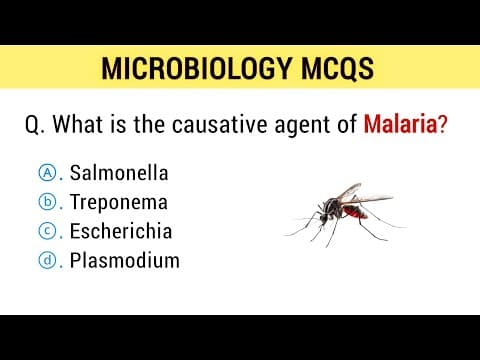
[11:18]The right answer is option A, Bacillus subtilis spores. Question number 43. The causative agent of malaria is:
[11:34]The right answer is option A, Plasmodium. Question number 44. Which enzyme do retroviruses use to replicate?
[11:49]The right answer is option C, reverse transcriptase. Question number 44. The phase where bacterial growth is stable without new division is:
[12:08]The right answer is option C, stationary phase. Question number 46. What is the main route of transmission for Hepatitis B? The right answer is option C, bloodborne. Question number 47. A bacterial cell structure that provides protection from phagocytosis is called:
[12:42]The right answer is option B, capsule. Question number 48. Which antibiotic is often used to treat tuberculosis?
[12:58]The right answer is option B, isoniazid. Question number 49. What are prions?
[13:11]The right answer is option A, misfolded proteins. Question number 50. Which bacterial genus is known for causing strep throat?
[13:27]The right answer is option B, Streptococcus.


