[0:03]Good evening and welcome everyone. Thank you for joining us. I am Megan Hurlbert, Associate Director in Exhibitions here at the Art Institute of Chicago. I started working on Gustav Kaibot painting his world in 2022 with tonight's speaker, and it has been a joy to see the exhibition come to life in Chicago. It is my pleasure to welcome you to the museum and to tonight's program. Gustav Kbot, artist as collector. This landmark exhibition reintroduces Gustav Kbot as a singular voice within impressionism, an artist who turned his gaze inward, capturing the intimate world of his family, friends, and everyday encounters. This program is generously sponsored by the Mary Sleman Lecture Fund. I'm happy to say that Mary Sleman is in the audience this evening, and we are so grateful.
[1:13]We are so grateful for her ongoing support of the museum. It is now my pleasure to introduce Megan True, who will present on Caybot's expansive impressionist collection, the impact that it had on his work, and the scandal that followed its donation. Megan is the curatorial assistant in the Department of Painting and Sculpture of Europe. She earned degrees from Butler University and George Washington University, where she specialized in 19th century French art. She has previously held positions at the Indianapolis Museum of Art and Newfields, the Smithsonian National Portrait Gallery and the Dallas Museum of Art. Megan will be starting a graduate program in the fall at the Corled Institute in London, England. We're grateful to recognize the John D and Alexandra C Nicholls Family Foundation for their lead support of Gustav Kaibot painting his world. Raymond James is the lead corporate sponsor. We thank them for their generous support. Now, please join me in welcoming Megan to the stage.
[2:30]Hello, everyone. Thank you so much for joining me here tonight.
[2:38]Gustav Kbot wrote his first will in 1876 when he was only 28 years old. His younger brother Rene had just died suddenly at only 26 years old, and this was only two, two years after the death of their father. And both of these losses deeply impacted Kbot. At such a young age, he was already thinking about his legacy and what he'd like to leave behind when he was gone. He had only begun exhibiting with the impressionist earlier that year, but he was already deeply invested in the success of the movement. He set aside a certain amount of money, uh, to hold another impressionist exhibition after he was gone and specified that he would like Edgar Dega, Claude Monet, Camille Pisaro, Pierre Gst Renoir, Paul Cezanne, Alfred Sicily, and Barrett Moiso to be included specifically, uh, others could join, but he specifically wanted those. Uh, and in addition to these funds for a future impressionist exhibition, Kaibot also stated that his collection of impressionist art be donated to the French state at the time of his death, writing, I give to the state the paintings that I own, only as I want the gift to be accepted and to be accepted in such a way that these paintings do not go to an attic or to a provincial museum but to the Luxembourg and later to the Louvre. It is necessary that a certain time elapses before the execution of this clause until the public, I do not say understands, but accepts them.
[4:15]This time can be 20 years or more, in the meantime, my brother Marshall, and failing him another of my heirs, will keep them. I ask Renoir to be my executor and to accept a painting that he chooses, my heirs will insist that he take an important one.
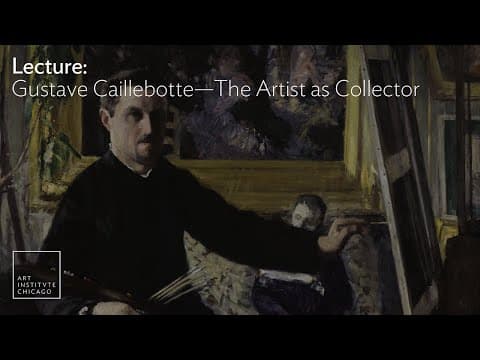
[4:34]The verbiage in his will is evidence that Kbot was not only thinking about his own legacy, but the legacy of impressionism as a whole. He knew that impressionism should be included in the canon of French art, and knew that it belonged not in an attic or a tiny little country museum, where they could kind of place it and hide it out of sight, but in the Louvre, the country's most prominent museum. To Kbot, his identity as a collector was equally as important to his identity as an artist. And we are able to see just how integral his collecting was to his sense of self in his 1879 painting, Self-Portrait at the Easel. This is the only self-portrait of Kbot, uh, that he made depicting himself at work. Uh, but while he shows himself in the act of painting something, he has his canvas angled away from us the viewer, so we can't see what he's working on. Instead, the focus is shifted to the large canvas behind him, uh, which is very identifiable as Pierre A Gst Renoir's Ball at the Moulin de La Gallette.
[5:52]And this painting obviously took pride of place in his home. He even enlarged the frame a little bit from what it actually was to really emphasize how important it was to him. If you look closely, you can see the frames of several other works that are just a little bit too indistinct to be identifiable, but we know that his collection was incredibly important to him and something that he kept very close to him.
[6:18]And Kbot, uh, began his collection actually before he even began exhibiting with the impressionists. So, he began studying art around 1873, and it was in 1875 that he began collecting a year before he would start exhibiting with the impressionists. And he started collecting in a little bit more of a traditional manner. Um, he started with works on paper, which were a little bit more accessible to beginning collectors. And so, he owned one work on paper, this drawing, uh, by Paul Gavarni, and two drawings by Jean Francois Miet. Both of these artists were kind of more in the realist vein. Their work was a little bit more acceptable at the time. And as I go through and kind of do a breakdown of the contents of his collection, you'll see that there are some that have this green highlight around them and some that don't. Those that are highlighted in green are works that were accepted by the French state after his death. Because as was alluded to earlier, there was a bit of controversy, uh, when this donation was made, and only some of them ended up making their way into the official French state collections.
[7:38]The next artist that he turned his attention to was Edward Manet, uh, who was an incredible influence on each of the impressionist artists. They considered him a precursor to the impressionist movement, and a lot of them, including Kbot and Dega, were always trying to convince Mane to exhibit with them. And Mane was never quite convinced that that was the right fit for him, but all the same, Kbot greatly admired him as an artist and would eventually own four of his works. Two of which he purchased from, uh, Mane's postus studio sale after his death in early 1884. Now, another artist whose style was quite different from Kbot, but he still viewed Cezanne as a very important innovator within the impressionist movement. He would own five paintings by Cezanne. Uh, these in particular were quite controversial when they were donated to the state. Uh, the vasive, or vase of flowers, there in the middle that's now in the National Gallery of Art was actually immediately struck from the list, um, by the French state. They were like, absolutely not. This is not quite our style. And of course, now it is in one of the best museums in the country. So, I'm sure they regret that move. And of course, we have eight pastels by Edgar Dega. Now, Kaibot and Dega famously did not get along very well. Uh, they both had very different ideas of what they would like the impressionist exhibitions to look like and what they would like the legacy of impressionism to be. Um, Kbot often wrote in his letters that he really admired Dega as an artist, but gosh, that guy is just not a good person. All the same, he owned quite a few, uh, Dega pastels, and at the time of his death, Dega's star was actually rising, and the museum wanted all of them.
[9:56]Um, and the one in the far, right over here, the Little Dancer is actually the work that Renoir chose for himself, um, as the executor of Kbot's will. And so, he ended up with that pastel, and it is now in the Metropolitan Museum of Art. And of course, he and Renoir were quite close. He was the, uh, godfather of Renoir's first child. And a big motivation for him as he was collecting was supporting his friends. He was born into independent wealth. Uh, he never had to sell his own work, he never had to market his own work, um, but he was in quite a different position than the other impressionists and he was very aware of that. Uh, Renoir, um, Monet and Pisaro in particular were struggling quite a bit throughout different portions of their career. And so, as they would hit a rough spot, Kbot would often, um, offer to purchase a work, but he was quite selective on what works he would purchase when. Um, in one instance with Renoir, his Study of a Female Torso in Sunlight there was actually included in one of the impressionist exhibitions and was a favorite to hate by the critics. Um, they absolutely loathed it. It got the most negative reviews out of any painting in the exhibition, and Kbot said, I will take that one. And now it's in the Musee d'Orsay, so, ultimately, it worked out. And Alfred Sicily, who is now kind of a lesser known impressionist, not quite on the same level as Dega, Monet, um, but Kbot really saw him as an essential member of the impressionist group. He always made sure to mention him and include him when they were planning the exhibitions, and their interests were actually quite similar. Um, you'll see a lot of the paintings that he owned of Sicily's were of the Sen River and sailing on the Sen River, which of course, were two of Kbot's great passions.
[12:10]And of course, he was very, very close with Claude Monet. He would not only purchase Monet's paintings directly from him for significantly more than they were worth at the time. He would also, um, assist him by paying the rent for studios and apartments as he was trying to just stay afloat in Paris and continue to practice his art. Um, and it's kind of amazing to think of we may not have as much Monet work as we do if not for Kbot supporting him. Um, and of course, a lot of these are now famous works. Um, we have one that's quite similar to some of his, um, series of the Gar Saint Lazare. We have one of those series that Kbot, um, really encouraged him to paint. And then finally, we have Pisaro. He actually ended up owning more Pissaros than any other artist. I think he was really taken by Pisaro's landscapes. Um, I think something that really spoke to Kbot as well as Pisaro was quite localized in his painting as well. Once he moved out to Pontoise, um, he really painted his home. And I think that resonated with Kbot, who if you've seen the exhibition, also stayed very close to his home. And with Pisaro, it's also quite interesting, he collected his first and only kind of more decorative piece with this fan here, which unfortunately was not accepted into his request and ended up in a private collection. And although a lot of, uh, Kbot's paintings from the late 1870s through the 1880s are set in the Boulevard Houseman apartment, which he shared with his younger brother Marshall. He really only gives hints at his collection aside from Self-Portrait at the Easel.
[14:17]You can see here that there is a hint of a frame up here in the, in the corner, there are a couple of other portraits where you can just see the bottom of a frame peeking through, maybe a hint of a painting. Um, but they really were very important to him. And interestingly, one of the best records that we have of his collection at the time he was alive is through his younger brother Marshall. Uh, Marshall married in 1887 and moved out of their home on the Boulevard Houseman into a nearby apartment on the Rue Screeb. And he became an amateur photographer in the early 1890s. We have a lot of pictures from him, um, in 1891, 1892. And these are pictures of the interior of his apartment. And what we can see from this is he not only had works by his brother Kaibot. We can see here, this portrait of their mother, um, in his home, but he also shared his personal collection of impressionist art with his brother.
[15:20]And we can see also in that room is Sicily's Brickyard Path. And it's quite interesting to kind of go through and see how anything in purple is work by Kaibot, anything in red is work from his collection of impressionists. And how it was really personal to the entire family. He was willing to share this and make sure that, um, everyone was had access to this art, and that was, um, a huge part of his ethos was being able to share the art of this movement that he was so passionate about. And so, here in Marshall's sitting room, we see a painting by Kaibot of the Seashore in Normandy. And then also, uh, Dega's ballet. And this, which we think is maybe the entrance to his apartment, you see a little corner of Monet's Regatta at Argantoy.
[16:19]And this here is a picture of his study. And in the corner there, you see a little bit of the Dance Lesson. And going back, unfortunately, maddeningly, not all of these are identifiable. I looked, and I looked, and I looked for this painting here, and could not find anything that matched up just right. So there are a couple mysteries throughout here, and maybe Marshall had his own collection that we don't have record of, but there are a couple outliers in there. And then here is Marshall's playing the piano. He was a composer. You see, uh, Miet's peasant returning with manure, very romantic painting drawing there. And then of course, Gustav did keep some of the paintings with him. So, this is, um, his kind of studio/workshop in his country home at Petite Geneve, which he moved to full-time after his younger brother married in 1887. And you see him here, he's working on a boat design. That was one of his passions at the end of his life, but you can still see how important art and painting was to him.
[17:37]And in the background, we can also identify Monet's Snow effect at Vitoy. And Dega's seated dancer massaging her left foot in the background there. And then this is a lovely little photo of what of his friends relaxing at his home. Um, you can see he displays these a bit haphazardly in his own home compared to his brother. If we go back to this as well, you can see canvases stacked up in the background here. We don't know if those are his own works, canvases that he's waiting to paint or just other other works that he hasn't hung yet. But even in, inside here, you can see a canvas laid up against the wall, which is quite interesting that he was a bit haphazard with those.
[18:30]But above the door there, we can see Mane's Lady at Her Window. Um, and I absolutely love that we can tell that it is in the same frame still, um, as it is at the Musee d'Orsay. And then curiously hung unframed is Monet's apartment interior. And then below that is Pisaro's Co Saint Denis at Pontoise.
[19:02]So, this is the entire Kbot collection. He, at the time of his death on February 12th, in 1894, um, he was only 45 years old, and he owned 72 works of art in his impressionist collection. And in March of that year, just about a month after his passing, uh, Renoir took control as the executor of his will and informed Henry Rouge, who was the director of the Cole de Boz Arts, of Kbot's bequest to the state. And later that month, the consultative Committee of National Museums, which included curators and directors from all of the state museums in France. So at the time, it would have been, uh, the Louvre, the Musee de Luxembourg, um, and the Cole de Boz Arts. They met to evaluate the collection and take a vote on the acceptance of the gift. So even in this meeting, as we are just starting out, there are some inconsistencies with the numbers. So, in the minutes of this meeting, only 60 of the 72 works are mentioned. Of course, one of those works was already taken by Renoir, and there were a couple that they kind of dug up as, as we discussed earlier, he was a little bit haphazard with his, uh, organizing. Um, so they were able to kind of find a couple of others later on as they were negotiating the acceptance of this gift. Um, but by the end of this meeting, 59 of these 60 works were accepted by the committee. And of course, that one that got knocked off was the, uh, Cezanne Vase of Flowers that they hated right off the bat. So, they, although they were accepted, there were still some term negotiation to do, and so it wasn't until April of 1894 that Marshall and Renoir were informed that the bequest was accepted. But at that time, they were also warned that, um, all of the works, uh, with the exception of the two Miet drawings, uh, would go to the Musee de Luxembourg, uh, which at the time was the museum for living artists. In order to be displayed in the Louvre, an artist had to be dead for at least 20 years. And at the time, Miet was the only one that fit that bill. Mane had not been dead quite long enough, or they may have taken him, but the rest of them were still alive, so it was a no go. Um, but the Musee de Luxembourg, because it was the museum of living artists, um, was quite crowded, as you can imagine. A lot of artists wanted their work in there, and it was quite difficult to find the space for such a large gift. And so, they were warned that they probably wouldn't be able to display all of them, especially at the same time, it would be broken up. And of course, uh, Marshall and Renoir were not happy about this. Um, they did not think that, although technically it may have followed the letter of Kaibot's will, it was not aligned with the spirit of his will. They wanted his collection to be seen in its entirety. And so, negotiations continued.
[22:36]Um, at this time, obviously, impressionism was still not accepted by the broader public. It was still considered quite a radical movement, um, and that complicated the negotiations a bit. There were people involved that did not think that these paintings were worthy of coming into the museums, especially as a full collection, uh, to be displayed together. And so, it took another year, but in January of 1895, a compromise was finally reached, stating that the French state would be able to acquire the works of its choosing from the collection, and the heirs of Kaibot would, um, retain the remainder that they did not choose. And so, at the time, the curator of the Musee de Luxembourg, uh, was Leonce Benedict, and he was charged with selecting the works.
[23:36]And he was actually quite progressive for the time and worked directly with Marshall and Renoir, as well as the artists that were represented in the gift, to kind of see which ones they would like to prioritize, making it into the museum, uh, which was actually quite nice at the time that they were able to kind of have a say into which of their works they thought would best represent them in the state museum.
[24:06]And so, eventually, 40 of the 72 works were acquired by the French state.
[24:15]So, the two Miet drawings did go to the Louvre, um, but the Luxembourg ended up acquiring two Mane paintings, two Cezanne paintings, six Renoir paintings, six Sicily paintings, seven Pisaro paintings, seven Dega pastels, and eight Monet paintings. And in the end, uh, most of the artists were quite happy with this compromise. They were happy that they got a little bit of a say in what was actually going up on the walls. Um, this, of course, uh, did not include Dega, who was quite upset that he, his works were going into a National Museum at all. Uh, he did not think that his work should be easily accessed by the public. So, that was a whole another thing, but it was thanks to Kbot that Dega's works were accessible to the public.
[25:08]But notably, Kbot did not include any of his own work in his gift. Uh, Marshall and Renoir, once all of these complicated negotiations were done, uh, decided that that really wasn't right and that he needed to be represented. And so, they went through his body of work and selected Floor Scrapers, which of course, was one of Kbot's most prized paintings.
[25:39]It was the first and only painting that he ever attempted to submit to the Salon, um, and then was quite celebrated at the impressionist exhibitions, as well as Few of Rooftops, um, to go into the, uh, French state's collection. So that he would be represented as an artist and not only a collector. Of course, his collection did overshadow his art for quite some time, but due to them, he was represented, and that was incredibly important to them at the time.
[31:19]In 2024, which was the 130th anniversary of Kbot's death, and luckily corresponding with, uh, the Orsay's presentation of Kbot, his collection that was accepted by the state was displayed together almost in its entirety. Uh, the Dega pastels weren't included, uh, because they were light sensitive pastels. Um, but always funny how he's always the outlier there. And this was the first time that they had been displayed all together like this, since they were hung in the Luxembourg in 1897. And so, I just think that this exhibit was such a great way to celebrate the achievements of this singular artist collector. And it really highlights his invaluable contributions to the legacy of impressionism. Thank you.


