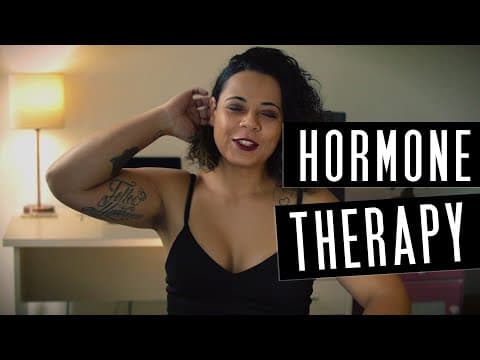
[0:01]After coming out publicly as a transwoman, I began my hormone replacement therapy, or HRT, and it's been one of the best decisions I've made for myself. I've never been happier and feel incredibly comfortable in my own skin. However, the process wasn't easy. There was a lot of learning I needed to do by myself as I was navigating this experience alone. So I thought I'd make this video about how I went about getting on HRT, and how you or your friends and loved ones could do the same with less difficulty. Okay, so before we talk about how you can actually go about getting on hormone replacement therapy, I thought it important just to talk around some of the important things about what it means to be on HRT, its importance, and a little bit about our healthcare system in South Africa.
[0:53]So without going into too much detail, hormone replacement therapy is effectively substituting or supplementing the existing sex hormones in your body in order to achieve a particular result. So for trans people specifically, hormone replacement therapy can be a useful tool in bringing one's gender expression in alignment with one's gender internal identity. Again, in the trans specific context, there are two main types of hormone replacement therapies. The first is masculinizing hormone replacement therapy, and two is feminizing hormone replacement therapy. Guys, of masculinizing hormone therapy, it will produce a number of masculinizing hormone effects. That would include things like growing facial hair, a slight broadening of the shoulders, more muscle density. In the case of feminizing therapy, uh, this often involves a softening of the skin, uh, fat redistribution, and also the growing of breast tissue. So different people might want to go on hormone replacement therapy for a number of reasons. However, it is vital and important to keep in mind that how somebody presents in their gender expression has no bearing on their gender identity. Again, in a trans specific context, no one needs to validate their transness by undergoing any form of hormone therapy or any kind of surgical intervention. So with that said, why is HRT important? So for trans and gender diverse persons, hormone replacement therapy can be a critical intervention in aligning a person's internal sense of who they are with their outward expression. So in order to talk about that, we have to talk about two things very, very quickly. The first is gender identity, and this is how you feel internally about yourself in terms of your gender. This is your own deep sense of who you identify and how you identify yourself. The second is gender expression. Now, gender expression is how you manifest your physical appearance to the outside world and how you present yourself. A person's gender expression might have nothing to do with their internal sense of who they are. Gender expression and gender identity are not one and the same thing. Somebody can have a very internal feminine sense of self, but then can express that in a very, very masculine type of way. Likewise, somebody can have a masculine internal sense of self, but present themselves in a very feminine kind of way. It's important to note that why I'm talking about these concepts in terms of masculine and feminine, it's very important to keep in mind that gender identity and gender expression exist on a spectrum. They can identify themselves on a number of different levels on that spectrum, and they can also exist outside that spectrum. It is impossible to tell what somebody's gender identity is from by just by looking at them, because people present themselves in a spectrum of ways and identify themselves in the same way on a spectrum. So it doesn't mean that because somebody identifies as being trans, or somebody identifies as being non-binary, that in order for them to identify as such they need to qualify that by taking masculinizing hormones or feminizing hormones or doing certain kinds of surgeries. No one needs to qualify their gender identity through external means, people are who they are and those experiences are completely valid. So now we've got that out of the way, how do you go about accessing hormone replacement therapy? So in order to understand how you can access HRT, one of the things we need to talk about is the pathologization of trans bodies. So effectively to pathologize something, means to treat it as if it is medically abnormal. And so for trans people, for a very, very long time, we had been pathologized by the medical fraternity in a number of derogatory and extraordinarily problematic way. Effectively trans identities and homosexuality were previously classified as being mental or psychological disorders. And people viewed these identities as something that could be cured or something that could be fixed. So homosexuality and trans identities are no longer classified as being mental disorders. However, trans people still face a very deep pathologization when we want to access things like hormone replacement therapy or surgical intervention. So part of this reason is because of the way our medical establishments are set up to diagnose and therefore treat certain conditions, or to provide medical care to certain people. And one such way that the medical fraternity identifies how there is a potential issue is by looking at what is called the ICD 10 code. So ICD 10 stands for International Classification of Diseases, the 10th version of it. From time to time, the classification does get reviewed and then adjusted and adapted, and then we come out with a new version, so the next one would be the ICD 11. So if you are attempting to access hormone therapy, the ICD 10 becomes absolutely crucial, especially for the state, because there are a number of medical procedures that are put in place in terms of how they administer and deliver their medical treatment to their clients or their patients. And the ICD 10 forms a big part of that. And in order for you to access HRT through the state, you need to be diagnosed with what is called gender dysphoria. So gender dysphoria is something that a person experiences when there is a mismatch between their gender identity and the sex that they were assigned at birth. So in the case of trans people, this is the mechanism that medicine uses in order to provide treatment for that distress. So when I started my HRT, I did mine through the state. And that was a very, very difficult and very grueling and very intensive process. If you're wanting to access hormone replacement therapy through the state, there effectively three steps that you need to take. The first is that you need to see a psychologist or psychiatrist. Effectively this person is going to diagnose you with gender dysphoria. They can then refer you to somebody who is able to assist you in the relief of that gender dysphoria. The person that they're going to refer you to is an endocrinologist. So the second thing that you need to do is to see the endocrinologist. So an endocrinologist is a medical specialist who deals specifically with hormones. These specialists often treat things like diabetes or thyroid disorders, and so they are the people that the state is going to assign to you in terms of managing your hormone levels and getting on HRT. So the endocrinologist will do a physical exam, they'll draw your blood, and they'll also explain to you what it means to be on HRT and what you can expect from the process. So please note that if you are doing this through the state, at your first visit at your endocrinologist, you will not get your hormones. This is because they need to evaluate your bloods to make sure that it is safe for you to go on hormone replacement therapy. They do this by taking your blood so that they can establish a base level of what your hormones are like in your body at the time pre-hormones. And so that they can monitor your process all the way through to see what impact the hormones are having on your actual physiology. And so this also means going for blood tests quite regularly, but we'll get to that a little bit later. So you've gone to see the psychologist, who's referred you to the endocrinologist, and now you're awaiting the results for your blood test before you can go on hormones. Once your blood gets back from the lab and the endocrinologist has had an opportunity to evaluate those bloods. They will then recommend whether or not it is safe for you to go on HRT. If they give you the green light, then everything is fine, and you will start your hormone replacement therapy. So the hormones that the state prescribes are oral medications. So in the case of feminizing hormones, the state will prescribe two types of oral medication that you need to take daily. The one is a blocker and the other is a synthetic form of estrogen. They'll always start you on a lower dosage and incrementally move you up as your body becomes more accustomed to the hormones. So once you're finally on HRT, you then go home, you take your medication as instructed, and you'll have to go back for regular blood tests in order for them to monitor your progress. So this is important. You have to be patient. Because this process does take some time, and there are amazing doctors and healthcare professionals that are doing their best to serve their communities, but the public health system is incredibly overburdened. So the process of getting on HRT does take some time. You have to see the psychologist in order for them to refer you to the endocrinologist, and then the endocrinologist will have to draw your bloods, evaluate you, and then only once you come back, can they recommend that you start. So for me, when I started this process, between seeing the psychologist and actually getting on HRT, it took me roughly about six to nine months in order to access those hormone replacement therapies because the state was so incredibly overburdened. So if you are doing this through the state, you need to be patient. So I've been doing my hormone replacement therapy through the state for a number of years, and so the process became incredibly triggering for me over a period of time, and so I made the decision to move from the state and go to private. So the thing about accessing hormones in the private space is that you have to jump through way less hoops and you get access to your medication a lot quicker and a lot more efficiently. And not to mention that if you find the right healthcare provider, the whole process will be less triggering and less stressful altogether. So moving over to private healthcare for my medical transition had been one of the best decisions that I've made for myself. So the hormones that I've been prescribed by my private doctor has been an injectable medication as opposed to an oral one. The injectable medication has worked much better for my body than the oral medication that I was on previously. It seems to be more effective for my body and doesn't carry the same level of risks and side effects that the oral medication does. So one of the upshots about going private was that I no longer needed to take off an entire day to sit in a queue in order to get my medication from the state. So it's important to remember that blood tests do cost quite a bit of money. So even if you are doing this through the state, the state will make use of the National Health Laboratory services to process that blood, and the National Health Laboratory services will get in contact with you in order to settle their accounts with them. And if you are going private, you are also covering the cost of the blood test yourself. So just to note that if you are on a medical aid, all of the costs will come out of your medical savings. And if your medical savings then runs out, you will have to fork out the cost for your doctor's consultations, for your medication, and for your blood tests. So I know that that was a lot of information and it might take you a little bit of time to digest it, but I just want to say that going on hormone replacement therapy was the best decision that I had made for myself. I feel so good and so comfortable in who I am. I would recommend to anybody thinking about going on HRT to consult with their physician, consult with their doctor, and I would recommend that you try and start HRT as soon as you possibly can. If you have any questions, please feel free to drop them in the comments below, and I will do my best to answer them. Thanks for watching. Ciao.
[11:13]Are we rolling? I don't even know what I mean Yeah, I think we're done. You do not know how difficult it is to shoot yourself while you're giving yourself an injection. Yeah.


