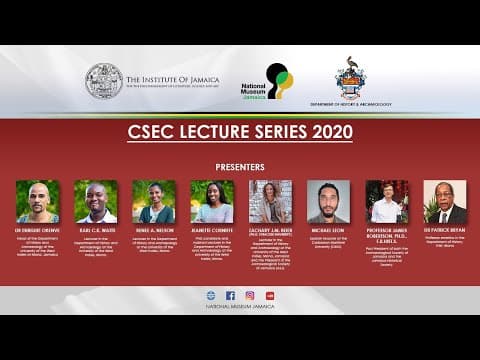
[0:10]Hi, morning everyone and thank you for tuning in to our CSEC lecture series for today. Um, this lecture series is a collaboration with the University of the West Indies, History and Archaeology Department, and the Institute of Jamaica. My name is Alexis Mac David and I am an outreach officer with the National Museum Jamaica Division, which is a division of the Institute of Jamaica, which is an agency of the Ministry of Culture. So, thanks again for tuning in today, and let's just get right into it. I would like to introduce today Dr. Renee Nelson, Dr. Renee Nelson is a lecturer in the Department of History and Archeology at the University of the West Indies, Mona. And her research interests include Caribbean regionalism, social history and digital history. So, thank you Dr. Nelson for joining us today and her theme is Caribbean political development up to 1985, The West Indies Federation, 1958-1962. So, Dr. Nelson, um to kick off, what was the West Indies Federation? Okay, the West Indies Federation was a political and economic block that existed between 1958 and 1962 comprising 10 British West Indian territories. These were Jamaica, Trinidad and Tobago, Barbados, Antigua, St. Kitts, Nevis, Anguilla, Montserrat, Dominica, St. Lucia, St. Vincent and Grenada. The coming together of these territories was born out of the desire by a war-ravaged Britain to reduce the burden of operating a vast colonial empire after the Second World War. And coupled with demand by West Indian nationalists, the colonies were encouraged to form a political union to manage their own affairs independently in the changed reality of world affairs brought on by the war.
[2:24]What is the background to this federal experiment? Well, the idea of Federation wasn't um, something new. Attempts at grouping the islands together for administrative and economic efficiency were pursued from the inception of British presence in the region. The territories in the Eastern Caribbean mainly experienced this, influenced by the close proximity of the islands involved.
[2:58]It was in the nineteenth century that most systematic efforts were made. Notably, we had the Leeward Islands Federation (1871-1956), which comprised Antigua, St. Kitts-Nevis-Anguilla, Montserrat, the British Virgin Islands, and Dominica until 1940. And they were administered together between 1871 and 1956. But not all attempts at grouping were welcomed such as in the case of the attempt to include Barbados in a federal union with the Windward Islands, which comprised Grenada, St. Lucia, St. Vincent, and Tobago until 1889. And um, this attempt was strongly resisted by local opinion in Barbados, which manifested itself in the 1876 Confederation Riots. But Barbados, nevertheless, um, retained joint governorship with the Windwards until 1885. Now, Jamaica was part of another administrative effort, being grouped with the Turks and Caicos and the Cayman Islands, which were all under its jurisdiction. And it was not until the interwar years of the early twentieth century that the possibility of Jamaica being federated with the wider British West Indies was actually considered. So, the dawn of the twentieth century now brought with it the aptly described tradition of 'Federation by conference' in the British West Indies. This referred to the numerous regional conferences on various matters initiated by special interest groups voluntarily working together without political obligation, which increased in frequency after 1931. Of special note is the 1932 Roseau Conference in Dominica whose discussions included a self-governing Federation of the Eastern Caribbean with Dominion status. The 1930s region-wide labor riots now resulted in the Report of the West India Royal Commission, also known as the Moyne Commission. And one of its conclusions was that the territories needed to be federated in order to address the ills experienced, but um, while the impression of the report was that local opinion at a woken to the possibility of Federation, it noted that the time was not yet right for such proposals from Britain. A further outcome of the Report was the establishment of the Development and Welfare Organisation in 1940 which held several inter-colonial conferences to discuss area problems and mutual solutions under regional advisors. The regional advisor for the British West Indies was stationed um in Barbados. And it is important to note that the presence of this organization actually prepared the Colonial Office and the colonies to see the West Indies as a single unit, you know, whose common problems could be addressed by joint action. Now, the case for self-government through federation was stalled by the outbreak of the Second World War in 1939, whose occurrence in turn fueled it. As the war itself, um, necessitated the increased working together of the British West Indies as a regional outpost of Britain, volunteering in like the armed forces and other associated activities, as well as pooling together um because of supply shortages, so this um thereby created a regional mindset. Also contributing to this regional mindset was the Anglo-American Caribbean Commission, established in 1942 to encourage and strengthen social and economic cooperation between the United States and its possessions and bases in the Caribbean and Britain and its colonies in the same area.
[7:18]The Commission advised on problems affecting the region, meeting in different Caribbean territories. It was later reorganized to include delegates um from the Dutch and French territories as well as local um representatives. And um it basically provided considerable stimulus to the federal idea because everyone was working together now. There was also increased local push, at the same time when all of this was going on, to integrate agricultural, medical and other services throughout the area. And there was increasing interest developing among um business, professional and other groups, whose influence strengthened the argument for political unity. Among these was the Federation of West Indian Civil Servants, which was the second regional organization created by public servants following the Caribbean Union of Teachers in 1935. Now, West Indies Federation increased in topical significance when Secretary of State for the Colonies, Oliver Stanley, he issued a dispatch in 1945 to all the territories to consider the possibility of political unity and to determine the climate of public opinion on the matter.
[8:44]Because one of the things we need to realize is that Britain wasn't willing to impose federation on any of its colonies. Britain wanted the colonies to decide on it themselves, so the dispatch generated much press and public opinion throughout the territories, sections of which began to view political union favorably. But 1947 was the momentous year. Not only were there discussions um by several interest groups on how to achieve closer association in the region, such as in agriculture and shipping, but more significantly was the Montego Bay Conference, um, which proved essential to the formation of the West Indies Federation 11 years later. Most of these discussions were regular meetings that developed over time and all were part of the established pattern of regional collaboration in the area. And the fact that so many were held in one year was not without significance, as this indicated that the region was ripe for more permanent ties. At this juncture then, the Montego Bay Conference served to probe the possibility of formalizing functional cooperation with political unity, and West Indian public opinion was more than ready for the Conference. So, how did this Conference come about? Um encouraged by the reception to Stanley's um dispatch, the new Secretary of State for the Colonies, Arthur Creech Jones, he proposed the conference to discuss closer constitutional, political and economic association, debating the advantages and disadvantages of union. And presided over by him, all British West Indian colonies except for the Bahamas attended. The conclusion of the Montego Bay discussions now witnessed the agreement by most territories on an economic and political federal scheme. And between 1948 and 1957, while the scheme was being worked out, the move towards Federation was nurtured by increasing attempts at regional cooperation. Including the establishment of the University College of the West Indies, now the University of the West Indies. Which was viewed as a beacon for regional unity. And as the glue that held the region together by encouraging increased contact and cooperation and promoting a West Indian identity, thereby becoming a breeding ground for West Indian consciousness and nation-building. And the University was viewed as laying the foundation for an independent British West Indies and as a means of strengthening and maintaining political federation, not only by its physical presence, but also by the enlightened thinkers that its doors would release, and by its crucial role in creating opportunities that would economically liberate the region. And as a matter of fact, there was a belief that education as a means to forge unity within the region should transcend all levels: primary, secondary and tertiary. A suggestion was even made that one of the best avenues to make Federation a reality was the large-scale movement of teachers between West Indian schools, a common curriculum, and standardized training. Various groups and organizations as well took it up themselves to amalgamate in areas such as agriculture and sports, and even among the youth and women of the region was union encouraged to bring them closer together. So for many people then, a West Indies Federation was seen as a mere formality joining scattered territories that had been collaborating in different ways for many years. Now, official preparations for the establishment of the federal structure occurred between 1948 and 1957, as previously mentioned. There were four conferences involving representatives from various colonies and British officials, as well as four commissions and five debates involving West Indian legislatures. Among the issues hammered out were the federal constitution, federal legislature, financial and judicial aspects of the union, and the location of the Federal capital, which eventually went to Trinidad and Tobago. And Federation formally came into existence on January 3, 1958. Federal elections were held on March 25 and contested by the West Indies Federal Labour Party and the West Indies Democratic Labour Party. The former party was victorious and formed the federal government. And Barbadian, Sir Grantley Adams, he became the first and only Prime Minister of the Federation, and the Federal Parliament was opened on April 22, 1958. Now, together with Adams, Jamaica's Norman Manley, and Sir Alexander Bustamante, and Trinidad and Tobago's um Dr. Eric Williams were the most important personalities during the life of the Federation. Okay, well thank you Dr. Nelson for giving that overview of the movement towards Federation and the British West Indies. What explicitly then was the reasons for forming the Federation? What were the reasons? All right. One was impetus from Britain. As mentioned in the beginning, Britain came out of the Second World War economically diminished and it had a vast colonial empire to oversee. And granting granting um independence to interested territories was a means of recovery. But in the case of the British West Indies, Britain encouraged federal unity because it felt that the colonies were too small to be economically viable on their own. And as a group, the British West Indies could better navigate the post-war era. But even before the end of the war, there was pressure on Britain to start um decolonizing its territories, including calls from its allies in the war and by Indian nationalist, Mahatma Gandhi. As well, Britain could not ignore the findings of the Moyne Commission, um mentioned previously, and it was also taking note of the developments in regional cooperation in the area. A second reason for federal unity was the growth of West Indian nationalism. For West Indian nationalists who longed for self-government and independence, Federation was seen as the principal means of achieving this. And this sentiment gained momentum after the labor riots of the 1930s with the emergence of labor and political leaders. And the granting of independence to India in 1947 further encouraged nationalist sentiment. A third reason for federal unity was that important constitutional changes were being made in the British West Indies, such as Jamaica being the first to move from the Crown Colony system to a fully representative constitution with universal adult suffrage in 1944. An important factor as well towards the development of Federation was the acknowledgement of the similarities of the territories in the region, such as a common historical background, language, laws, economy. So, some major benefits of Federation then were political independence, increased clout and bargaining power in the international arena, and combining resources and ideas to tackle economic and social um issues experienced by the territories. So, now that you've outlined um all the reasons um for and the benefits of the Federation, what were some of the challenges of it? Okay. Despite its um ambitious beginnings, Federation was destined to live a short life. As historian Franklin Knight described it, Federation was born in strife and rivalry. Many reasons were put forward for this, not the least of which um was conflict between political personalities over various aspects of the operation of the union, such as the federal constitution, freedom of movement, federal taxation, customs union, and the location of the Capital site. Now, Jamaica, whose position within the union was always shaky, was often at odds with Trinidad on issues such as the time frame for dominion status and on the role um that the federal government should have. Um for instance, Jamaica insisted on the federal government having limited input in its affairs, while Trinidad was um reluctant to open its borders indiscriminately to the other units. And Jamaica was the territory that was most vocal against customs union. The economic and industrial development of the island in the mid-50s led the government to advocate deferment after 1958 to protect its growth. And with Jamaica's um request for increased representation in the federal parliament also, there were fears in the Eastern Caribbean of the island dominating the union. So, the major conflicts we had emerging here was over whether the Federation should have a weak um central government versus a strong central government, unrestricted movement among the territories versus unit control of such movement, phased in customs union versus immediate customs union. And additionally, the refusal of British British Honduras and especially British Guiana to join the union added to its problems. Now, this bickering between the leading political figures eroded pro-federal sentiment for many people. And pro-federal sentiment was also weakened by the reluctance of the key or the chief politicians responsible for the federal negotiations in five of the ten territories refusing to stand for office in the federal Parliament in um early 1958. Of particular note is Norman Manley, as one of the staunchest federal supporters still in office um since the Montego Bay Conference, and highly regarded for his political astuteness and commitment to the political destiny of the West Indies, Manley was expected to have been the first Prime Minister. But his decision to remain in Jamaica as Chief Minister in order to further um the island's development and counter the growth of anti-federal sentiment there was shocking and mainly unpopular outside of the island. Added to these problems facing the Federation was the fact that the opinion of the West Indian people was never consulted in the creation of the federal structure, and this negligence was especially exploited in Jamaica. An official mass-based drive towards creating support and acceptance of the Federation only began in 1957, one year before the Federation came into operation. And this was done with the Federal Information Service, which was the public relations organ of the Federal Government. However, sufficient time and resources was not on its side. Its important and far-reaching role was cut short by the demise of the Federation, the immediate trigger being the 1961 Jamaica Referendum, which resulted in the island withdrawing from the Federation. In this regard, anti-federal sentiment among some sections of Jamaica's political elite exploited the previous mentioned fractures in the federal scheme. And Jamaica's internal political um struggle took on a decidedly federal character. Whereas Manley, who was in power, was willing to support the Federation when concessions in favor of Jamaica were agreed to, Bustamante, leader of the opposition was against it, and he challenged Manley um to the referendum, where the people of the island would actually decide on the issue. So what followed was a vigorous referendum campaign, which was conducted from mid-June to mid-September 1961 with pro-federalists arguing for continued inclusion in the Federation, and anti-federalists for Jamaica's secession and individual independence. Contemporaries at the time observed that the campaign of the politicians um generally appealed to party politics as opposed to pertinent West Indian issues among party supporters. But a survey of newspaper coverage of meetings actually revealed that's you know, there were speeches on pertinent, you know, aspects of the federal structure.
[22:24]But the vote was Jamaica out. And this negative vote, now, this negative vote against Jamaica's continued participation in the Federation sent shock waves throughout the territories. And basically the referendum ended up being the proverbial um straw that broke the camel's back. And with Jamaica's exit, Trinidad and Tobago now saw the burden of the federal effort falling on its shoulders, and decided to leave the Federation as well. And this basically ensured the dissolution of the Federation. And Jamaica went on to independence on August 6, 1962, and Trinidad and Tobago on August 31 of the same year. The other territories, under the leadership of Barbados, they tried to continue on as the Little Eight, but to no avail. Um this attempt, which failed to meet um popular approval in some territories, fizzled in 1965 with Barbados's decision to seek independence on its own, which it achieved on November 30, 1966. So, in concluding, the West Indies Federation lasted only four and a half years, coming to an end at midnight, May 31, um 1962 and leaving in its wake a failed model of regionalism. And while Economist Arthur Lewis surmised that poor leadership, rather than internal problems, destroyed the political union, and Gordon K. Lewis that it was concerned with form, rather than function. Franklin Knight argued that the fundamental cause laid in the competing forms of nationalism among the islands. And um although short-lived, the federal experiment, nevertheless, left the idea that some sort of integration was still necessary for the territories um concerned, later manifested in the Caribbean Free Trade Association, CARIFTA, the Caribbean Community, CARICOM, and the CARICOM single market and economy, CSME. Okay, wow, well thank you so much Dr. Nelson for that presentation. Um, I certainly learned a lot about the Federation that I did not know before. And also thank you for everyone for tuning in today, and please follow and subscribe to all of our social media platforms, the Institute of Jamaica, National Museum Jamaica, and of course, the University of the West Indies, Department of History and Archeology. So, thanks again and please stay tuned for our next episode. Bye.


