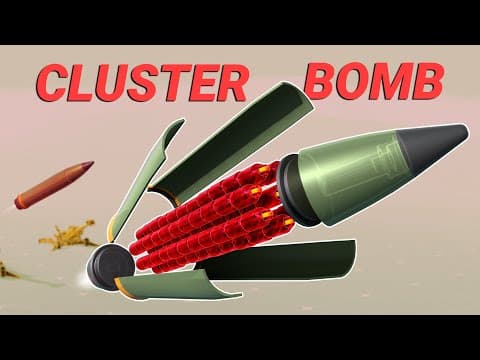
[0:01]A cluster bomb is a type of weapon designed to release multiple smaller explosives, known as submunitions or bomblets across a wide area. These bomblets are usually unguided and scatter over the target zone due to the momentum of the main container and the influence of wind. The cluster munition unfurls its ribbon indirectly semi-arming the shaped charge. Is it at this stage that it becomes a lethal weapon and the inertia weight takes action to detonate the grenade. The United States, Russia and Iran are among the few countries known to use these weapons. We will also be examining the advantages and disadvantages regarding the devastating consequences of this weapon. All in the video ahead. Let's dive into its parts and functions. Starting from the back, this is the base burn assembly. Just above it is the propellant added to create extra thrust to reach an estimated range of 29.4 km and 18.3 miles. This is the base of the artillery. It can stack 88 M42 or M46 grenades. That's a lot of firepower packed in this small little artillery. But how can you stack 88 cluster grenades in one artillery shell? If you turn the grenade upside down, it's actually hollow from the bottom. This was designed to fit the shaped charge. It was also one of the reasons they were able to stack 88 grenades one after the other just as shown here in the animations. Just above it is the pusher plate, which is connected to this expulsion charge cup required to eject the grenade. Finally at the top is the fuse often used to arm the artillery shell for different variety of detonations. It has a length of around 937 mm from the tip to the base of the artillery shell. While it has a diameter of 155 mm, that is one of the standard rounds for NATO artillery calibers. It weighs 46.5 kg, which is pretty heavy considering its size and the 88 grenades stacked inside it. If there's any confusion, this is the size when compared to an average human. This firepower needs a platform to deliver to its designated target. The answer is this 155 mm Howitzer and the self-propelled Paladin gun. The Paladin is armed with a 155 mm Howitzer fitted with a semi-automatic loading system. It has a maximum range of fire of around 24 km with standard projectiles and 30 km with rocket-assisted projectiles. While the maximum rate of fire for this self-propelled gun is four rounds per minute. But in this video, we will be focusing on how it is fired from this 155 mm Howitzer built in the 1970s, often referred to as the King of Battles. This artillery can be divided into five basic parts. Number one, the barrel required to fire the 155 mm shells. Number two, the recoil system, which is required to absorb the force when fired. Number three, firing platform and the traverse handle. Number four, this is the breach ring built with the highest quality steel and materials. Number five, here comes the loading tray to load both the shell and the propellant. Number six, just above it is the firing handle. Number seven, a lanyard to pull from a certain distance for safety purposes to ignite the propellant charge. Number eight, this is the trail system required to keep the gun stationary on the ground when fired. Now that we have understood its parts, let's fire this gun in these super simplified steps. Step number one, once the fuse is verified, the shell is loaded on this receiving tray. Step number two, here the shell is manually pushed by a soldier, inserted with this curve-looking object. Step number three, a small propellant charge is inserted just after the verified round was loaded. Step number four, the tray comes back up to make space for the breach ring to close. Step number five, all set and done, the soldier pulls the lanyard. Triggering the primer to fire the propellant charge required for this dual-purpose improved conventional munition. This will propel the shells to a maximum range of fire around 24 km with standard projectiles and 30 km with rocket-assisted projectiles. Now that we've cleared that out, let's examine the basic step-by-step process once fired. The fuse assembly activates the explosive charge. The expulsion charge pushes this plate.
[4:46]The outer casing detonates releasing the M42 grenades as shown in this animation.
[4:56]As soon as it's expelled, a nylon-ribbon stabilizer kicks into action. This stabilizer extends and positions the grenade perfectly, getting it ready for its next moves. But that's not all, due to some clever engineering, the rotational forces at play start unthreading the threaded firing pin from its weight, making the grenade semi-armed. And as the firing pin is pulled out of the slide assembly, things start getting even more interesting. Step number five, this is where arming the grenade takes place. Now pay close attention. With the firing pin out of the way, the slide assembly becomes free to move. It's like a well-choreographed dance, all thanks to the slide spring and some centrifugal force. These two work together to smoothly move the slide assembly into the armed position. The slide spring ensures that the assembly stays in this fully armed state. Impact and detonation. Fast forward to the impact. This is where the chaos happens. When the grenade hits its target, a specially designed inertia weight takes action. This weight drives the firing pin right into a detonator known as the M55, setting off the firing train. Step number seven, at the firing train ignites, get ready for a spectacular display. A shaped charge jet is propelled downwards, while the body of the grenade bursts into a multitude of tiny fragments. Think of it as a controlled explosion that delivers some serious firepower. This jet is incredibly powerful, capable of penetrating around 2.75 inches of solid armor plate. That's some serious punch, destroying tanks and light armor vehicles. The fragmentation of the grenade body creates a devastating anti-personnel effect. Those tiny fragments we talked about earlier, while they become lethal projectiles causing havoc within their radius. It's a smart design that adds an extra layer of effectiveness to this powerful weapon. First up, let's talk about the potential advantages of M42 cluster bombs on the battlefield. These cluster bombs or some called dual-purpose improved conventional munition are strategically designed to cover a wide area with smaller sub grenades. But folks, we cannot ignore the serious downsides to M42 cluster bombs. Let's break down the major concerns. Indiscriminate nature. This is a big one. Critics argue that M42 cluster bombs lack precision, releasing submunitions over a wide area including populated regions. This indiscriminate nature poses a significant risk to civilians, including children. Those unexplored submunitions, they can remain hazardous for years, causing civilian casualties and hindering recovery efforts long after the conflict is over. Potential unintended consequences. Last but not least, the wide area of impact can spell trouble. M42 cluster bombs could lead to unintended consequences like harming friendly forces, damaging critical infrastructure or even displacing civilians. This is how we make original 4K 3D animation from scratch in Blender open-source software with two animators working on it full-time. Do subscribe and light up the comment sections.


