[0:00]This is Australia, an island nation straddling the Indian Ocean basin and the South Pacific. Once a colony of the United Kingdom, the country began its move towards independence in 1901. Today, the Commonwealth of Australia encompasses the mainland of the Australian continent, Tasmania, and more than 8,000 other islands in the continent's surrounding waters. It may appear remote, arid, and desert-like with a sparse population filling up the mainland, but it boasts one of the most successful economies in the world. Australians are among the world's wealthiest people on a median per capita basis, ranked fourth in the Global Wealth Report 2022. Australia had a very impressive run, experiencing its first recession in almost three decades after COVID-19. That is why it's often called The Lucky Country. Three big lessons can be learned from Australia: Be smart, be organized, be lucky. So the advice for other countries is to try and be as lucky as Australia. However, luck alone does not make a country rich. So how does Australia become rich? That luck has to do with Australia's treasure trove of natural resources: iron ore, coal, gas, and gold. Australia is on the other side of the world, sitting on tremendously valuable minerals. It is the world's largest exporter of iron ore. In 2023, Australia exported approximately 895 million tons of iron ore, which constituted about 56% of the global seaborne trade of iron ore. The value of iron ore exports was around 110 billion Australian dollars, making it one of the most significant contributors to Australia's export income. Australia has just been through one of the biggest mining booms in its history, particularly during the early 2000s and into the 2010s. This boom, driven by high global demand for minerals and energy resources, particularly from rapidly growing economies like China and other Asian countries. China's rapid industrialization and urbanization created an insatiable demand for raw materials. Australia's iron ore exports to China increased dramatically during this period. For instance, in 2000, Australia exported about 88 million tons of iron ore. By 2014, this figure had skyrocketed to over 700 million tons annually, driven by China's steel production boom. This mining boom increased Australian living standards substantially. By 2013, the boom is estimated to have raised real per capita household disposable income by 13%, raised real wages by 6%, and lowered the unemployment rate by about 1.25 percentage points. However, not all parts of the economy have benefited. The mining boom has also led to a large appreciation of the Australian dollar that has weighed on other industries exposed to trade, such as manufacturing and agriculture. But the effects within manufacturing are quite diverse. So say you're an engineering firm that is producing equipment for the mining companies, you were doing very well. If you were an import competing company like textiles, clothing, and footwear, you will be hurt very badly by higher exchange rates. Australia as a whole was the winner in the mining boom. The timing of this boom was very auspicious for Australia because just as the rest of the world was hit by the global financial crisis, their economy suffered and their unemployment rates went up. The boom in Australia was so powerful that it overrode that effect. As a result, Australia escaped the financial crisis and was one of the very few countries that managed to do so. If we take a broad historical view and go back to the gold rushes in the 19th century, one of the lasting impacts of these mining booms is that they attract a lot of people to the country. When the mining boom is over, most of them stay. The size and nature of the economy shift as a result. The same thing has happened this time around. Australia has had very, very large migration flows over the last decade, which were largely unanticipated, mainly around education and skills. But nevertheless, those increases would not have occurred if they had gone through the global financial crisis. The last decade is possibly as worth noting as World War II and the depression in the 30s. It has been an exceptional decade and a half. Paying your tax cuts, the Treasurer, of course, would say it's all about strong economic management, but the truth is all about another incredible economic boom. The boom in China.
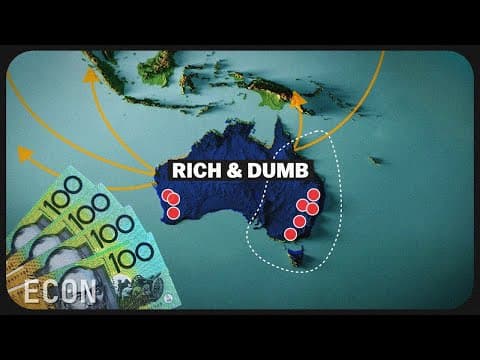
[4:41]For decades, successful mineral booms, iron ore, coal, gas, and growing Asian demand have underpinned economic activity. The resource curse, more like a blessing for Australia. The term resource curse, also known as the Paradox of Plenty, refers to the phenomenon where countries rich in natural resources tend to experience less economic growth, less democracy, and worse development outcomes than countries with fewer natural resources, such as most of Latin America and Africa. However, Australia has largely turned this potential curse into a blessing. Australia has well-established regulatory frameworks that govern the extraction and export of natural resources. These frameworks ensure that resource extraction is conducted responsibly and sustainably. Transparent processes in awarding mining licenses and managing revenues have helped prevent corruption, a common issue in countries suffering from the resource curse. Unlike many resource-rich countries that rely almost exclusively on their natural resources, Australia has a diversified economy. While the mining sector is significant, the country also has strong agricultural, manufacturing, and service sectors. Another reason behind Australia's economic track record lies in its immigration policy. Since the late 1990s, Australia has seen growth in temporary migration, with many arriving in the country on student or temporary work visas. The number of temporary migrants peaked in the year 2000. However, a recent change to immigration law in 2018 gave visa applicants more hurdles to overcome if they wanted to come to the country. Even when average incomes, as measured by GDP per capita, aren't rising significantly, the total GDP continues to rise due to the increasing population. This means that immigration is one of the key factors contributing to an economic growth rate of 3% to 4%. Much of this growth is underpinned by a faster-growing population. For most developed nations, population growth is so slow and steady that it hardly matters over a short-term time horizon. Not so for Australia. Australia's population has grown by nearly 45% since 1991. No other major developed country even comes close to that rate. Unlike similarly fast-growing countries in Africa and the Middle East, Australia doesn't have a particularly high fertility rate. In fact, the rate is well below the replacement level required to keep its population stable. The majority of Australia's population growth comes from immigration. In turn, Australia's so-called economic miracle is based on immigration as well. Australia's economy, while developed and prosperous, is not considered a global economic giant like the United States, China, or the European Union. So why is the Australian economy not a giant, and what economic problems could impact its future growth and stability? By any measure, Australia's geography suggests it couldn't be an economic powerhouse. Yet, few ever talk about it in such terms. By purchasing power parity, its economy is ranked 22nd globally by size, behind the likes of Turkey, Italy, and Mexico. Australia is geographically isolated, with a small population stretched thinly along its coasts. Surrounded by vast seas, Australia is highly dependent on maritime logistics. About 98% of Australia's trade by volume is transported by sea. Distance and isolation mean high transportation costs. Shipping goods from Australia to key markets like the United States, Europe, or even neighboring Asian countries can be more expensive and time-consuming compared to countries located closer to these markets. Unlike countries in Europe or North America, Australia is not part of a densely integrated economic region, which limits the ease of regional trade. Its closest trading partners, such as China and Japan, are still several thousand kilometers away, impacting the ease and cost of doing business. Although Australia is isolated from major economic blocks, it still generates enormous wealth from exporting iron ore, coal, oil, and gas. These exports contribute significantly to the economy, but Australia has failed to develop the industries needed to sustain its position among the top ranks of the developed world. Put simply, Australia is rich and dumb and getting dumber. Unlike most wealthy countries, Australia's economy lacks both diversification and sophistication. Australia's primary exports are in low-complexity categories such as mining and agriculture. Despite being the world's 13th largest economy, according to the Observatory of Economic Complexity, Australia fell from 57th to 82nd in economic complexity from 1995 to 2021, a decline that is accelerating. In contrast, Australia's top trading partner, China, rose from 51st to 19th over the same timeframe. Economic complexity is important because it allows countries to produce unique, sophisticated, and high-value products with diverse export destinations. It also guards against major economic shifts that could dramatically affect a country's reliance on a small number of industries. While technology is rapidly shifting, complex economies tend to be either at the forefront of these technological changes or have the knowledge to pivot in response. Additionally, Australia's largest export, iron ore, is heavily reliant on Chinese demand, which presents a further geopolitical problem. While China has placed trade barriers on a number of Australian products due to tensions between the two countries, it has yet to do so for iron ore because it cannot find a substitute high volume and efficient supplier. Most experts think Australia's economy is strong, but it's not without risks. Australia is currently suffering from low productivity growth. A country's ability to improve its standard of living over time depends almost entirely on its ability to raise its output per worker. Australia's productivity growth, output per worker, has been low for decades. This means the capacity to get more out of all inputs in the economy is low, which is really holding back Australia's broader performance. The capacity to improve productivity depends on having dynamic Australian businesses and a dynamic economy. Dynamic in this context means how businesses are constantly evolving: starting and failing, innovating, expanding, and contracting. Innovation, risk-taking, entrepreneurship, and skills development are essential for productivity and competitiveness as businesses create and respond to new market opportunities. However, Australia continues to rate poorly in areas critical to its long-term competitiveness. According to the IMD World Competitiveness Rankings, Australia was 61st out of 63 countries in entrepreneurship. Workplace productivity also dropped from 20th to 41st. In terms of business efficiency, Australia rates poorly in remuneration and compensation, international experience, employee training, skilled labor, and working hours. It is little wonder, therefore, that Australian businesses are struggling to access the skills they need. The Australian government should implement suitable policies and promote productivity-enhancing investments in research and development, which are currently low compared to other advanced economies. Due to Australia's geography, its big cities are located along the coast and serve as economic and cultural hubs. While Australia has vast tracts of land, much of it is not suitable for residential development due to geographical and climatic conditions. That's why about 85% of Australia's population lives within 50 km of the coast, with more than 60% residing in the capital cities of the states and territories. Major cities like Sydney, Melbourne, Brisbane, and Perth have experienced significant urban sprawl as they expand to accommodate growing populations. This has led to increased demand for infrastructure, such as roads, public transport, utilities, and especially housing. Australians have always loved talking about housing, from how much their house is worth to renovations and even investment properties. There has been a lot done at the policy level to ensure housing as a commodity to be speculated upon, not simply a means for people to live. Housing is seen as a vehicle through which to become wealthy, at least for the lucky ones. Australians have long held a fascination for property, with the family home considered synonymous with wealth and security. This is evident in the relatively high levels of homeownership compared to other countries, with the proportion remaining well over 50% since the post-World War II period. Now, Australian houses are less affordable than they have been in decades. Australians are not alone. House prices are high relative to incomes across the rich world, and last year they defied expectations by rebounding after only the briefest of blips. Rental markets are hot, too. What is behind the unexpected resilience in prices? The first factor is that domestic and foreign demand for Australian housing is greater than ever. Australia's population has jumped more than 30% over the last two decades to the current 26 million. A big reason for this has been the much higher net immigration rate since the mid-2000s, which has fueled demand for new homes. The second factor is the cost of materials. The producer price index for construction has risen by 30% since 2021. This increase has made houses costlier to build and has led to fewer builders in Australia. More than 1,500 construction firms have collapsed, mostly due to cost overruns. The result is a reduced supply of new homes and even more upward pressure on prices. But the biggest brake on home building, and the third factor driving house prices up, is local council's planning rules. A prime example is Sydney, where large numbers of homes face development restrictions. Meanwhile, zoning rules raise house prices well above the combined underlying cost. This housing economy consists of residents buying and selling property to each other at even higher prices, using borrowed money, creating a surreal pyramid of paper wealth that reached 9 trillion Australian dollars, more than four times GDP in 2021. This structure is narrow and risky, fostering low quality, fictional prosperity. The economy is exposed to volatile commodity price cycles, as Australia's mining wealth is based on non-renewable, finite resources. Additionally, fossil fuel energy exports will be affected by emission reduction measures. Due to Australia's geography, it will always be a country that extracts resources and exports them overseas. Replacing mining, coal, and gas aside is not realistic, but diversifying the country's economy to produce other goods is essential. Australia's entire economic strategy hinges on just two things: selling houses and extracting resources from the ground. Australia's wealth masks a serious failure of national strategy. The wealth generated from its abundance of resources should have led to investments in industries and skills that Australia currently lacks. South Korea's transformation from a poor, agricultural-based economy to a high-tech powerhouse demonstrates that altering a country's economic structure can be achieved, even without the same starting platform that Australia possesses. However, South Korea had one thing that Australia has yet to demonstrate: a serious vision of its future. Thank You for Watching Subscribe Like


