[0:01]Right now is a stressful time for many American workers. Employees across job sectors are worried about growing economic uncertainty, major shifts in government policy, and the looming question of how artificial intelligence will change the workplace.
[0:17]In fact, according to APA's latest Work in America survey, more than half of US workers, 54%, say that job insecurity is causing them stress.
[0:28]So how does all this uncertainty affect people's mental and even physical health?
[0:33]How does it affect their relationships and their life inside and outside of work?
[0:38]What can people do to build resilience in the face of job uncertainty?
[0:43]And what can employers and organizations do to foster well-being and stability even in these uncertain times?
[0:52]Welcome to Speaking of Psychology, the flagship podcast of the American Psychological Association that examines the links between psychological science and everyday life. I'm Kim Mills.
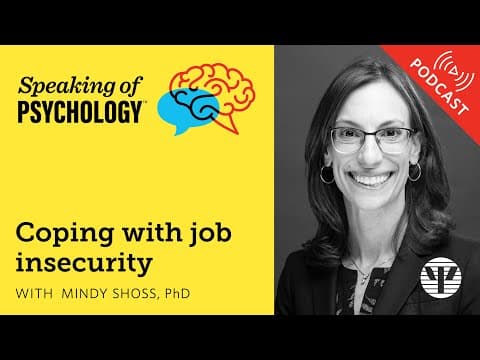
[1:07]My guest today is Dr. Mindy Shos, a professor of psychology at the University of Central Florida.
[1:13]Her research focuses on the intersection of occupational health psychology and the future of work, including such topics as job insecurity and precarious work,
[1:25]the integration of artificial intelligence and robotics in the workplace, worker well-being, and adaptation to change.
[1:30]She's a fellow of the Society for Industrial and Organizational psychology and sits on APA's Future of Work Advisory Committee.
[1:39]She's been interviewed by media outlets including the New York Times, the Wall Street Journal, the BBC, and the Washington Post about the future of work and worker well-being.
[1:49]Dr. Shas, thank you for joining me today. Thank you for having me.
[1:53]I'd like to start with the APA survey data that I mentioned in the introduction, which found that 54% of people are saying that job insecurity is causing them stress and having a significant impact.
[2:06]From your perspective as someone who has studied job insecurity for quite a while, does now seem like a particularly unstable and stressful time for workers?
[2:16]Unfortunately, this the survey finding drives with with what we're seeing in our survey and research data as well.
[2:24]And now is a particularly uncertain time because there's really a confluence of events that are both threatening people's jobs, but also giving people sort of opportunity to take a step back, try to evaluate what's going on in their own job situation and and it's creating a lot of a lot of concern.
[2:44]So, first, there's been constant headlines about corporate layoffs.
[2:49]Uh certainly we saw this during the pandemic, um but we've also seen this over the last year or two, particularly in that technology sector, but other sectors have also followed suit.
[3:02]Uh even this week there are headlines of layoffs at household names, companies that are household names, Procter & Gamble, Microsoft, Walmart.
[3:11]And when people hear about layoffs, they they start worrying about their own job and their own company.
[3:18]Of course, another factor, as you mentioned in the introduction, is the emergence of of AI.
[3:25]Uh as a rapidly developing technology and you know, there's there's a lot of concern out there, uh rightfully so, from workers about how AI is going to get implemented into the workforce and and what the implications are going to be for people's ability to to find and hold on to good quality jobs.
[3:47]And a third factor, as you mentioned, is really the government layoffs.
[3:53]Uh not only government employees have been impacted, but also employees at all sorts of organizations that do business with government or rely on government partnerships for their work.
[4:06]And we see the ripple effects as APA just reported in the most recent work in America survey.
[4:12]Now, how do you define and measure job insecurity in your research?
[4:17]So, we commonly measure job insecurity by by asking people to report the extent to which they're worried about being laid off and losing their jobs.
[4:29]And the focus on individuals perceptions and worries kind of places us squarely in in the psychological tradition of understanding how people perceive threats.
[4:43]Um and even there's a project led by one of my now graduated uh doctoral students.
[4:49]And we found that people may experience significant worries about their job security, even if they think there's a relatively low likelihood that they would be actually laid off.
[5:01]Um and this is because jobs are really, really important to people.
[5:04]They play a lot of roles in our lives, both financially and psychologically, and give structure to our time and our lives.
[5:17]Also keep in mind that things like health care, retirement plans, uh all these things are connected to having a job.
[5:27]So when the job is up in the air and it's uncertain, um all these basic needs that people have are also up in the air.
[5:45]So not surprisingly, you'll see that job insecurity is, um, found in the literature to be associated with harms to physical and, uh, mental health.
[6:46]Uh colleagues of mine, uh Court Rudolph, Hannessaker, and I just published a longitudinal analysis.
[6:53]We had 33 waves of certain monthly data where people would report their job security and and their physical and mental health.
[7:01]And what we found was that there's really a a negative amplifying cycle where job insecurity harms mental health, then decreases in mental health further contribute to concerns about job security.
[7:17]And and we think that this finding helps explain why job insecurity continues to be found to be such a pernicious stressor.
[7:27]I'm wondering what effect job insecurity has on work quality and productivity.
[7:32]I mean, if your boss is talking about the possibility of layoffs, does that motivate employees to perform better so that they won't be let go or does it make them less effective at their job?
[7:45]I'm really glad you asked this question because I think there's a lot of misconceptions here.
[7:52]And the short answer is, no, job insecurity is not helpful for performance.
[7:59]So, people certainly want to keep their jobs and they're motivated to do so.
[8:06]But that doesn't necessarily translate into performing better.
[8:10]So, research from my lab and others has found that that job insecurity instead leads to performative behaviors, for example, trying to look busy.
[8:23]Um leads to competitive behaviors, trying to get a step up on others, and and really fear-based behaviors because people are are really afraid.
[8:31]And that's not good for performance or innovation or all the other types of things that we hope for when we think about performance at work.
[8:40]Well, what is helpful, what are the factors that will make people perform better at their jobs?
[8:48]Sure. So people actually tend to perform better when they have some sense of security, when there's not an overwhelming amount of stress that's distracting attention, um or well-being, uh that detracts from job performance.
[9:05]And when people feel supported and energized and empowered to really try things and to try to have a positive impact and pursue the goals, um of the organization.
[9:18]So, those things, those things are helpful, not the, uh, threat of layoffs.
[9:24]Do, do people get used to uncertainty in the workplace or is it always stressful?
[9:30]For example, say someone's been a long-time freelancer versus someone with a previously stable job in a field that's now undergoing rapid change.
[9:40]Sure, this is a great question and I think in several ways it's still somewhat unanswered in the literature.
[9:49]Um however, there's a a team of researchers in Europe, uh Nel Dekyper and Hans Wit, who've been comparing reactions to job insecurity, um amongst workers with temporary or permanent contracts.
[10:05]And I think the general conclusion that that they found is that while job insecurity is less of a a violation of expectations amongst those who have inherently insecure temporary contracts,
[10:20]um job insecurity is still a challenging experience in terms of just well-being and job satisfaction.
[10:30]And so, you might think of it this way, and as human beings, we like to predict and control important aspects of our lives.
[10:41]And uncertainty threatens our ability to do that. That said, people have been in these positions for a long time, have probably adopted strategies to help them manage uncertain periods.
[10:52]But that doesn't necessarily mean that that the uncertainty is not a stressor for them.
[10:57]What can workers do, those who are feeling stressed and uncertain, what can they do to cope? Are there strategies that they can use to build their resilience both in the workplace and outside of it?
[11:10]That's a great question because, as, as you reported in the APA sure shows, many people are experiencing job insecurity, so it's going to become really important to engage a variety of strategies, uh, to try to try to cope with this experience.
[11:26]So, some strategies, um, and I think we all see this on various LinkedIn posts or things right now is just remembering that you as a person are more than just a single job.
[11:40]So people hold various roles in life, they have various pieces of your identity, and all of those are important, and trying to affirm and and remember and engage with those different parts of who you are as a person,
[11:57]um, can help manage some of the threat that comes with, with job insecurity.
[12:04]Um, also when times feel very uncertain, always trying to think about, okay, what are the things you can control, uh, and what are the things that that you can't control?
[12:15]And or what is the information that that you might need to help make a decision, trying to focus very concretely on what you can control or what information you need.
[12:27]Um might help, uh, there's also some, certainly advice on developing skills, creating a backup plan.
[12:36]I think all of those are probably helpful when dealing with periods of uncertainty.
[12:40]Um, but also remembering that times that people have coped with uncertainty.
[12:46]So all of us have faced various periods of uncertainty in our lives and remembering times where you didn't know what was going to happen or things were up in the air and and you dealt with it could be helpful.
[12:59]Uh in some research we've done, we've found that sort of thinking of yourself as a resilient person who bounces back from events, who tries to look for creative ways to deal with difficult situations, can be helpful in counteracting some of the negative effects of job insecurity.
[13:17]We're going to take a short break and when we return, we'll talk with Dr. Shas about what employers can do to increase well-being in organizations that are facing uncertainty and change.
[13:29]What's the role of employers in this case? I mean, what can they do to increase work or well-being, especially in organizations that might be facing uncertainty and change right now?
[13:41]So I've a good friend who's a systems engineer and she told me once that there's certainty in process.
[13:48]Uh and I think that's true.
[13:51]I think while job insecurity and uncertainty is stressful, organizations can help reduce stress and uncertainty by making clear and transparent decisions, by communicating, about decisions,
[14:06]by demonstrating fairness, uh by addressing rumors and by generally, you know, communicating plans.
[14:12]This is how we're going to move forward as an organization, uh that show that they value their people.
[14:20]Um even in our research, we found that managers just actively listening to employees concerns, actually decreased people's perceptions of job insecurity and increased their sense of control.
[14:33]And is that better for people if it's happening on an individual level, like you just mentioned managers or does it help more if it's coming from the CEO, the board, you know, people at the top of the organization?
[14:45]I think all the above, because in times of uncertainty, psychological research shows that people, people have a need to find information.
[14:53]So they're looking for information, they're looking for certainty, they're looking for best guesses of what's going to happen and they look widely.
[15:02]Um, so even if the organization itself is not facing any immediate threats or doesn't have plans for layoffs, just hearing about other organizations engaging in layoffs can make people worried about their own job and it could create rumors and things like that.
[15:18]So I think there's a need for all levels to kind of address the fact that we are living in a currently uncertain time where lots of people do have, um, stress over and worry over the future of their jobs.
[15:32]I hear a lot of talk these days about toxic workplaces, and I think that term has a very specific meaning.
[15:40]What constitutes a toxic workplace and how can employers guard against creating those conditions?
[15:48]So, when I think of a toxic workplace, I think of a workplace sort of defined by fear or fear is defining the defining aspect of the interpersonal relationships in the workplace.
[16:04]It's the defining aspect of the culture, it's the defining aspect of really how policies and practices are implemented and executed.
[16:11]So how can employers guard up against creating toxic workplaces?
[16:17]I think the great question because I think there is a role for active leadership and management in making sure that toxic workplace conditions don't don't occur, especially in times of uncertainty and rumor, or when organizations need to make rapid decisions.
[16:36]So again here, I think that leadership that emphasizes the missions and the value of the organization, leadership that emphasizes support for workers,
[16:47]what is rewarded and valued in the organization and making sure that's consistent with goals of transparency and fairness and innovation and all the things that we think about when we think about sort of good and strong organizations.
[17:03]Sometimes in practice it doesn't always come through necessarily the way people think about it in principle, but I think being very conscious of what the culture is and making sure that culture, um, hopefully it's a positive one, but trying to build a positive culture that can, uh, be a strong kind of grounding board as organizations and individuals, uh, go through times of uncertainty is is important.
[17:29]Now maybe it's too soon to ask this, but I'll ask it anyway, because that's what I do.
[17:32]So, I'm in Washington and of course, we're all in a tizzy over what's been happening, the department of governmental efficiency has been eliminating jobs right and left.
[17:44]So we're really seeing it on on an individual level here in in Washington, but how is that trickling out into the world at large?
[17:51]Are you seeing impacts in other places besides Washington or centers of where the big cities where there are a lot of federal workers?
[18:01]Sure, yeah, I think we see that we're seeing some ongoing research because again, people are cognizant of what's going on, um, and potential threats to certainty and stability.
[18:17]And so, even if they're not employed by the government, um, it suggests that there's potential threats to stability and certainty that might come down the pipeline.
[18:30]So, um, particularly with, with the government uncertainty, government jobs have typically been viewed as relatively secure, assuming, you know, high level of performance, etcetera.
[18:41]And so, there's also this sort of sensemaking that is occurring, I think quite broadly about what is this mean?
[18:49]What does this mean about assumptions of job security or careers, does job security even exist anymore?
[18:57]Um, and so I, I think you will see kind of ripple effects there that will go on for some time.
[19:04]You know, a couple of years ago, the, the big chatter was about the pandemic and the effect that the pandemic was having on on workplaces.
[19:14]Are you still seeing fallout from that?
[19:17]So, I think there's, there's fall out perhaps in two ways.
[19:23]One, um, goes back to questions not only of the job as a whole, but also questions about stability of components of the job.
[19:35]And so, certainly as we've gotten out of the pandemic, there's been questions about return to return to the office and, you know, what that means for for people's jobs and people's works, and there's uncertainty there.
[19:50]So I think there's sort of follow-on uncertainty.
[19:53]I think there's also uncertainty that's created when people have watched the employment system kind of collapse overnight and watch lots of layoffs.
[20:05]And so, um, you know, I saw a poll the other day that said 80% or something of people would be worried about their job security if there was another recession.
[20:14]Right? So losing one's job isn't necessarily this far off abstract notion anymore.
[20:21]It's something that people can envision because they saw it.
[20:25]They either went through it or they saw their friends and neighbors, or they saw news stories that showed, you know, people filing for unemployment.
[20:34]Um, and when you put that in the realm of something that could happen, I think that's going to continue in people's minds as as a possibility and it's really going to shape, uh, their views of of work and of the employment relationship.
[20:50]One of your areas of research is AI and technological change in the workplace.
[20:56]How do you see AI changing our work and our workplaces in the coming years?
[21:02]And how fast is this going to happen? Yeah, that's that's the million dollar question right there.
[21:08]Um, so in some ways AI is already changing work because AI is creating, even if it's not implemented in certain workspaces yet, it's creating a lot of uncertainty about how it's going to be implemented, whether it's going to be implemented.
[21:24]Um, certainly we're seeing companies developing AI, companies deploying AI, we're also seeing a lot of company AI projects fail because they're not being well integrated into the, into the workplace or, they're solving issues that maybe AI shouldn't, you know, people don't really want AI to solve certain issues.
[21:49]So I, I think there's going to be a lot of time that that sort of kind of in between, sort of negotiation time.
[21:55]There are a lot of questions. So I think it's not can AI just do certain tasks or certain jobs, but what does that mean for the human workers?
[22:06]How does that change things like status, pay, teaming, accountability, performance management, all of the, the systems and structures and institutions of work.
[22:19]So I think you're going to see a lot of, I don't know, forward movement, backward movement, sideways movement, um as a lot of companies start toying with it, as workers kind of react to it, and see how this technology can actually be be helpful or be used.
[22:35]You mentioned that there have been some, some missteps, and what are some of the areas where companies have tried AI and just been off base and it hasn't worked?
[22:45]So, I think there's, there's quite a few examples here, but, um, and I think we tend to see them when they come out in the news about, um, AI hallucinating or things like that.
[22:58]Unfortunately, AI is also only as good as as the data it's trained on, and if there are issues in the underlying data, then the output of AI is not going to be great.
[23:10]There's also a number of questions about the extent to which people should rely on recommendations from AI versus human decision-making.
[23:21]And I think what's happening in different companies and organizations is right now AI projects are still very expensive.
[23:28]And so, the question is, what's the, what's the value add and then what's the impact on your human workforce, which humans are the lifeblood and competitive advantage of organizations and talent.
[23:43]So, I, I think all of these kind of questions are really, really up in the air at the moment.
[23:49]And in your looking at technology, are you looking at robotics as well and how that has has going to be playing a role in the workplace?
[23:57]Yes, yes, we are.
[24:00]Um, we've had a few projects working with uh service robots, looking at how service robots are are impacting the, the hospitality sector and how people, uh workers and customers are responding to the service robots.
[24:20]And one of the interesting things that we find is the reactions to the technology are not necessarily always based on the technology itself.
[24:30]Uh, but they're actually also based on just the environment in which the technology is coming into.
[24:36]So how well prepared are people to bring in this technology?
[24:39]Do they understand why this technology is even being brought in?
[24:43]Have they thought about how they're going to shift their work roles and use this technology to help solve problems?
[24:51]Um, and so I, I think it's a really interesting time.
[24:56]But I think it's also a time where leadership and management's going to matter a whole lot because these technologies are coming out, they're being used and the question is, is there a backdrop that's going to help people adapt to them?
[25:12]And is there a backdrop where these these technologies are going to be really used to help people rather than replace human work?
[25:19]And I've heard some people say lately that it's not a question of whether AI will replace us, but the the people who get replaced are the people who won't understand how to use AI.
[25:31]Are you of that opinion as well? Um, I don't know.
[25:36]I think I would say that I'm of the opinion of that the qualities that make humans special and unique, the empathy, the ability to to understand context and how context changes things.
[25:54]Those are going to be the characteristics and qualities of people that will continue to be be in demand.
[26:00]The people who can take output from a team of humans and AIs and and figure out really what to do with it and what it means.
[26:09]Um, the people who have kind of leadership and and really human skills.
[26:15]Those are the folks who I think will be, uh, the most successful in this new age of technology and AI.
[26:19]What got you interested in this aspect of psychology to begin with?
[26:24]Sure, so I finished my graduate training coming out of the great recession.
[26:30]So I was really interested in how people were dealing with uncertainty, in economic uncertainty, job insecurity and layoffs and things like that.
[26:40]But I've also been very interested in how people adapt and and cope with change.
[26:45]And I think we see across the psychology literature, uh, just a lot of evidence that while, yes, there's major stressors connected with uncertainty and change, there's also the remarkable ability for humans to adapt, to demonstrate resilience, and to come up with just really creative solutions for problems.
[27:07]So that really got me interested in in understanding, you know, how, how changes in work impact people, but also how people are impacting changes at work.
[27:18]Another unfair question, but I'll ask it anyway, because that's what I do.
[27:23]If you had to predict in 10 years how technology would change workplaces, where do you think we'll see the biggest changes?
[27:32]And could somebody please create some AI that will control my email inbox?
[27:38]Right, I have the same challenge.
[27:43]AI is is tailed as this, you know, amazing capability, but yes, I would love someone to AI to manage my email and my calendar, that would be, that'd be most useful.
[27:55]Um, so, right, the saying is, is predictions are hard, especially about the future where they're impossible.
[28:03]So, I guess I tend to be a middle of the road person.
[28:08]I don't think everything will be AI, um, but I don't think nothing will be AI either.
[28:16]Um, and so I, where I think AI's going to have an impact, probably most is, um, probably entry-level work.
[28:26]And I think those jobs are going to have to change.
[28:29]Um, I also think you're going to see a larger proportion of the workforce that are essentially taking on managerial positions because they're going to have to be evaluating the output of AI and monitoring the output of AI, um, and making decisions based on the output of AI.
[28:47]So I, I think, yes, you're going to have some workers who will need to to reskill and learn how to use AI.
[28:56]But but I think you're going to end up having workers who are going to reskill and learn various tools of sort of management and leadership to know what to do with what's being produced with this technology, to know when the decision or output of this technology is good or useful.
[29:11]Um, so that's, that's what I see.
[29:14]Again, I, I think there's going to be some steps forward, steps back and it'll be really kind of interesting to watch what's going on, but that's my, my middle of the road answer there.
[29:26]So, so what are you working on now? What are the big questions you're trying to answer?
[29:30]So I'm currently working on a book with a colleague Tara Props from Washington State University in Vancouver, and we're trying to translate research on job insecurity for a popular audience.
[29:44]So, our tentative title is Leading, Managing, and Thriving in an Uncertain World of Work.
[29:50]And that'll be my big uh summer project here, but in addition to that, the big questions my lab is currently working on to understand is, um, continue to understand how job insecurity and uncertainty are shaping workplace environments, shaping interpersonal relationships, shaping people's long-term career planning, um, and also shaping outcomes outside of the immediate organization, like families and communities.
[30:25]And we're also trying to understand how responses to job insecurity are different when we're looking at something like AI, for example, versus layoffs versus recession.
[30:39]Are these different experiences that people are having? Um, and then really trying to understand again the very human experience of dealing with uncertainty and having to adapt to change.
[31:01]Well, Dr. Shassa, I want to thank you for joining me today, this has been very interesting.
[31:06]Thank you for having me, it's been a pleasure.
[31:09]You can find previous episodes of Speaking of psychology on our website at speakingofpsychology.org or on Apple, Spotify, YouTube, or wherever you get your podcasts.
[31:21]And if you like what you've heard, please follow us and leave a review. If you have comments or ideas for future podcasts, you can email us at speakingofpsychology@apa.org.
[31:31]Speaking of psychology is produced by Lee Weinerman.
[31:34]Thank you for listening, for the American Psychological Association, I'm Kim Mills.


