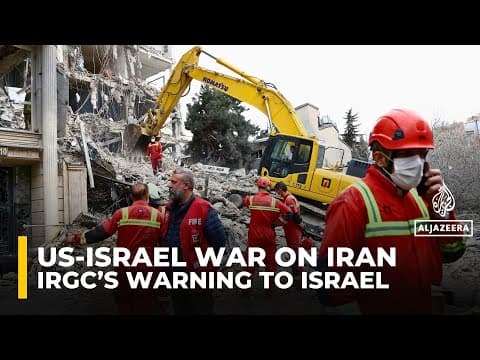
[0:00]Well, there's a new warning to Israel from Iran's revolutionary guards. Talking Sadi joining us now live from Tehran. I understand that this is also referring to Israeli military troops in Gaza as well. What more do we know?
[0:15]Uh, well, actually, this is a very recent statement that we received from the Public Relations of the Revolutionary Guards. They came out to say, quote unquote, uh, we warned the criminal army of the Israeli regime. If the crimes against Lebanese and Palestinian civilians continue, the positions of the enemy forces in the north, occupied Palestine, and the Gaza Strip will be subjected to heavy missiles and drone attacks by the revolutionaries.
[0:41]This is a very recent statement, as I told you that we hear as we see the continuation of the air strikes by the Israelis and Americans, targeting different parts in the capital and across the country. And, of course, the retaliatory strikes that the IRGC is talking about the 78th wave of which they're saying that was conducted.
[1:01]And, of course, speaking of the latest development, around half an hour ago, we received, we heard the sounds of massive explosions in the eastern parts of the capital. And since the beginning of these air strikes, eastern parts of the capital, um, have been the locations that have been, uh, very much, uh, attacked by these air strikes.
[1:25]But also we know that in other cities in other places in the capital and in in in the country, including cities like, uh, Tabriz, Esfahan, Karaj, and Khorramshahr attacks and air strikes are reported also in the capital. We know that, uh, according to the claim that was put forth by the army, they're saying that, uh, actually one drone was downed in the skies across the skies of the capital.
[1:51]And these are the military developments. Meanwhile, there are diplomatic developments that are very much important. The American side is talking about negotiation while the Iranian side denies reports and statements in that regard.
[2:07]We've got the speaker of the parliament, Mohammad Baqer Qalibaf, as well as the spokesperson for the Ministry of Foreign Affairs, both coming out to say that at this point there is no negotiation. And that means the situation looks to be far from de-escalation.
[2:20]However, Iranian Foreign Minister Abas Arachi is talking about uh phone conversation with his counterparts across the region and beyond with a long list. Pakistan, Oman, South Korea, Azerbaijan, Turkmenistan, Russia, and Turkey and latest of which Egypt with the with his counterpart in Cairo, Barashi had a conversation where the Egyptian foreign minister said that he is involved in diplomatic interactions with international regional players aimed at actually de-escalation and decreasing the tensions across the region.
[2:57]That could be interpreted as a sort of indirect messaging between Washington and Tehran, even though, even on that, we don't have any confirmation from the Iranian side. And it goes without saying that speaking of the uh potential negotiation, we know that we're not dealing with an easy situation. It's not going to be easy for the Iranians to open up conversation with the Americans, due to the complexity of the situation.
[3:22]And of course, due to this cloud of mistrust that is out there, Iranians were involved in talks not once but twice over the past one year, while they were, uh, they faced a campaign of air strikes all of a sudden in the middle of negotiation. And that is just making it even more, uh, arduous to think about potentiality for diplomatic engagement.
[3:48]And, of course, it goes without saying that what we hear from Tehran is on the basis of uh this condition or this pre-condition. They're saying that as long as these air strikes go on, it's not possible, it's not relevant to talk about any ceasefire and, of course, negotiations. So they are waiting for maybe a potential decrease of the American and and Israeli air strikes and then there might be a possibility, however slim, to talk about potential negotiations.
[4:18]To, thank you very much indeed, Tohid Sadi there, talking to us from Tehran.


