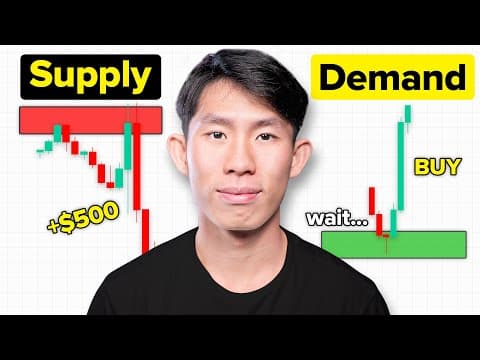
[0:00]When you truly master supply and demand, you will be able to trade with the smart money, and you will know exactly when to enter and when to exit the trade so you can maximize your profits and minimize your risk. But in order to master supply and demand, there are five pillars which you must fully understand. Number one, what is supply and demand? Number two, how to identify supply and demand zones? Number three, where to enter and exit? Number four, high quality zones versus low quality zones. And last but not least, why some supply and demand zones work and why some don't. And I'll be covering all these five things in this long as lecture today. So put your seat belt on, focus and take down some notes. Guys, do not skip around. You must watch this video in order from part one till part five in order to fully understand how to trade supply and demand. Now, first and foremost, what is supply and demand zones? Supply and demand zones are basically areas where big banks and smart money are trading at. Which means that if you can identify this supply and demand zones, that means you will be able to trade with these big banks and take advantage of their liquidity. And if you look at any market, beat for stock or crypto, you will realize that the markets actually move between cycles of balance and imbalance. So to identify the supply and demand zones, you need to look out for areas of consolidation, like all these grey boxes that we have right here. These grey boxes areas are what we call balance, right? Balance is basically where the price is choppy, slow, consolidating, and there's no clear trend. So these are areas of balance. After price creates balance, imbalance will eventually come just like how in life. Sometimes when you are experiencing a good thing, eventually a bad thing will happen to you, sooner or later. So this imbalance is basically this strong move that will occur after the consolidation, where price is inefficient, right? So during this imbalance, that's where price is inefficient and there's a lot of momentum. Now, one thing you must understand about supply and demand zones is that they are caused by momentum. So the stronger the momentum of the price, like this imbalance move here, the stronger the zones will be. Now, to make things simple for you, I have basically split the different types of supply and demand zones into two category, reversal zones and your continuation zones. Let's look at the supply part first. So for supply zones, there is your reversal zones. So this is what we call supply reversal, or rather what I call it, all right, to make things easier. So basically how it works is that price will have a strong up move and eventually price will lose steam, right? And then price starts consolidating. And next thing you know, price reversed and he has became a downtrend. So this is what we caught your supply and reversal zone. Another name for it is called rally base drop, where it's literally what the name implies, rally, base, drops. All right, that's how this other name comes from. Next type of supply zones is your continuation supply zone. So in this type, you can see price will drop, and then starts consolidating, and then it will drop again. So basically price is just continuing in this downtrend after a period of consolidation. So this is reversal supply zones, or supply reversal or supply continuation, whatever I like to call it, right? Just the names actually don't really matter. Next, let's look at the demand zones. Demand zones for reversal is when price drops, and then starts consolidating, like I said, this downtrend is losing steam. Right now, there's like a balance between buyers and sellers, right? The amount of same buyers, same amount of buyers and sellers, and price doesn't know where it's going, where exactly it's gonna go. And then eventually, it breaks out this consolidation and it actually reversed to become uptrend. So drop base rally, drop, base, rally. And then for your continuation is basically, like I said, it's a continuation. So price is in an uptrend, it pushed up, starts consolidating. And then eventually, you'll break out this consolidation and push up even further. So rally base rally. So this is your rally base drop, rally, base, drop, drop, base, drop. Drop base rally, rally, base, rally. You don't really have to memorize all these names, honestly. It's just a good way to identify these zones. So to identify supply and demand zones, you want to look for any one of these four scenarios that you can see right here. So example, when you see this on the charts, you will know that somewhere around here, this is your supply zone, or if you identify this, you can see that somewhere right around here, this is your demand zone. So you can wait for price to come back down to this demand zone area and look for your entry, which brings me to the next point. Once you identify a zone, what you must do is to wait for price to come back to the area of the zone, right? Come back to the area of the zone, example. Only then is when you can finally enter for the trade, after price has come back down to this zone that we have right here. So let me show you a few examples. So over here, you can see price rallies, starts consolidating, and then starts dropping. So over here, we have can actually draw like a little supply zone right here. So, somewhere right around here, that's a supply zone. So what we can do next is to wait for price to eventually come back up to this supply zone that we have drawn. Touch your seat, and that is when you can enter for a sell position. And you can see price will continue to go back down, because price has entered a supply zone and it's going to go back down and continue with this overall downtrend. Another example right here. Price was in a downtrend, starts consolidating. So once again, we can draw another supply zone right here, and then you can see price starts to eventually go back up to retest the supply zone, and then eventually go back down. Same thing over here, but in this case, it's the demand zone instead of supply zones. So once again, price drops, starts consolidating, and then starts going up. So at this point of time, you should wait for price to come back down to this zone, right? This little demand zone that we have right here, and then that is when you can enter for a buy. Now, you must understand that when price is like somewhere right around here, right? When price is making this up move, most beginner traders, they will be entering. They will be rushing to enter because they feel a sense of fomo. They feel a sense of fear of missing out. They don't want to miss out on this huge opportunity. So they enter for a buy somewhere right around here in this up move. And next thing you know, price comes back all the way down here to retest this area, this little demand zone, and stop them out. While you, the smart ass supply and demand trader, enter for the trade right here, and take the price to the moon. Another example right here. Price goes up, consolidate, immediately draw your demand zone, wait for price to come back down here, retest this demand zone, and then that is when you can enter for the trade. Okay, so now that you briefly understand what is supply and demand, the next thing you must know is how to identify and how to draw this supply and demand zones. And by the way, you can use this for any time frame, be it the five minutes or the one hour or even the weekly time frame. So this supply and demand strategy works really, really well even if you are a scalper, an intraday trader, or a swing trader. It doesn't matter, it will work for you. Okay, so very simple, you need three steps to identify and draw this supply and demand zones. First things first, you want to look out for those strong, big momentum move in price, and how you can identify that is by looking out for those gigantic long as candles. Like example, this one right here. This is a very strong bearish candlestick that we have right here. It was a long candle. So at this point of time, we have identified the strong move, or another example right here, you can see huge candle compared to the other previous candles, very strong move, very strong momentum, there's a lot of buying pressure. So that's the first step, identify your strong move. Second step is to identify the candle before the strong move. So this is the strong move, you want to look out for the candle before the strong move, which is this one that we have right here. This is the candle before the strong move, and for in this case, is this one right here. This is the candle before the strong move. Now, the third step is actually to just draw a box. So go on the trading view, and just take this box, this rectangle too, that we have right here, and draw a box of this previous candle from the top to the bottom. Bear in mind, this is where most people get confused, because they don't know exactly whether they should draw the box at the week or the candlestick body. I myself will recommend you to actually draw from the top of the week to the bottom of the candlestick week, like the highest point price went to to the lowest point price went to. So what I mean by that is that you can see, this is the highest point of the candlestick week, plot your first point right here, and then plot your second point right here. This is the the lowest point of the week, and then there we have it. This is your supply zone. Another example right here, drag it from the highest point to the lowest point right here, and drag it out. This is your demand zone, as simple as that. So this is actually how you actually draw your supply zone and your demand zone. Once you draw your supply and demand zone, that is when, like I said just now, you want to wait for price to eventually go back up to this area, this zone that we have drawn, and then that is when you can look for your sell opportunity and shop price all the way down. Same thing over here, demand zone, wait for price to come back down, touch this demand zone, and then that is when you can enter for a buy position and buy it all the way up. Now, I want you to bear in mind that these zones, right, they can be as small as just one candle. It doesn't matter how big they actually are, as long as you follow these three steps and draw them correctly. What matters more is the strength of the explosive move after the consolidation. Now, let's open a blank chart and start drawing up some supply and demand zones. So over here, we have GBPJPY, which is a currency pair that I have not been trading for a very goddamn long time now. So we're going to use this and drop some supply and demand zones. So, first things first, like I said, three steps. You want to identify the strong and explosive move, right? So over here, strong and explosive move that we have right here. Second step, identify the candle before the strong move. So this is the candle before the strong move. And then third step, draw a box on that candle from the top to the bottom, like this. So there we have it. This is your supply zone. So we want to wait for price to eventually go back up to this area, and then that is when we can short it all the way down. So another example right here. In this case, let's look for uh, some maybe like a demand zone now. Huge green candle, explosive move. This is the previous candle, draw a box around it. And look at what price did. Price eventually come back down to this demand zone right here, and then bounced back up. So, this is how you can really like, just, just keep on doing this, right? This is how you actually practice on drawing your supply and demand zones. Because remember, practice will actually makes you more competent. So you need to ready keep on practicing and practicing so that eventually you will get good. So another example, maybe somewhere right around here. You can see right here, I saw a big ass green candle right here. Strong up move. So immediately, I know that you have to mark up the candle before this strong up move. So you draw right here. This will be your demand zone. Okay, then you drag it, extend it to the right side, and wait for price to eventually come back down to this demand zone. Then that is when you can enter for a buy. Look at this, price went back down to this demand zone, enter for a buy here, and then price eventually go all the way back up. So, just keep on repeating this. Like I said, guys, practice, makes competency. So keep on practicing. So another one right here. This is your supply zone. You can see, price goes up, and then come back down here. You can draw like a little supply zone somewhere right around here. Price comes back, retest it, and then just eventually went all the way back down. So supply zone, demand zone, demand zone, supply zone. Let me give you a test real quick. So based on those four scenarios that I have explained to you just now, which scenario is this? Go comment down below. If you get it correct, I'm going to give you a kiss. Right now, I'm going to give you five seconds to go comment. Five, four, three, two, one. Okay, the answer is this is actually rally, base, rally, because this is an up move, followed by a consolidation, and then another up move. So in this case, what you could have done is that you can draw a demand zone right here, because this is when price made this extreme up move, and before that, we had this little candle right here. So mark it up over here. You can see price come back down to this area here, and then goes back up. Do you call it correct? If you get it correct, here's a kiss. Now, I'm going to show you a simple, but high win rate supply and demand trading strategy that works. So first things first, you want to identify the zone. So over here, this is a rally, base, drop. So somewhere over here, there's a huge selling momentum, right? So over here, we know that there's a supply zone right here. So we can identify this by drawing at the previous candle before this huge move down, draw a supply zone right here. So this is our supply zone. And we want to wait for price to come back up to retest this supply zone, and then that is when we can enter our sell position, which is exactly what price has already done. Price has already come back down up here, touches our supply zone. So somewhere right around here, we can enter for a sell. So you can enter for a short somewhere right around here, and then this is when it gets a little bit tricky. You want to place your stop loss above the zone that you have drawn. So if you are drawing or rather you are trading a supply zone, you want to place your stop loss a few pips above the supply zone. And then for the take profit, you want to take profit at the next opposite zone. So if you are trading a supply zone, you want to take profit at a demand zone, the next demand zone. But then if you are trading on a demand zone, you want to take profit at the supply zone, the next supply zone. So over here, we want to identify the next demand zone, and you can do that by just looking down somewhere right around here. You can see there is a supply zone somewhere right around here. I mean, not supply zone, demand zone somewhere right around here. So this is where we can take our profit, right? And as you can see, price immediately rejected this supply zone that we have drawn earlier, and eventually went down here to smash our take profit, as simple as that, guys. So over here, this example was on the daily time frame, which is more for like swing traders. So I want to show you that this strategy works on other time frames as well. So let's look at other examples. Let's look at this example over here. Right now, we are on GBPUSD, and we are on the one hour time frame. So this is more for intraday traders to swing traders. So over here, you can see there's a drop, base, rally, right? So over here, we can see that there's a huge bullish engulfing candlestick right here, which indicates there's a demand zone somewhere right around here. So you can indicate the demand zone by drawing a box at this previous candle right here. So this will be our demand zone. So right now, our next job is to wait for price to come back down and touches this demand zone, and that is when we can enter for our buy position. So right now, we still wait. Be patient, be patient. And then you can see eventually price comes back down, touches this demand zone, gave us a Doji candlestick. So at this point of time, this tells us that this little selling pressure is going to be gone, right? The buyers are going to come back in at this demand zone, institutional, the big banks are going to be buying at this demand zone, and they're going to be buying in bulk. So that is when you can look to enter for a buy position somewhere right around here, right? So what you can even do is to wait for a confirmation, right? Which means you wait for a green candlestick to be form at this demand zone. And then that give you like an additional confirmation that tell you that, okay, buyers are here. Buyers are inside this game right now, which is usually what I will wait for. We'll wait for some sort of green candlestick to be form, like, like example right this, like this, I mean. So this is where you can enter for a buy, place your stop loss below this demand zone. Take profit at the next supply zone. And if you look towards the left, right? You can identify there's actually a supply zone somewhere right around here. Somewhere right around here, there's a little supply zone. So this is where we can look to place our take profit. And by the way, guys, you can see in this case, right, this stop loss is over 60 pips. So if you want to minimize your loss, what I will suggest you to do is that after price has rejected this demand zone, and it starts going back up, right? That is when you can move your stop loss to below this last high right here, this last low right here, a few pips below this area here. When price has just rejected and it's about to go up to the next supply zone. So that is when you can place your stop loss right there. Because if price eventually do something like this, right? Where it go up a bit, then it starts coming back down and goes deeper into this zone, most likely this demand zone is going to fail, it's not going to work. So guess what, you will get out with like a small, tiny loss. So over here, let's look at how this trade plays out. You can see eventually price goes up and smash our take profit somewhere right around this area here. Right there, as simple as that, guys. And as you can see, this is a one is to three risk to reward trade as well. If you notice on all these supply and demand trades, you will actually get a very extremely good risk to reward, because you are literally entering the trade at such an optimum position with precision. That once you enter the trade, price almost immediately go into take profit. That is the beauty of supply and demand. Let me show you another example. You can see right here, there's a huge selloff, right? This gigantic long as red candlestick implies there's a supply zone right here, as clear as day. So place your supply zone right here, extend to the right. So right now, like I said, we want to wait for price to come back up to this supply zone, touches it, reverse, then that is when we can enter for our sell position. So over here, price went back down, and then start to reverse and reverse and eventually came back up somewhere right around here, and it actually touches the supply zone, and it actually gave a long upper week.
[18:19]What does this tell us? A long upper week tell us that there's a lot of sellers at this area pushing the price down. Therefore, the price is closing somewhere right around here, which is at a very low price. And next candlestick, price gave us a huge red candlestick, which tell us once again, selling pressure, selling momentum. This take down is about to happen. Price is about to collapse and hit back down. So that is when you can look to enter for a sell somewhere right around here. Like I said, I would have entered some when it's over here, because look at this long upper week, long low week, right? Clear as day, this market manipulation. All right. So, place a stop loss above this supply zone that we have right here. Take profit at the next demand zone, which could be somewhere right around here, actually. This is the next demand zone. So, as you can see, this probably wasn't like the best trade setup that we have possibly yet. So let's just skip this a little bit by going back to the one hour time frame. And you can see price eventually go back down and smash our take profit right there. You can see right here, right? The moment price actually created this new lower high, right? That is when I will potentially move my stop loss from over here, right? This hundred pips wider stop loss, move it all the way down to here. This is so that I can minimize my loss, eventually if price reversed and break market structure, guess what, I get out with like a tiny loss once again. All about minimizing risk and maximizing your reward. That's all trading is. So, as you can tell, this strategy allows you to identify where to enter and where to exit easily. This helps to increase the chances of you using this strategy consistently. And bear in mind that there is a lot of flexibility in terms of where you place your profit target. I myself like to place my profit targets at the next key level or even at the Fibonacci extension levels. So just automatically just test this out, experiment with the different take profit levels and find out what works for you and just stick to using that. The key to this strategy is to trade the high quality zones and avoid the low quality zones. You want to trade like a sniper, not a machine gun. Most people think that profitable trading is staying at the charts all day, but in reality, it's actually patiently waiting for the perfect A plus trade setups. That means you need to trade the high quality zones, because you will have a higher chance of winning. Momentum is how you differentiate these high quality zones from the low quality zones.
[21:00]So, when you are determining the quality of the zone, you must look at the price action and the size of the candlesticks. In this example right here, we have pattern A and pattern B, demand zone A and demand zone B. Which one do you think has more momentum? Which demand zone do you think is stronger? Obviously, it will be the demand zone A, because in the demand zone A, there is a lot of momentum. Like if you look at this two candlesticks, right? Huge long candlesticks, indicate a lot of buying pressure, a lot of buying momentum, and you can see it's moving very, very fast. So in this case, more momentum right here. This means that this demand zone will be stronger. So chances are, eventually when price comes back down, touches this zone, it's going to react to this zone, higher chance of reacting to this zone, and it's going to go up. Compared to this one right here, when you can see, the candlesticks are a little bit small, small, small, small candlesticks. There's not much momentum right here. So this demand zone will be a lower quality compared to demand zone A. Let's look at a few examples now. So over here, you can see there's a huge bearish engulfing candlestick right here. Big red candlestick tells us there's a lot of momentum. A lot of selling pressure. So in this case, we know that there will be a strong supply zone somewhere right around this area here, right? Strong supply zone. And if you look at this, and let's just copy this circle, and then put it to this previous zone right here. You can see, same thing, there's a supply zone right here. So there is one supply zone right here, another supply zone right here. You can see, in this one down move, it took one red candlestick to do it. But if you look at the same scenario right here, it took three red candlesticks to complete this same down move. So, obviously, this has more momentum, more selling pressure, and therefore, this supply zone is stronger, compared to this supply zone that we have right here. Or another example right here, in a demand zone, huge move, huge momentum. So, there's a demand zone somewhere right around here, right? Compare this to right here. There is a demand zone as well right here as well. But then which one do you think would be stronger? This one with the a lot of momentum, a lot of buying pressure, or this one where there's little momentum, right? Obviously, it's going to be this one. This demand zone is going to be much more stronger than this one. So basically, the point here is the momentum in the move will indicate the quality of the zones. So, if you have fast movement, lots of momentum like this, where there is more full candles, this indicates high quality of your supply and demand zone. However, on the other hand, if you have slow movement like this, or even more like a lot of choppy candles like this, where price is just consolidating, and lots of like chop, right? This indicates low quality, low quality zones. Here's a harsh truth. No strategy works all the time. Not all supply and demand zones work 100% of the time. Accept that losses and wins are part of the game. There are three ways to tell whether a zone will work or not. Firstly, market structure. Secondly, death. Third, time. Let's dive deep into each one of these three factors. So actually, to illustrate this, I've created a new supply and demand watch list, where I've added some currency pairs, some of which I've never, ever touched or seen in my life just to show you that this whole supply and demand tips, right? Works on anything. Be it crypto, stocks, or forex, whatever it is, whatever they trade, it will work. So, first things first, you want to focus on market structure because this is actually the key to finding out whether a zone will work. So, if price is in an uptrend, you want to buy at demand zones. And if price is in a downtrend, you want to sell at supply zones. Why? Because you want to trade with the trend, rather than against the trend. However, there is an exception to this. So, you want to buy demand zones that have taken out supply, and you can also sell supply zones that have taken out demand. I know it's quite, it's quite confusing right now. So let me just show you a few examples. So over here, we can see there's a downtrend, right? In this downtrend, price is creating what? Your lower highs, lower lows, lower highs, and lower lows. So, clear as day, there is a downtrend. So in this case, right, what you can do is to mark up all your supply zones first. So I can see there's a supply zone somewhere right around here. Another supply zone somewhere right around here, right? So in this case, right, what I can do is to mark up all your supply zones first. So I can see there's a supply zone somewhere right around here. Another supply zone somewhere right around here, right? So in this case, right, what I can do is to mark up all your supply zones first. So I can see there's a supply zone somewhere right around here. Another supply zone somewhere right around here. So in this case, right, what I can do is to mark up all your supply zones first. So I can see there's a supply zone somewhere right around here. Another supply zone somewhere right around here, right? So in this case, right, what you can do is to mark up all your supply zones first. So I can see there's a supply zone somewhere right around here. Another supply zone somewhere right around here, right? So in this case, right, what you can do is to mark up all your supply zones first. So I can see there's a supply zone somewhere right around here. Another supply zone somewhere right around here. So in this case, right, what you can do is to mark up all your supply zones first. So I can see there's a supply zone somewhere right around here. Another supply zone somewhere right around here, right? So in this case, right, what you can do is to mark up all your supply zones first. So I can see there's a supply zone somewhere right around here. Another supply zone somewhere right around here, right? So in this case, right, what you can do is to mark up all your supply zones first. So I can see there's a supply zone somewhere right around here. Another supply zone somewhere right around here, right? So in this case, right, what you can do is to mark up all your supply zones first. So I can see there's a supply zone somewhere right around here. Another supply zone somewhere right around here, right? So in this case, right, what you can do is to mark up all your supply zones first. So I can see there's a supply zone somewhere right around here. Another supply zone somewhere right around here, right? So in this case, right, what you can do is to mark up all your supply zones first. So I can see there's a supply zone somewhere right around here. Another supply zone somewhere right around here, right? So in this case, right, what you can do is to mark up all your supply zones first. So I can see there's a supply zone somewhere right around here. Another supply zone somewhere right around here, right? So in this case, right, what you can do is to mark up all your supply zones first. So I can see there's a supply zone somewhere right around here. Another supply zone somewhere right around here, right? So in this case, right, what you can do is to mark up all your supply zones first. So I can see there's a supply zone somewhere right around here. Another supply zone somewhere right around here, right? So in this case, right, what you can do is to mark up all your supply zones first. So I can see there's a supply zone somewhere right around here. Another supply zone somewhere right around here, right? So in this case, right, what you can do is to mark up all your supply zones first. So I can see there's a supply zone somewhere right around here. Another supply zone somewhere right around here, right? So in this case, right, what you can do is to mark up all your supply zones first. So I can see there's a supply zone somewhere right around here. Another supply zone somewhere right around here, right? So in this case, right, what you can do is to mark up all your supply zones first. So I can see there's a supply zone somewhere right around here. Another supply zone somewhere right around here, right? So in this case, right, what you can do is to mark up all your supply zones first. So I can see there's a supply zone somewhere right around here. Another supply zone somewhere right around here, right? So in this case, right, what you can do is to mark up all your supply zones first. So I can see there's a supply zone somewhere right around here. Another supply zone somewhere right around here, right? So in this case, right, what you can do is to mark up all your supply zones first. So I can see there's a supply zone somewhere right around here. Another supply zone somewhere right around here, right? So in this case, right, what you can do is to mark up all your supply zones first. So I can see there's a supply zone somewhere right around here. Another supply zone somewhere right around here, right? So in this case, right, what you can do is to mark up all your supply zones first. So I can see there's a supply zone somewhere right around here.


