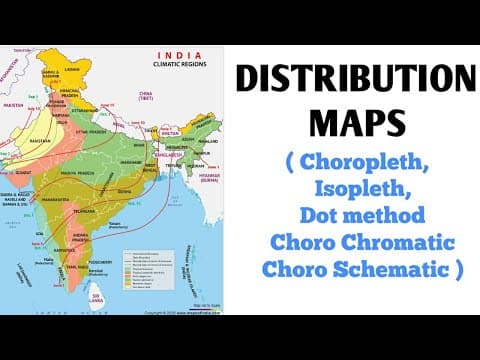
[0:00]Hello everyone, welcome back to my YouTube channel Geographical. Aaj ke is video mein hum log jo topic discuss karenge, woh hai practical geography ka, distribution maps. Ismein hum log dekhenge ki distribution maps kya hote hain, unka definition, plus unka use, aur different types of distribution maps with example hum log ismein discuss karenge. So jaldi se hum log start karte hain distribution map. Video start karne se pehle main aapse ek cheez bolna chahunga, ki agar aap mere channel ko follow karte hain regularly aur videos dekhte hain toh please video ko like kare, share kare aur channel ko please subscribe kare. Aur agar aap mujhko social media se through connect hona chahte hain toh please mere Instagram account ko pe follow up kare jo ki maine description mein dal diya hai. So let's start with the video distribution maps. So distribution maps ko start karne se pehle hum log yeh dekhenge ki cartographic symbols kya hote hain. Yeh bahut hi important hai. Aapka agar viva question hai viva ka paper hai toh usmein pucha jayega ki what are the cartographic symbols toh aapko teen cartographic symbols batane honge teen type ke hote hain point line and area. Plus yeh pooch sakte hain ki in cartographic symbols ke examples batao ki point symbol ka example, line ka ek example ya area ka ek example. So aapse uska cartographic symbols kya hote hain yeh bhi pooch sakte hain. Plus point line and area in teeno mein se kisi ek ka example hi puch sakte hain. So as the name suggest point, point matlab yeh hota hai jo ki point size ke objects hote hain jin cheezon ko hum log as a single point represent karte hain on a map. For example yeh map hum log ne use liya hai jismein hum log teenon symbol bataenge ki kaun sa point hai kaun sa line and kaun sa area hai. So ismein aap agar dekh rahe ho toh jo temple wale symbols bane hain yahan par, ye aap dekh rahe ho ye temple wale symbols jitne hi bane hain, these are the point symbols. Point symbols matlab yahan par ek point pe ek cheez dikhai gayi hai. Okay. Political maps pe jin points pe woh dikhaya jata hai ki yeh city kaun si hai Lucknow, Patna, ya Delhi, ya Bengaluru, kaun si city ek point symbol ke through represent ki jati hai. So woh sare point symbols hote hain. Line symbols matlab woh symbols jo ki linear hain matlab ek line ke form mein for example river, road, railway track, aur electricity line, ye sab line ke form mein, linear form mein represent kiye jate hain. Toh inko hum log line symbols kehte hain. Ismein ye jo symbols hain road dikh rahi hai. Okay. Ye boundaries dikh rahi hain. These all are the point symbols. Sorry line symbols. Ab hum log dekhte hain area symbols. Area symbols mein point aur line donon ka hi combination hota hai. Theek. Bahut sare point symbols ko aise bhi samajh sakte hain aur aise bhi samajh sakte hain ki ek particular area, ek particular bada sa area continuous area dikhane ke liye hum log area symbol use karte hain. For example yahan par ye lake hai. Is lake ko dikhane ke liye hum log ne area symbol use kiya hai. Ye grassland hai, ye green color ka jo portion dikh raha hai ye large area hai. Okay. So this is represented by area. So point, line and area symbols ke ye teen examples aur kya hote hain maine aapko bataya. Uske baad distribution maps. Distribution maps are useful for explaining the patterns of distribution of a particular geographical variable. Koi ek geographical variable, variable matlab jo jo change ho raha hai. Jo vary kar raha hai. For example climate hai, vegetation hai. Okay. Ya rainfall hai. Ye sab kya hai vary kar rahi hain. Toh kuch aisi cheezein jo variable hai geographical variables aur kuch constants bhi for example cities hain. Okay. So in sab cheezon ko dikhane ke liye jo hum log tak taknik apnate hain ya jo hum log method apnate hain unko hum log distributional maps kehte hain ya distribution maps kehte hain. Okay. The distributional maps are useful for explaining the patterns of distribution of a particular geographical variable. Distribution map basically teen cheezein dikhata hai density, pattern and dispersion. Density matlab ghanatva. Ki ek particular cheezon mein jagah pe vahan par kisi cheez ki kya density hai for example ek particular area hai maan lo Uttar Pradesh ya Bihar mein ya India mein as a whole population density kitni hai kitne jagah pe kitne zyada log rehte hain. So woh density. Toh density can be shown by distribution maps. Pattern. Pattern matlab vahan par swabhav kaisa hai pratirup kaisa hai us jagah pe. Okay. Ki pattern of settlements kaisa hai. Pattern of vegetation kaisa hai. Okay. Pattern of relief kaisa hai. Toh ye cheez hum log kis se dikha sakte hain distribution maps ko.
[4:57]Dispersion. Dispersion matlab kaise woh cheezein phaili hui hain phailav kaisa hai for example India mein coal kahan kahan paya jata hai uska dispersion. India mein Manganese, India mein sugar cane cultivation kahan kahan hota hai uska dispersion. So ye sab dikhane ke liye hum log distribution maps use kar sakte hain.
[5:17]So agar aap se viva mein pucha jaye ki distribution map ko hum log kis liye use karte hain toh aap simple sa yeh jawab dijiye distribution map ko hum log density, pattern aur distribution ko show karne ke liye use karte hain. Ab distribution maps basically do type ke hote hain ye bhi viva mein pucha jata hai. Distribution map kitne type ke hote hain toh quantitative and qualitative. Quantitative again char type ke hote hain choropeth, isoplat, dot method and diagrammatic. Qualitative maps teen type ke hote hain color patch, choro-chromatic and choro-schematic. Choro-schematic geometrical pictorial and alphabetical teen type ka aur hota hai. Ab in sare maps ko hum log ek ek karke lenge ek ek karke padhenge. Pehle hai choropleth map. Choropleth map as the as what is written in this PPT ismein kya likha hai it uses difference in shading, coloring or placing of symbols within a pre-defined areas to indicate the average values of particular quantity in a particular area.
[6:17]Ek particular area mein ek particular quantity ki average values dikhate hain hum log choropleth map se. Aur in maps mein hum log kiska use karte hain? Dekhiye har map ki quality hoti hai. Ki in map mein hum log is cheez ka main use karte hain isliye ye aur map se alag hai.
[6:40]Choropleth map ko banane ke time hum log shading use karte hain ya agar hum log ke paas shading available nahi hai woh bhi main aapko aage batata hu shading nahi hai shade nahi ho pa raha hai toh hum log kya kaise method use kar sakte hain.
[7:12]Choropleth method map is used to show population density, types of forest cover, uses of land. Yeh teen cheezein hum log basically dikhate hain kisse choropleth map se. Choropleth map ka ek advantage hai it provides an easy way to visualize how a measurement varies from across an area. Ek bade area mein kaise measurement vary kar raha hai isko ek ek glimpse de ke ek bas nazar maar ke hum log dekh ke bata sakte hain.
[7:38]Disadvantages. Disadvantages mein kya hota hai? Kyu hum log choropleth ko disadvantages mein kya disadvantages hain iski? Pehli. Boundaries matlab agar ek jagah pe maan lo low density hai aur ek jagah pe high density hai. So jo in low density aur high density wali ki jo boundary area hoga vahan par jo actual cheezein hain usmein ek abrupt change hoga aur false cheezein dekhne ko mil sakti hain. So ye ek iska disadvantage hai. Uske baad different shades ko distinguish karne ke liye ismein hum log bahut hi mushkil ho jata hai so choropleth map ke ye do disadvantages hain. Ab iska example. Example ki dekhiye ismein totally shading use ki gayi hai. Shading mein yeh actually literacy rate 2001 ka India ka map hai jismein ismein dekhiye yeh ek chart niche ek index bana hua hai. Jismein shades different colors of black ko use karke us pe ek particular legend bana diya gaya hai. Ki dark hai toh above 83 usse kam 74 se 83. Usse kam 65 to 74. Usse kam 56 to 65 aur usse kam to less than 15.
[8:51]Okay. So ismein hum log ne kya kiya jin jin states mein jis hisab se literacy hai us hisab se is color ko hum log ne is in shades ko ya in black color ke tints ko use karke hum log ne usko bhar diya hai. Lekin aap jab isko pen se banaoge toh aapke paas itne options nahi honge ki aap itne sare shades use kar sako ek hi pen ko use karke. So hum log jab apni files mein ya exam mein banate hain toh hum log is type ka map banate hain. Ismein hum log kya karte hain hum log ismein bhi hum log ne black color hi use kiya hai ismein hum log ne different lines and shapes use kiye hain. For example ye average rainfall ka map hai. Millimeter mein agar 2000 se upar hai toh woh ek dam inhone dark black kar diya hai. Agar 1000 se 2000 hai toh inhone horizontal lines banayi hain jaise for example yahan par ye jitna bhi area aapko dikh raha hai yahan par inhone dekhiye black lines banayi horizontal. Agar 600 se 1000 hai toh inhone vertical lines banayi hain for example ye dekhiye sab vertical lines hain. Aur agar 600 se kam hain toh inhone dots banaye hain for example this. Okay. So agar aapke paas different shades of black available nahi hai toh aap simply lines ko ya straight lines ya slantting lines ko use karke ek choropleth maps ko ka distribution dikha sakte ho. Okay. Isopleth maps. This method makes use of line joining locations or places having same or equal values of a particular variable. Basically hota kya hai ki ek particular area mein jahan jahan par equal values hain for example agar humne ek India ka map dekha usmein humne dekha ki Lucknow, Patna, Kolkata, fir niche Raipur, Nagpur aur Gandhinagar in sare areas mein same pressure available hai same atmospheric pressure hai. Toh inhone kya kiya in sare points ko ek line se join kar diya. Toh jab humne inko ek line se join kar diya toh ye ek line ban gayi. Ye line dikha rahi hai ki in in jagahon par same pressure hai. Toh is method ko hum log isopleth method kehte hain. Ab ek line to nahi hai banali ab hum log ne dekha ki aur Srinagar mein Jaipur mein aur fir Rajkot mein in sab jagahon pe ek dusra pressure hai. Okay lekin equal hai toh hum log ne kya kiya yahan par in teenon jagahon pe ek line se represent kar diya. So isopleth ka matlab it makes use of line joining locations or places having same or equal values. Okay same or equal values ko jodne wali lines ko hum log iso lines bolte hain. Isopleth word Greek words se derived hai iska matlab isos aur ka matlab same plethron ka matlab measures. Ab inki problem kya hoti hai aur inke acchai kya hoti hai? Advantages and disadvantages. Okay. Ab the spacing of lines expresses the rate of variation. Jo lines hoti hain jo jin line jitni agar closely matlab jo ek line aur dusri line jaise hum log map mein dekhte hain. Ab yahan par hum log ne map mein dekha toh yahan par dekha yahan par dekhiye ye lines hai. Ab ek line 990 mb ki hai ek 980 mb ki hai. Toh ismein main dekhe aur ek line 1000 mb ki hai. Toh dekho 1000 mb aur 990 mb ki line bahut closely hai close hai. Aur 990 mb aur 980 mb ki line bahut door hai. So ismein hum log dekh ke bata sakte hain variation. Agar paas paas lines hain do toh matlab variation bahut steep hai bahut high hai aur agar door door lines hain toh iska matlab variation vahan par bahut gentle hai for example yahan par 990 aur 980 mein jo hamara variation hai woh gentle hai aur 990 aur 1000 mein variation is quite high.
[12:43]Uske baad they are not suitable for discontinuous or patchy distributions or where variability is great. Jahan ka hamare paas data available nahi hai, vahan par jahan par patches hain matlab maan lo MP ka data available nahi hai, Chhattisgarh ka available nahi hai. Toh aise areas mein India ka isopleth map banana bekar hai because aapke paas beech ka data available nahi hai. So vahan par hum log isopleth method use nahi kar sakte hain. Aur inko banane ke liye hume large amount of data chahiye hota hai jo ki lana bahut problematic hai. Isliye isopleth methods ka ye disadvantage ho jata hai. Ye isopleth map ka ek example hai. So ye isobars dikhaye gaye hain ismein. Isobars matlab jo equal pressure ko jo lines equal pressure ko jodti hain. Toh jahan jahan par 1000 1000 pressure hai vahan par 1000 wali line dikh rahi hai. Jahan par 990 pressure hai vahan 990 wali dikh rahi hai. So ye ek basically isopleth map hai. Ab bahut important table hai ye maine kafi jagahon se dhund dhund ke aapke liye ek ek just format mein ek concrete format mein ikattha kar diya hai. Ismein yeh bataya gaya hai geography se related matlab jo terms geography mein use hote hain kaun se isolines kya cheez show karti hain for example jo humne map dekha usmein dekha ki isobars show ho rahe the. Isobars jo hai woh same atmospheric pressure wali lines ko show karte hain. Toh matlab jahan jahan same atmospheric pressure hai un lines ko jodne wali lines isobars hoti hain. Waise hi isotherms, isohyets, isohels, isonephs, isobaths, sari lines maine aapko multiple naam diye hain. Ye kya show karti hain for example isochrone. Isochrone points taking the same time to reach from a given place. Isogon points with same wind direction. Toh ye total table aap apne aap note down kar lijiye ya iska screenshot le lijiye. Aur ye aapko yaad karna hoga for viva purposes. Okay. Dot maps. Dot maps bahut hi easy hain bahut hi important bhi hai. Dot maps jo hain woh ek woh dots ko use karte hain of uniform size. Ek particular size aur ko use karke hum log map pe distribution dikhate hain. Aur ek dot ek certain amount of quantity ko represent karta hai. Bahut hi easy to understand hote hain. Aur kisi bhi area ki varying density ko yeh bahut acche se dikha dete hain. Aur it allows for mapping with distribution of another phenomena. Okay. Aur bhi hum log kehte hain multiple dots ko multiple color ke dots ko use karke hum log do teen variables ko ek hi map pe dikha sakte hain. For example agar hum log dekhen ki jo North India hai us taraf wheat cultivation zyada hota hai. Toh wheat cultivation ka hum log ne dot le liya pink ya green. Aur South mein rice cultivation ka hum log ne dot le liya green ya purple. Toh hum log ne ek hi map pe do color ke dots ko use karke hum log ne alag alag distribution dikha diya. Ab inki problem kya hoti hai if the dots are get too dense it's difficult to read. Agar dots bahut paas paas ho jate hain toh inko padhna bahut mushkil ho jata hai. Aur inko hum log use kyu karte hain? Kya dikhane ke liye? They are preferred to show distribution of population, stocks, crops, mineral products, etc.
[16:03]Ye India population ka ek dot map hai. Yahan par ek dot 200000 persons represent kar raha hai. Toh dekho.
[16:16]Aap is map pe dekh ke bata sakte ho ki jo yeh wali belt hai Ganga wali belt vahan par zyada population hai. Okay. Jaise yahan par. Yahan par zyada population hai because yahan par dots bahut zyada dense hain. So obviously baat hai jo India ka jo Gangetic plains hain vahan par population density bahut high hai. Similarly ye jo aap ek dam dark black color ka portion dekh rahe ho. Ye hai New Delhi. Yahan par population density bahut zyada hai approximately 11000 person per square kilometer. Okay. So ye aap ek dam bas ek bar dekh ke bata sakte ho ki kahan par population density zyada hai kahan par kam hai toh ye inka ek fayda hota hai dot maps ka. Fourth and the last method for quantitative methods is diagrammatic method. Diagrammatic method mein bahut zyada simple hai. Ismein hum log kya karte hain ki ek particular area ke data ko show karne ke liye. Hum log bahut sare symbols bahut sare diagrams ko use kar lete hain. For example bars, bar graph use kar sakte hain blocks use kar sakte hain pie charts use kar sakte hain. Directly in figures ko hum log map pe incorporate karke apna analysis ya apna distribution dikhate hain.
[17:58]Ab qualitative methods mein pehla hai color patch method. Color patch method basically kuch nahi bahut hi simple. Yahan par hum log colors ka use karte hain aur basically colors hum log sirf isliye use karte hain ki takki boundaries ko hum log alag alag dikha sake. Okay declare the boundaries yahan par boundaries ko alag alag dikha sake distinguish kar sake. For example political map of India. Ismein hum log ye jo jitne pink green yellow aur brown aur purple colors use kiye gaye hain. Inka koi special motive nahi hai ki yahan par desert paya jata hai to yellow kar diya yahan par plain payi jati hain aisa kuch bhi nahi hai. Yahan par basically in colors ko sirf isliye use kiya gaya hai takki hum log Uttar Pradesh ki, Telangana ki, Ladakh ki in sab ki boundaries ko dusre states matlab jo unke adjoining states hain jo unke neighboring states hain unse alag kar sake. Agar same color ke do states sath sath kar doge toh ho sakta hai boundary pechanne mein problem ho jaye. Sirf inka basic use ye hota hai. Choro-chromatic choro-chromatic yani ki symbol method. Choro-chromatic map choro jo word hai ye Greek words khora matlab location aur chroma means colors se liya gaya hai. Isko tint method aur layering method bhi bola jata hai. This method makes use of different colors. Isko is method mein hum log bahut sare colors ka use karte hain for distribution of various features of map. Map mein bahut sare features ko dikhane ke liye hum log colors ka use karte hain.
[19:30]For example vegetation map mein hum log forest ko green color se dikha sakte hain grasslands ko yellow se aur desert ko brown se. Side mein niche aap jitne bhi Atlas mein ye colored wale map dekhoge niche ek index zaroor bana hota hai. Toh side mein ek index banana bahut zaroori hota hai. Also by this method distribution of single element can be shown. Okay. Ek single element ka distribution hum log dikha sakte hain is map ko is method ko use karke. For example, rainfall dikhani hai toh hum log ek color hi use karenge jaise blue. Blue ke hi different shades use karke hum log rainfall dikhayenge. Okay different elevations ko bhi use dikha sakte hain. So ye ye ek chorochromatic map hai jismein dikhaya gaya hai ki Indian India ka natural vegetation. Natural vegetation mein hum log dekh rahe hain ki jo desert hai usko brown color se dikhaya hai. Jo sorry jo ye hamara moist deciduous hai usko light green se dikhaya hai. Okay. Jo dry deciduous hai usko yellow color se dikhaya hai. Toh hum log different different colors use karke yahan par hum log ne natural vegetation India ka depict kiya hai. Toh ye chorochromatic method hai. This is also a chorochromatic method maine kya bataya tha ki ek feature ek particular feature bhi aap is method ko use karke dikha sakte ho. Yahan par humne sirf rainfall dikhai hai aur rainfall dikhane ke liye humne sirf blue shade use kiya hai aur yahan par blue ke hi different different shades use karke hum log ne is method rainfall dikhai hai. Aur niche yahan par hum log ne kya banaya hai ek index banaya hai. Index banana bahut zaroori hai agar aap index nahi banaoge toh is map ka use koi nahi kuch nahi hai. Because kaun sa color kya dikha raha hai usse koi pata hi nahi chalega. So jahan par dark hai vahan par pata chal raha hai ki vahan par rainfall sabse zyada hai aur jahan par light hai vahan par pata chal raha hai ki rainfall bahut kam hai. Third is alphabetical method. Alphabetical method mein hum log simple alphabets use karte hain for showing anything on the map.
[23:09]For example is map pe hum log ne coal ko C se represent kiya hai toh jahan jahan coal mil raha hai vahan hum log ne CC likh diya hai. Zinc ko Z se represent kiya hai toh jahan jahan zinc milta hai vahan par hum log ne Z se likh diya hai. Gold ko G se toh jahan jahan gold mil raha hai vahan par hum log ne G likh diya hai. So ye alphabetical method hai jahan par hum log alphabets ka use karte hain. So ye total choroschematic matlab teen methods symbol symbols use karte hain teen yani geometrical alphabetical and pictorial methods. So ye the qualitative methods also toh humne is puri video mein qualitative aur quantitative donon ko discussion acche se kar liya hai. Umeed hai aapko video pasand aaya hoga pasand aaya ho to please like karo share karo subscribe karo to my channel aur agar aap mujhe social media se judna chahte ho toh please mere Instagram pe follow karo. Link in the description. Thank you for watching and Jai Hind.


