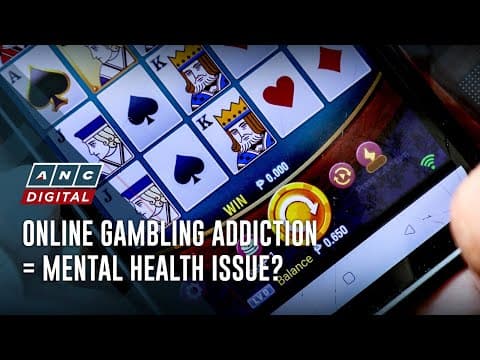
[0:03]Philippine health authorities say addiction to online gambling can be considered a mental health problem. It notes easy access to online gambling has greatly contributed to the growing addiction problem, especially among the youth. For more on the damaging effects of gambling, we're joined by clinical psychologist Dr. Randy De Los Santos. Dr. Randy, good afternoon. Hello, Ron. Thank you for inviting me. Hi, nice to talk to you again, sir. Dr. Randy, I've I've heard gambling addiction being described as a hidden addiction. I'm wondering why it's called a hidden addiction as opposed to the other compared to other addictions. And how does this make it possibly more dangerous and possibly more difficult to treat? Okay, first of all, I'd like to say it's very much hidden and yet very much open. It's open in the sense that, you know, it can be legal, gambling can be legal, gambling can be culturally acceptable. And gambling can also be family sanctioned. So, you know, people can do it out in the open. And yet it's the addiction that can be very hidden in the sense that you know, there's a shame and denial about it. So people will have the tendency, the gambling addict will have the tendency to hide it and perhaps protect gadgets from being found out and from, you know, debts and loans from being found out. And and there's no uh physical uh symptom of it, unlike other addictions where you can see people actually losing or or gaining weight. Correct. Yes. Well, physically, we'd have to rely on behavioral manifestations. Like, for instance, money getting lost or debts getting made or even loans, you know, unreasonable loans being made. These are behavioral manifestations. And also about perhaps time being spent gambling or perhaps missing class or missing work. Then these are the physical manifestations that can be noted. The the hottest issue right now, of course, Dr. Randy is online gambling. Do you think this is more dangerous than the regular form of uh gambling addiction? Well, I would say any form of gambling is dangerous, but online gambling can be kept more secret. Of course, online gambling happens in private uh, you know, gadgets. It can be done secretly. And you know, it's very easy to make loans online, especially from uh professional scammers who lend money. So, this is the reason why online gambling, although as harmful as, you know, casino gambling, can be equally as harmful because it can be kept more secret. What what happens when a person maybe starts gambling? If we're talking about youth, and we're talking about online gambling, what happens when a kid starts using or uh playing online gambling early and gets addicted to it early as well? Yes. Well, sadly, of course, the teenage years are the formative years of the person. And it's very bad that, you know, the teenager grows up with addiction problems. Now, of course, for any person, whether a teenager or an adult, the gambling addict can experience depression. Because there's a sense that, you know, he enjoys or she enjoys the act of gambling, but he or she also knows that there's something wrong with what he or she is doing. So there's a sense of shame, there's a sense of depression. And then there's also the sense of anxiety of having to be found out, you know, and can you imagine that the kid grows up feeling depression, anxiety, and shame and guilt? So, this happens all during his or her formative years. And then there's of course, the possibility that he or she may, you know, miss class or failing his or her subjects, and this can be all be very damaging, especially the shame that the family may found, uh may find out and brand him or her as, you know, black sheep. Speaking speaking of uh families, Dr. Randy, what do families look out for? Uh, as we mentioned a while ago, they online uh addiction, online gambling addiction does not show any physical symptoms. Uh, what do family, close family members have to look out for to see if their their child or any family member is already addicted to gambling. What kind of uh behavioral issue or changes? Yes. Behaviorally, I I well, I would probably say emotionally, there will be mood swings. Okay. Mood swings is one, and the other thing is probably, uh, the act of hiding, perhaps the gadget, protecting the gadget from being opened and found out. And then, of course, there are accidental, uh, discoveries, no, like, uh, bets, loans, and the stealing of money. And perhaps academically, the kid will suffer with low grades or poor grades. Right, right. For a person, uh, who may want to treat himself for for gambling addiction, who who do they, who do they go to, uh, to get treated? Who do they ask? Yes. First of all, it's very important, uh, to, uh, consider family members. You know, perhaps there's an empathetic or sympathetic family member who the addict can open up to. That's a start. If not a family member, perhaps a friend, you know, and if they're not open to, um, approaching family members or friends, then perhaps they can consider the counselor at school, or professional health. Perhaps a psychologist for talk therapy or psychiatry if they feel that they they have some something uh more serious going on. Right. How how are they treated? And and does treatment take long if they do go to a medical professional? Well, first of all, they have to be assessed whether they might have depression, anxiety, perhaps ADHD, or some other impulse control disorder, you know? So the psychiatrist will find out if there's a disorder underlying the gambling. Secondly, uh, talk therapist or psychotherapist will find out if there are emotional issues or emotional baggage that are leading to the person to escape through gambling. Uh, yes, and perhaps, if it's needed, if it's very serious, then perhaps rehab may be considered. When we talk about rehab, it may be an inpatient program where the person gets confined or an outpatient program where a behavioral contract is made, which the addict is supposed to comply with. Is is it possible to fully recover from from gambling addiction, doc? I would say yes, because I would say that, you know, it's very challenging, but perhaps 80% of my patients actually get well. As long as they have this desire to get well and there's good family support system. Then this will all add up to recovery. Right, that's great. Uh, just going back to the to the family, how should family members approach uh a close loved one uh suspected to have of having gambling addiction already. How do they talk to that person? Right. So first of all, it's very good to, you know, kind of, uh, compose oneself, if you're the family member, compose yourself, try to be neutral. Postpone your judgment or emotionality because what your aim is is to have an open communication with the, you know, your loved one. Secondly, it's good to, you know, judgmentally inquire what's been happening. And uh, what help or what triggers might there be? And it's also very good for family members to be supportive so they can ask the person whether he or she is willing to receive professional health from a psychiatrist or psychologist. Is is recovery faster with the help of family? Definitely. Because sometimes, you know, even the family has to be considered in the evaluation, psychiatric evaluation. Because sometimes the family itself may be the trigger. Sometimes the addict may be escaping from family issues or family conflict. And then gambling is the way to feel good. It's the pan solution for feeling good. So, you know, the, the gambling addict is the identified patient, but really, it's the whole family system that might be the actual patient. Dr. Randy Dellosa, thank you very much, sir, for talking to us.
[10:07]Yes. I would like to tell you if you have a gambling problem that seeking help is a sign of courage, not a sign of weakness. Because weak people wouldn't find help, but brave people will. That's one, seek help because it's a sign of your courage. And secondly, there is hope and help for you. All you need to do is reach out, and there will be a lot of people who will be willing to help you recover and uh, heal from your emotional baggage and even become a better version of yourself. Dr. Randy Dellosa, thank you very much, sir, for talking to us. Thank you, Ron.


