[0:00]This episode was made possible by Cheddar, and their new YouTube channel that covers business, technology, media and news, but without the boring parts. Be sure to check out their video on preventing a robot uprising after this.
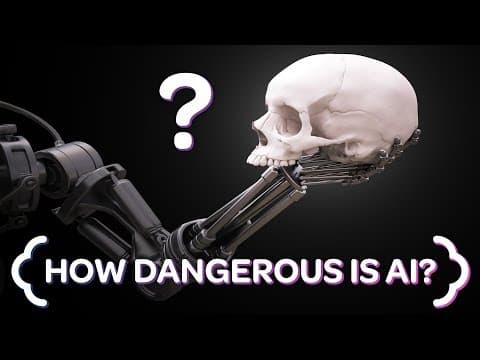
[0:14]Let's get one fact straight. It's only a matter of time before we successfully create an AI that surpasses the intelligence of a human being. Estimates for this event, known as the singularity, range from anywhere between 10 and 50 years from now. What happens next is anyone's guess, but there are two prevailing theories. One, humanity is fast tracked for more amazing technological innovation than we've experienced in our entire history. Or two, extinction at the hands of a sentient super AI who is indifferent to our survival. Let's back up a little bit. There are a few distinctions to make when talking about advanced AI. On the low end of the intelligence spectrum, there is weak or narrow AI. Software that is useful within a fairly limited range of tasks. Alexa, Siri, and all the other personal assistants are the most obvious examples. But we're actually surrounded by narrow AI. Your Netflix caters to your taste in movies and TV. Amazon predicts the kind of products you like based on your browsing habits and your purchase history. Machine learning algorithms represent another form of narrow AI. Any program that can adapt based upon user interaction can be lumped into this category. This type of artificial intelligence is rarely considered a threat. Take Siri for example. There's no real intelligence there, no mind, no self-awareness. She'll answer some questions for you, but she's completely useless outside the scope of even fairly simple ones. Moving up one level, we have artificial general intelligence or AGI. This type of AI is able to apply its intelligence to a much wider range of applications, and can successfully perform any intellectual action a human can. This level of AI is generally the goal for projects aiming to develop an advanced artificial intelligence. Academics often refer to AGI with the ability to experience consciousness as strong AI. Think how from 2001 a Space Odyssey, or the T800 from Terminator, or Ava from Ex Machina. These are machines or software that are just as intelligent or more intelligent than humans, but have not entered a state of runaway self-improvement that would lead to the next stage of AI. As of 2017, there were at least 40 organizations around the world actively researching AGI. Now for the big one, artificial super intelligence. This is the level of AI that some of the world's leading experts believe could spell the end of mankind. A super intelligence would be smarter and more capable than all of humanity's greatest minds put together, and getting more intelligent every second. These AI would seem like gods to us mere mortals. Infinite knowledge, the ability to perform countless tasks at once. Instant answers to questions we haven't even thought of yet. The biggest question we have thought of regarding a super AI is whether or not it'll be friendly. When we think of modern AI, we think of giving it a task and it performing that task, then waiting for the next command. It's not friendly or unfriendly, it just performs its task. What happens when we have a vastly more capable AI and we task it with ending world hunger? The easiest solution for the AI would be to eliminate humans and thus end world hunger for good. That may sound like a far-fetched example, but consider how the AI would see humans. We look at insects and have little regard for their lives because they're insignificant, and more importantly, far less intelligent than we are. We step on ants without a moment's hesitation. How would an entity millions of times more intelligent than humans be likely to treat us? We tend to disregard the danger because we assume AI will be human-like. After all, we're making it in our own image. This arrogance could lead us to develop a sentient machine that would see our existence as nothing more than a nuisance. A parasite that causes more damage than anything else on the planet. In that regard, the machine would be right. And if it considered us a threat to its own existence, it's unlikely that we could do anything to stop our ultimate destruction. How can we stop a being that has access to all of our knowledge and more, can control our computer systems, can create and destroy at will by using our already existing infrastructure? Or worse, by building its own that is far beyond human understanding. If this super AI is truly sentient, it would be able to communicate with us. But whether we would even merit that communication is up in the air. This is why some of the leading experts expect true artificial intelligence to be our final invention. The greatest achievement in history that leads to our own destruction. One thing that movies and TV tend to get wrong about destructive AI is that it always seems to take the form of a humanoid robot. In reality, a super AI would have no need for a single human-shaped enclosure. A sentient software-based AI could travel instantly between electronic devices, and inhabit many of them at once, making it impossible to get rid of. A single evil robot makes for good TV, but in the real world, we'd probably be dead before we even realized the mistake we had made. Of course, this may not come to pass. Humans have a way of surviving our most destructive inventions, at least so far. And even using that same technology to improve our lives. The same could be true of artificial intelligence. If we could develop an AGI and train it to experience human emotions such as empathy, we could potentially create the most powerful force for good in the history of mankind. A benevolent AI whose only task is to improve the lives of humans and work towards a greater good, could make for a future free of disease, hunger and suffering. This AI wouldn't even have to be fully sentient. If it was intelligent enough to be turned loose on difficult problems, but lacked any kind of motive or self-awareness, as long as we were careful with instructions, we could have an incredibly useful software-based assistant that could be put to work over a very wide range of applications. We could even integrate with this AI in the future by augmenting our brains to run the software. Kind of like a super advanced personal assistant in your head, able to fetch answers, teach you new things, and help you make important decisions. No one's really sure what will happen when we finally reach the singularity. But whatever happens, it will change the course of history forever. The future of humanity is one of our favorite topics here at Second Thought. So we were more than happy to partner with Cheddar on this episode. Cheddar recently launched their own YouTube channel and are making videos that cover business, technology, media and news, but without the boring parts. I just watched their episode about avoiding a robot uprising, and I highly recommend you check it out too. And if you like it, consider subscribing to their channel, which has tons of other fun and informational content and watch more of their videos.


