[0:00]Good morning and thank you, Chairman Gasser, ranking member Lowenthal and distinguished members of the subcommittee. Thank you for this opportunity to provide testimony this morning to enable federal oil and gas leases to be held by the production of helium. My name is Jason Des and I am President and CEO of Tacitus Ventures Corp, a privately held company dedicated to the exploration and development of North American helium resources. The focus of my company's activities is to find and develop helium rich gas accumulations, and our interest as a company is to secure and maintain leases on certain federal public lands which have been identified in order to pursue these helium development opportunities. While helium is the second most abundant element in the known universe, it occurs relatively rarely on our planet in commercial concentrations. The vast majority of current helium output is produced as a byproduct of natural gas processing including LNG. Following the 2013 helium stewardship Act, the privatization of the BLM's pipeline and storage system in 2021, and the reduction of the strategic helium reserve. A shortfall of nearly half of the United States annual requirements of around 2 billion cubic feet is expected between between annual requirements and the expected US production. Based on the current demand, this shortfall is likely to impact the US helium market within the next five years. If that occurs, the United States risks becoming dependent on foreign sources of helium. Currently and as you stated, the world's largest producers of helium outside the US are Qatar, Algeria and Russia, who's expected to come on with additional production sometime after 2021. Helium from each of these countries comes with a certain level of geopolitical risk as illustrated by current and recent events with the blockade of Qatar that has temporarily removed approximately one third of the world's helium supply from the market, reigniting significant concerns about another helium shortage. The United States is blessed with an abundant resource of helium, most of which has been identified through extensive oil and gas exploration in the first half of the 20th century. Many of these helium resources have been left undeveloped as it is often found in its highest concentrations within gas deposits that have been regarded as non-commercial from a hydrocarbon perspective. Bringing new US supplies of helium to market over the next 5 to 15 years will mitigate the risk that nearly half of the current and expected US helium requirements will have to be sourced from countries that may be unstable, unfriendly to US interests or both. Now under the existing BLM oil and gas leasing rules, helium is specifically excluded as an extractable resource without a federal oil and gas lease and a supplemental agreement with the federal helium program administration. Thus, unless stipulated oil and natural gas production quantities are met, these leases expire under their terms, regardless of the revenues arising from the sale of helium. And by extension, any associated helium agreements expire simultaneously. Based on the present regulatory structure, long-term development of helium resources on federal public lands is precluded where hydrocarbon gas streams are not considered commercially viable by the mineral leaseholders, effectively stranding any helium potential. Helium is often found in its highest concentrations within these gas deposits that are regarded as non-commercial, create create a creates a compelling case for enabling the development of helium resources to be decoupled from the historical regulatory treatment with hydrocarbons, thereby encouraging private sector investment in the exploration and development of helium resources which are commercially viable in their own terms. Bringing these known helium resources into production and encouraging explorations for new resources would firstly lead the United States to continue its helium self-sufficiency for the long-term, eliminate future dependency on potentially unstable or unfriendly foreign source supplies. Secondly, we would create greater flexibility and stability in in a market currently vulnerable to disruption from gas production plant outages, hydrocarbon processing plants and geopolitical events. It'll also generate new federal revenues without creating additional costs associated with new regulatory oversight and it leads to job creation and increased economic activity in the more remote or rural regions of the country. In summary, Mr. Chairman, in order to create the conditions to encourage private sector investment in exploration, resource development and associated infrastructure, we respectfully request the distinguished members of the subcommittee support the proposed helium extraction Act to enable development of helium resource on federal public lands to be decoupled from hydrocarbon production and stand on their own economic merits. Mr. Chairman, thank you for the opportunity.
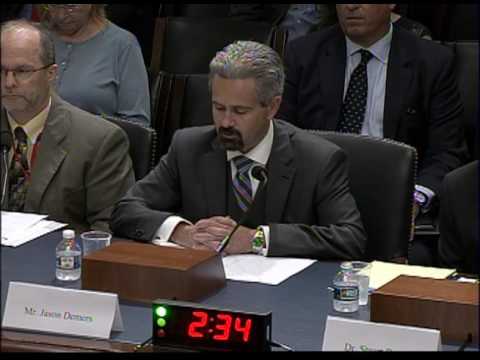
Copy of 6.21.17. EMR. 10:00 AM. Demers
House Committee on Natural Resources GOP
4m 53s764 words~4 min read
AI audio transcription
Transcript source
AI audio transcription
This transcript was generated from the video's audio because no usable YouTube caption track was available. The transcript below is server-rendered so it can be read, searched, cited, and shared without opening the original YouTube player.
Pull quotes
[0:00]Good morning and thank you, Chairman Gasser, ranking member Lowenthal and distinguished members of the subcommittee.
[0:00]Thank you for this opportunity to provide testimony this morning to enable federal oil and gas leases to be held by the production of helium.
[0:00]My name is Jason Des and I am President and CEO of Tacitus Ventures Corp, a privately held company dedicated to the exploration and development of North American helium resources.
[0:00]While helium is the second most abundant element in the known universe, it occurs relatively rarely on our planet in commercial concentrations.
Use this transcript
Related transcript hubs
Watch on YouTube
Share
MORE TRANSCRIPTS


