[0:00]In this video, we're going to talk about price action rules and why it is so important to have understanding of these rules. Why price action rules work? It's simple, it's because markets reflect human behavior, human greed and fear, and since the core human behavior hasn't changed and most likely will not change, market will continue to move in the same way and will continue to form the same patterns again and again. Most retail traders are unaware of the fact how price action moves on the chart. And why is that? It's because average trader gets first introduced to information that will do the complete opposite of what it should do to educate him. Most traders at first look for system that will do the work for them and they will look for indicator based strategies. But as most traders already know, this is a false erand and indicators don't work, they only show past performance. All these fancy indicators look great at first, but only thing these indicators do is they clutter your chart. Having all these indicators on a chart will stop you from learning about the true movement of price and is going to be next to impossible to get the proper understanding about the price movement. Only when you start to focus on raw naked price action, you will understand how price actually moves. Since markets are not random and there is a reason to how price action moves, there are rules that will help us to stay on the right side of the market. And the first rule is the trend line rule, which says, after break of a trend line, which means that the candles will close outside of the trend line, new extreme is going to be formed. And after new extreme is formed, we expect correction phase or possibly straight up reversal. Now, we have a downtrend looking structure on the chart. So as price action traders, we want to find a pattern because price action is never alone and naked on a chart and is always contained by some form of a pattern. So you guys can see, we have a nice bearish downtrend working lower and we have a triple confirmation of this downtrend. So at this point on, the structure is bearish and trader is only looking for short opportunities. Notice what price created, there was a break of this channel, there were candles that closed outside of this channel. Most traders will take this information and they will think that the trend is over and they will start counter trend trading, they will start looking for buying opportunities. But at this point on, according to trend line rules, we know that we cannot go long just yet. This downtrend needs to get new low, it needs to get retest of this previous low. And notice what price created, it created move to new extreme and after new extreme was formed, then we expect correction or possibly straight up reversal. And price in this instance straight up reverse and this is the uptrend now when you're safe to be looking for buying opportunities. So this is the rule number one, when you're following the trend line, you're only looking for longs after you get a proven trend in opposite direction. And after you have a break of a channel, you expect new stream to be formed. Same thing will apply for the short channels as well. Notice as there is a downtrend working lower, there are short uptrends in between. And these uptrends at the same time have a break. And retest of a new extreme or at least attempt to create new extreme, break new high, only in this instance, there's a break. No new extreme form, but that's because the downtrend is just too strong, but you expect the same thing to happen even on a micro level, even for these corrections. After break of uptrend, you expect new extreme to be formed and then you know that this uptrend is over. So this is the trend line rule, bullish uptrend working higher, break of the channel, and the trend line rule says that after break, new extreme is most likely going to be formed. And price created new high and this high is higher than the high inside of this channel, so the trend line rule was fulfilled. After that, price created a short downtrend, which also had a break, move to new extreme, and then price indicated a correction phase. So after you have a break and new extreme and you have a reversal pattern, you can start looking for shorts, but once this downtrend played out, because this was just a short pattern, the correction phase for this overall initial uptrend came into play. So this is how you follow the trend line rule. When price breaks the trend line, don't counter trend trade just yet. Expect continuation of the previous trend. Counter trend trading while trend line is in play is against the rules and most of the time, you will get burned. After correction, trend can resume or reverse, meaning after there is a break of a channel, new extreme form and there is a correction phase. If the bias is strong enough, there can be a larger pattern and trend may resume or after that correction, the new trend may start in the opposite direction, the trend may reverse. We have a nicely fitting option working higher, multiple confirmation indicating to me that this channel is valid. So, I'm following the trend line rule, I'm only focusing on long opportunities, I'm not looking for shorts. Even when I have a break of this channel, just because we have a break of this channel, that doesn't indicate reversal, that's against the trend line rule and that's against the price action rule. I expect for price to create new high, price created new high, formed a double top, which is close enough to be considered as new high. And after that, price slowly consolidated and there was eventually downtrend after that, but only after you get a break and new high, the trend line rule is fulfilled and then you can start acting accordingly. Bearish downtrend working lower, beautifully fitting channel, this is why market geometry is real thing and this is how you can understand that the structure is bearish. You don't need any indicator, all you can need is the simple naked chart, naked candlesticks and you can get the understanding what the price is going to do. Price closed outside of this channel, indicated break. This is not the time to buy the market just yet. Price created big move to new low, to new extreme and from this point on, traders are safe to at least play with the idea of possibly buying the market and eventually going long. With trend line rule correlates the second price action rule that says, don't counter trend trade. Lot of beginner traders, when they're watching the strong trend go, they feel that the trend cannot go any further and they will start to pick tops and bottoms and this lot of times lead to never ending frustration and to a lot of multiple losing streaks. Doesn't matter how good the signal bar looks, how good the setup looks, if the trend is in play under any circumstances, you cannot counter trend trade just yet. You will use the trend line rule to identify the trend, to follow the trend. And if you cannot find the perfect trend line, you will still follow the overall bias. Only when you get a trend in proven opposite direction, that's when you can start looking for entries in that trend. But under any circumstances, you cannot pick tops, cannot pick bottoms and you cannot count and trend. Probabilities are just not in your favor and most traders are losing their money trying to pick tops and bottoms. Markets are designed to make counter trend entries look favorable and there are designed to make with trend pullbacks to look sketchy. For that reason, lot of traders are attempting to buy the bottom in strong downtrends, but most reversal attempts in trends will fail. These rallies to the upside are just reversal attempts and most of them will fail, they are against the overall trend. When you are not sure if the trend ended or not, you follow the overall bias and even if you are struggling to find a proper trend line, you are sticking with the overall bias and you are not counter trading. Don't sell the uptrend even if long traps occur. Sometimes there can be a good long setup, good buying opportunity in a bullish structure, in a bullish trend. Behavior may be wrong, the trade may be a little bit of a congested, which is another rule we're going to talk about. There may be a short trend line that is in play that needs to play out. Remember the trend line rule, it goes even for the short term trends as well, even if there is a small channel and the structure is not that big, because right now I have an example of a quite a strong bullish uptrend. Even if there's uptrend is minimal, you still don't want to counter trend trade unless you have a break of a trend line and new extreme form.
[10:00]This one is a big one, the trading range rule. The most important thing to understand about trading range rule is that most breakouts of trading ranges will fail. But we see it all on the internet, beginner traders are trading breakouts. Majority of traders are trying to trade breakouts and they keep losing money because most breakouts of training ranges will fail. At least temporarily, there can be a pullback and the breakout may succeed eventually. But if you are trading the breakout, you want to take it on the breakout pullback setup. You don't want to trade the breakout in its breakout phase because most breakouts of trading ranges will pull back into trading range and the breakout will fail. These breakouts are working just enough to keep the majority traders trying, but in a long term, this is not the proven strategy to approach the market and it's against price action rule. Now when we are watching trading range, we are observing the health of a trading range. We want to see if there is a bullish imbalance or bearish imbalance. Now trading range rule also says, not only most breakouts will fail, but we want to buy low and we want to sell high. You want to do the opposite what the common sense is telling you. Congestion is just a small pattern of a trading range and you want to avoid trading these congestions. That's a price action rule, trading range rule because congestion is just a micro level of trading range and the price gets too indecisive there and you want to stay away from these trades. Price is swinging up and down, up and down. We as price action traders need to identify the support, identify the resistance, ours are never alone on the chart, there's always some form of a pattern. Remember, price action reflects human behavior. And this behavior always result into price action patterns. Price formed a double top and we have a break below support, but notice the breakout ended up failing. Why? Because most breakouts of trading ranges will fail. Price broke above the resistance, and what ended up happening, breakout failed again and price pulled back into trading range. This is how you approach training ranges and this is the trading range rule that you want to follow. You're looking for opportunities of the bottom of the top, you're trying to fade the breakout, you're trading them against the direction of a breakout. If breakout breaks to the downside, you want to look for buy, and if breakout breaks to the upside, you want to look for sell. Another trading range structure, huge breakout to the upside that is looking very bullish. Lot of traders rely on momentum, but the breakout snapped back into trading range. Another breakout, price pull back into range, another breakout and price pull back into range again. Most breakouts of training ranges will fail. Most beginner traders trade breakouts. Momentum lures traders in. We have a nicely fitting uptrend working higher, and price formed the double top, which is looking very bullish. Lot of people relying on momentum, price breaking out. It's time to buy. However, momentum is just not enough when you're looking for high probability setups. You also need to combine it with other price action rule, like a high probability setup rule, which we're going to talk about next. Most breakouts will fail even in small trading ranges. This right here, this small consolidation is a trading range structure just like we saw in the examples earlier, just on a small micro frame. There's a support, there's a resistance, there's just indecision.
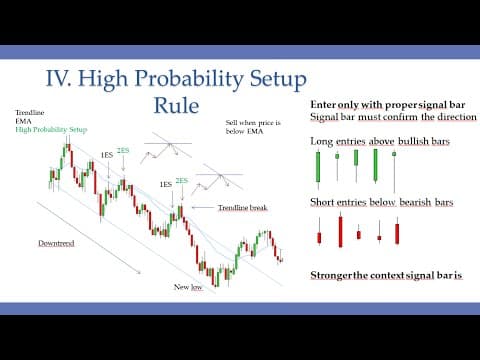
[14:38]There's no clear direction, price broke to the downside strongly, this is a failed breakout and price pull back into trading range. Notice we traded up into this trading range, so you expect for price to eventually break to the upside. And even when there was a breakout to the upside, notice price pull back first, because the first breakout will fail at least temporarily. And this is the breakout pull back, when now you know that you want to go long. After price pull back and now you're safe to look for longs, but most breakouts will fail even from these tiny congestions and you want to stay away from trading in the middle of these tiny little consolidations. That's against the rule. We just talked about three price action rules, that mainly has to do with the structure and the bias of the market. But is there a rule that will help us identify proper place to enter? Yes, there is, and it's called the high probability setup rule. When you train your eyes to see the price movement, you will realize that market moves in pairs of two's. Market is not just pointing straight up or straight down. No, these would be V-shape reversals and they are not common, they are small pullbacks in between and these are two leg of pullbacks. Remember, price reflects human behavior, what high probability setup rule does, it will tell us when to enter and when we put odds on our side that the trade has high likelihood of succeeding. So what is a high probability setup? High probability setup is a second entry at key entry points with the trend, it is a failed second entry that goes against the current trend. Failed breakouts or higher lows, lower highs confirmation setups. Now, these setups don't mean anything on their own. If we want to take a high priority setup, we need to combine it with the key entry point. This is the place on the chart where high probability setup can appear. Now key entry point is a trend line, support or resistance line and exponential moving average. Now, I'm aware the exponential moving average is a indicator, but we use this indicator only as a supportive tool. We are not relying on this blindly. This is very useful tool that can help you identify the proper key entry point and can tell you information about the structure. This is what the high probability setups look like. Notice, we have a bearish structure. So what we have to do, we have to draw the channel. We have a trend line working lower. Notice, we have a break and a new extreme, perfectly following the trend line rule. I mentioned that price likes to move in pairs of two's, and this is what it looks like. We have a first leg, correction, second leg, and this is the key entry point. You guys can see the trend line, support or resistance line or this blue line 21 bar exponential moving average, this is the two leg a pull back. So we have a downtrend working lower, price is working to the upside, we have a short uptrend that had a break and new extreme. Remember the trend line rule, you keep drawing it even for the short term corrections. So you know that the uptrend played out and price created first attempt to sell, second bullish leg up and the second attempt to sell. It is off the two key entry points, not only the trend line, but the 21 bar exponential moving as well. And this is the place where the odds of this trade succeeding are highly in your favor. So you guys can see, two leg a pullback second entry short at the key entry point. Uptrend working higher, break and new extreme. First trend line break, you're following the trend line rule, you expect to get new extreme, so you're still thinking about selling, you're not counter trading at this point on. This is a two leg a pullback, second entry short, and resulted in a big move to new extreme. This time, you're below EMA, you're at the exponential moving average, even though you're not coming off the trend line, you're still following the rule because you're combining the trend line rule with the high probability setup rule. I also talked about a failed second entry that goes against the trend, but it's fairly simple. When we have a bullish structure working to the upside, we're not counter trading, we're following the trend line rule, we're looking for second entry longs, two leg a pullbacks at the key entry points, but we can also take a failed two leg a pullback to the downside, failed second entry short. Because the trend is to the upside, it's not to the downside, so any second entry short means nothing and it means that it's going to most likely fail. And we have a second entry short right here, new low, first entry short, second entry short, and we have a second entry short failure. This is a failed second entry short against the overall trend. Your stop loss goes one tick below this signal bar and would have resulted in winning trade. Same scenario right here, price created new low, first entry short, pullback, second entry short. So this is a failed second entry short, also at the same time, it is a second entry long. First leg, pull back, second leg, first entry long, second entry long. So the high probability setup rule says that you're only taking these setups that have higher chance of succeeding. You're not interested in taking setups, they are not confirming the key entry points, they are far away from EMA from the trend line and they are not variations of a two leg of pull backs. We have a bunch of entries right here, but you're not interested in taking these entries, chasing the market, you're not interested in selling the market. High probability setup is when price pulls back to key entry point. This is where a lot of smart traders are starting to buy on a high probability setup. The fifth price action rule that you need to follow is the signal bar rule, which means you only want to take longs above bullish bars and you only want to take shorts below bearish bars. You only want to enter with the proper signal bar. Signal bar must confirm the direction and momentum of the market. These are few examples of good bullish bars that you want to go long above and these are just few examples of good bearish bars that you want to sell below. You never want to sell below these bars and you never want to buy above these bars. You need to combine the high probability setup rule with the signal bar rule, so you can maximize the probabilities of trade succeeding. Of course, stronger the context, the signal bar is less important. Sometimes the context may be just so strong, where you can afford to take a slightly less ideal signal bar and you're still following the rules. But for the most part, you want to stick to this rule, you want to follow a good signal bar. Let's now take a look how to use these rules in markets. Let's talk about price action rules in trading range structure. When I'm trading trading ranges, there are a couple key points that I have to go through in my mind when I'm trying to identify a high probability setups. And these are just a few points that quickly flash through my mind. Number one, I try to identify the structure. It is uptrend, or is it a downtrend, or is it a trading range? I want to locate key levels. If I know that it is trading range, I want to find a support and resistance line because market likes to oscillate in between these lines. And if I want to follow the trend line rule, which means I want to buy low, sell high and fade the breakouts, I need to identify my support and resistance correctly. I also want to locate trend lines. I want to locate the short trend lines because there are trends working even inside of a trading range. Trend line rule still apply even inside of the trading range. For the most part, I'm carefully trading in the middle of trading range. I want to stay away from congestions, that's very important rule. I want to look for setups to fade the breakout. Following the trend line rule, buy low, sell high. I want to be patient, don't want to chase entries in case I miss the trade. If I miss a trade, I need to wait for another high probability setup to appear. I cannot just jump the gun and risk taking entry that is not a high probability. I cannot trade a breakout, I cannot take first entries, I cannot count and trade, that will not result in long term consistent success. I'm looking for entries at exponential moving average. I'm looking for good signal bars if I'm about to enter and I'm looking for second entries with the trend and failed second entries against the trend. Because like I said, there are trends working even inside of trading ranges. So when I'm looking at the trading range like this, what I have to do, I need to identify my key levels and I need to identify my short trend lines. Because you guys can see, there's uptrend, break, two legs to new extreme, downtrend, break, new low. And you guys can see the trend line rule playing out perfectly after each new break, there's a new extreme and then reversal. Uptrend working higher, little break, new extreme. So at this point on, I expect for price to go down. But at this point on, we are in the middle of trading range, so I'm just sitting patiently, I'm not doing anything. Notice, price created last leg to new extreme and eventually traded down. So I keep drawing my short channels, I keep following the trend line rule. We have a break, new extreme form which tells me that the downtrend played out. And notice, we broke below the trading range and most breakouts of trading ranges will fail. So I'm looking for opportunity to trade back into trading range. I'm following the trend line rule, I'm following the trading range rule, I'm following the high probability setup rule, but I don't have a great signal bar, so I'm just waiting patiently. Price indeed pulled back into trading range. I need to draw the short channels. At this point on, I have a strong bullish uptrend and I'm waiting if I get a good setup at the exponential moving average, at the key entry point. Because I'm most likely not going to get good entries off of this channel, because it is too tight and it would be too far away from the exponential moving average. Notice, price is strongly continuing to the upside. We bounce off the resistance, but I'm not selling just yet. That would be against the trend. I don't want to counter trend just yet. We have a 20 bullish bars consecutive working higher. Only bearish bar was this one right here, but you can classify this as a bullish bar as well because it has gigantic bullish stem at the bottom. So I expect according to trend line rule to get new extreme, and notice price getting new high, first entry long. I'm not interested in taking a long entry here because it's just a first entry, and price created, we tick over here and created a second entry long. We have a little inside bar here, but this is the proper second entry long right here. So this is two leg a pull back at the key entry point, under bullish structure, great signal bar, this is a high probability setup and this is the entry that I want to take. After I take this entry, I can hold the runner, but I cannot take entries at these highs. We're now far away from key entry point and at this point on, since price keeps pushing higher, there is a probably a different pattern. There's a spike and a channel pattern, which is typical when the first leg is steep and then the channel flatens, the second leg flatens. Now we have a by channel pattern, and notice price created new low formed, first entry short, second entry short. But I'm not taking this trade because it is far away from EMA and it is far away from the trend line. I'm still patient here and I'm just watching market go without me. Preferably, I'm still holding the runner and letting this portion of the market run so I can capitalize and locking profits without me getting antsy that I am missing a big move. Price is finally pulling back to my key entry point, to the EMA in a form of a new high, first entry long, second entry long, with a two leg a pullback. Big bullish bar, following the signal bar rule, second entry long in a strong bullish structure, all rules apply. You're in the short downtrend, break in new extreme. So this is a high probability setup, followed by a higher low confirmation of a two leg a pull back. And new low form, first entry short, second entry short that goes against the trend, failure. Off two key entry points, great signal bar, still sticking with the trend. And at this point on, once again, I'm not chasing entries up here. I'm only interested in the high probability setups. Notice, this is the point where price is creating these big moves up. And without the knowledge of price action, you're wondering why price is turning up from these points. What's so magical about these points that price will always bounce here? Well, it's because there's a key entry points. It's because there's a two leg a pull back, and it's because all other price action rules are being met. Price action rules for downtrend are the same as for uptrend, just vice versa. I'm still following the same rule, but I'm looking for short opportunities. I see a somewhat range-like structure, but with a bearish bias. Highs are still lower than the previous highs and the lows are still also lower and lower. So we have a range structure right here, but with a bearish bias. So at this point on, I'm not particularly looking for longs, I'm just waiting patiently for a good opportunity to appear. Notice what is happening next. Price is continuing working sideways. Price form a new low and created a two leg a pullback, first entry short, pullback, second entry short. Can I take this entry? Well, I don't really want to take this entry. Why? Because it's getting a little bit stacked. We have multiple bars just working next to each other showing indecision. This is not showing me any momentum and we closed above EMA. If I want to go short, I preferably want to sell below EMA. And we are in the middle of this trading range as well. So this is not particularly the perfect area I want to sell. However, I can still see the low being lower than this and then this, there's a possible downtrend working lower. Notice what formed next. There was a lower high confirmation setup of this second entry short. Not only that, price now confirmed the momentum and pushed below EMA. So now this is better entry. Lower high after second entry short below EMA, confirmation setup and it's according to rules. Price is failing to reach the resistance, is staying below and the possible downtrend is now coming into the tuition. It can also be treated as a small breakout pull back of the micro congestion right here because these bars are just small little congestion working next to each other. At this point on, structure is clear, bearish downtrend. I can identify the stronger downtrend. It fits nicely off the lows, and as the price is pushing lower, we have multiple setups, either first entries or whatever setups. They are just far away from exponential moving average. I'm not interested, I'm not interested in buying the market. It seems the price moved too far down, we're way over done. It's time to pick a nice signal bar to pull back, that is not how you're going to maximize the probabilities on your side. You only want to stick with the direction of the trend and this trend line is still in play. Another new low form, first entry short, second entry short, two leg a pull back, but signal bar is doji horrible. I'm waiting patiently. Price created another second entry short. Why am I calling this another second entry short? Because we have here what looks like almost to be a micro double bottom. A micro double bottom reset the count. So technically, I can treat it as a first leg, second leg, first entry short, second entry short. This right here right now has a much better signal bar, it is at the key entry point and this is the proper entry. Price form a lower high, confirmed a two leg a pull back, but the signal bar is horrible. So even though context is perfect here and I can take a signal bar that is not great, lower highs are supposed to have good signal bars, they are confirmation setups. So this is how you're using price action rules, you're still sticking with the trend and you want to see price pull back to key entry point. Another new low form, another two leg a pull back where uptrend played out with a break and new high, EMA keeps holding price. Key entry point, second entry short, great signal bar, high probability setup. The scalp was made. Price pushed higher, confirmed the key entry point, so you're still inside this channel. Price form a lower high, form even a failed second entry long below EMA in a strong downtrend. You're coming off the trend line, and second entry long that goes against the trend is still high probability setup. After that, notice, price is losing momentum, first break of a channel, you expect new extreme. And these are the rules for a high probability setup. If the signal bar is bad, like on this entry right here, I'm not interested. This is a horrible doji. I really want to see a great signal bar. If context is good, I can have signal bar that is not perfect, but the signal bar still has to be somewhat decent. And this pure doji is not what I want to sell below.


