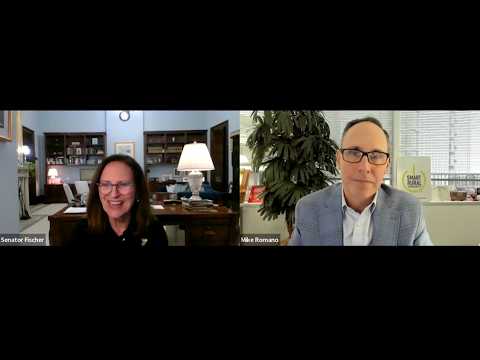
[0:06]Hi, I'm Mike Romano and we are delighted and honored to have Senator Fischer joining us today for this inaugural edition of the Broadband Break. We really couldn't think of a better guest for this first episode. Senator Fischer, you've been so instrumental in the rural broadband space, especially in chairing the Senate Commerce subcommittee on telecommunications and the media. You've been laser focused on ensuring that rural Americans are well connected and it's been encouraging to see a champion for universal service in this role. And with 27 NTCA members in Nebraska alone, I know our folks are going to be delighted to hear from you today. So, our sincerest thanks for joining us and welcome. It's great to be here, Mike. Thank you. I, uh, I love talking about all this very cool stuff that we, that we all are interested in and that we all do. So thank you for giving me this opportunity. Absolutely and we'll jump right in with a few questions I wanted to tee up for you, starting, of course, with the working group. So last year, you relaunched the bipartisan bicameral USF working group with Senator Lujan. Can you give a little light on sort of the thinking surrounding that decision and and maybe to the extent you can, any updates on where that stands? Well, I think first of all, we need to recognize, um, how important the Universal Service Fund is. Obviously, it's uh, very important as I look at my policy work here in the United States Senate. For decades, it has supported, um, communications access to rural America and at a, at a reasonably comparable rates, uh, which is so important. You know, it's it's important that rural America can have that, uh, same access, the same cost as our urban and suburban communities have. It's been 30 years since Congress created the Universal Service mission and today it's uh, really poised for some updates. And that's why we felt we needed to get the universal Fund Working Group back together again, I guess. We want to make sure that this fund is sustainable, that it's modernized, and really importantly that it is predictable. So in August, uh, we began collecting a range of comments, uh, from stakeholders on their outlook for the Universal Service Fund. And my staff and uh, the working group, we've reviewed hundreds of comments and uh, really excited about the level of interest that we have. Well, great and I couldn't agree more with the goals you stated about sustainability and predictability, all incredibly important to rural broadband providers. So thank you for leading that effort. Um, want to pivot now to mapping. Uh, so you recently introduced the map for Broadband Funding Act and uh, we were very pleased to see that pass out of the Commerce Committee. Um, mapping is an iterative process, it continues to get better, but it could get much better still and especially as federal grants and loans, the bead program starts to get out the door for example. Um, can you talk a little bit about what drove that bill and how important it is for the federal government to get broadband mapping right and make sure that broadband funding flows to the communities that need it most. Well, if you, if you know my background, you know that, um, my family has a cattle ranch in the Sand Hills of Nebraska, a very, very sparsely populated area of the state of Nebraska. And when I was in the state legislature, I uh, represented uh, the legislative district, the largest in the state, the size of New Jersey, with a lot more cows than people. And so the connectivity just wasn't there. We had a lot of, uh, really spotty internet. Uh, it makes life difficult. I mean, even our cell phone connections, um, are pretty spotty too, just the, the way the lay of the land is there. And I just believe that everyone, uh, should have access. We live in the 21st century, it's important, uh, that that, that we have the access. It's also important that we get the funding mechanisms right for this. And I originally created the Broadband funding map as as part of the bipartisan infrastructure law. And with the, my map for Broadband Funding Act, I think we're providing some new oversight, some fresh oversight of the FCC's map. So that we can, we can track where each agency funds broadband deployment. I think, I think that's really going to be helpful so we don't see a lot of duplication going on. We want to, we want to be really, uh, cognizant of the fact, again, that we safeguard dollars, but also that we can fund, uh, deployment projects that are able to reach, uh, across our country, across our states, even into the most sparsely populated areas. Well, we really appreciate that continued focus on data. It's just so important to get these decisions right and and there's a lot of stakes. So I do appreciate that. Um, before we dive a little bit more into policy, we call us the broadband break for a few reasons, including the fact we like to take a break a little break from policy for a second during it to sort of ask some questions about, um, other things. So as I mentioned at the start, we have a lot of members in Nebraska and rural communities we care deeply about. Um, you know, can you tell me something, you know, what a Nebraska person product, place, tradition that you sort of point to and think the rest of the country should know more about? Well, everything about Nebraska, first of all, we're, we're the only triple landlocked state, uh, in the country, but we also have more miles of river than any other state. And in the Sand Hills, where, where our ranches, we sit on top of the Ogalala Aquifer. So that's, um, wonderful to have those water resources. But the best thing, uh, I think, is our runs of restaurants. Have you ever heard of runs? Yes. Yes, fantastic. They're wonderful. It's um, the Russian or the Germans from Russia. It was um, um, like a a cabbage beef sandwich and these restaurants started, a franchise of restaurants started, uh, with one in 1949 and now we have a number of across the state. And runzers are even sold in Memorial Stadium on football game days. So, uh, runzers are are the best, when my DC staff comes out to Nebraska, they have to have runzers and franks. Oh, that's fantastic. Yeah, I know that they they're they're a great tradition and uh, you know, look forward to getting back to Nebraska, hopefully get to the College World Series again and have some runzers. Oh, good. Yep, absolutely. Um, so now back to Bead, uh, so recently NTI has held some listening sessions to take input on how to use it so-called non-deployment funds, the funds that were not used after the benefit of the bargain around for deployment. You've been very active and and vocal in this space, sending several letters to NTIA, raising questions about sort of where the money could go next and offering ideas about making sure that it goes first and foremost to broadband expansion. Um, can you give a little bit more detail about, you know, where you think we are now and and sort of your views on how that money could be best put to use? You know, under the, uh, bipartisan infrastructure law, I think it was very clear on how that money was supposed to be spent for deployment. But now we're looking at, um, a lot of left over funding. I know in my state, we have a lot of of quite a bit of leftover funding. I want to make sure that that can still be used, um, for infrastructure development, those investments that we need. So I've been pressing NTIA to make sure that, um, we ensure the proper stewardship of those non-deployment funds, but still make sure that they're being used to close that digital divide that we have. The law, the infrastructure law spoke about important considerations for connectivity to make sure we could support telehealth. And we all found out how important telehealth was when we went through COVID and that's something that we, we need to continue to develop so people are connected. We want to make sure that that funding can also be used for cyber security, extremely important in this day and age. Uh, and then also for economic development. We want to see development across this country, economic development, and you have to be connected in order to have that. So I'd like to see those non-deployment funds go for precision agriculture. I want to see that that to be one type of eligible use. That's a huge, huge driver of economic development in the state of Nebraska. So that includes line extensions, uh, wireless infrastructure, to be able to retrofit existing structures like our center pivots. And they all require that that high-speed connectivity. So I want to make sure that that bead funds reach our ag producers, so we can strengthen our economy and promote those, um, technological efficiencies and advancements, uh, that we're seeing, uh, being developed at such a rapid pace. That's great. Yeah, really focusing on the beefing up the other pieces of the infrastructure that really drive those productive uses for state like Nebraska, that's fantastic. Um, before we get to the final sort of word we're going to give you here, um, just, you know, another sort of break in the moment here, any particular apps or technologies or platforms that you use, that our audience may be interested in knowing about that you rely upon every day? It could be something as simple as email, which is probably my the thing I'd point to, but welcome your thoughts on where that is. Uh, email and texting, you know, that's how I, um, stay in touch with my family. I don't like to talk on the phone to be honest with you.
[10:21]So my family knows that, they don't either, so we text a lot, um, but also it's really important to be able to communicate with my staff. And, um, we've we do that through email and texting a lot of times when I'm, when I'm on the road back in the state of Nebraska and and even during the day here in the capital. That makes sense. Yeah, very similarly, in fact, I think I text with my kids and the only thing they criticize me about is I use punctuation, which apparently is not allowed. You do too. I do too and I spell, I write everything out, I spell everything out, I don't, yeah. Old habits die. You and I, you and I can start texting, Mike. There we go. Exactly. Um, so, uh, last question for you, um, floors yours. Anything you would like your constituents, our members, the broader sort of community stakeholders to know about what you're working on or anything that you see as priority or anything you think they should be aware of that maybe they're not paying attention to right now? Well, first of all, I just want to thank all your members for what they do. Uh, it's important that we can close this, uh, digital divide that's out there. Because it will only make our community stronger, it will make our country stronger. So I thank you for that. Uh, besides the Universal Service Fund, I also work hard on a lot of network security issues. And none of the work that we do to expand the internet access can be completed unless we know that the infrastructure is safe and our networks are safe as well. And we have to be able to develop a a unified cyber, uh, defense strategy. So I introduced, um, my fact act and that would require the FCC to publicly identify companies that hold FCC licenses that are owned by, uh, adversarial governments. You know, we, we live in a dangerous world. I think, uh, especially today, uh, we, people are more and more aware of that, uh, all the time. So I was happy that the Senate passed the bill, the fact Act last year, and I'm really, really happy that the FCC has proactively started to comply with its intent. So, we'll hopefully get the, uh, bill through the house and signed this year. Well, that's wonderful. So, well, thank you for being such a terrific guest. It's been wonderful to catch up with you. Thank you for making time for us and we really look forward to continuing to work with you to, uh, advance those goals you articulated at the start of us for rural connectivity across the nation. So thank you. Thank you. And thank you. I know, uh, every time I visit with your members, um, you know, they're all kind of wonky when it comes to, uh, telecommunications policy. But, um, they're also very, very committed and very sincere to make sure that we have access to, uh, reliable internet and, uh, to make sure we that that we can have those connections for all of us. Well, thank you so much, Senator Fischer. Appreciate you joining us today.


