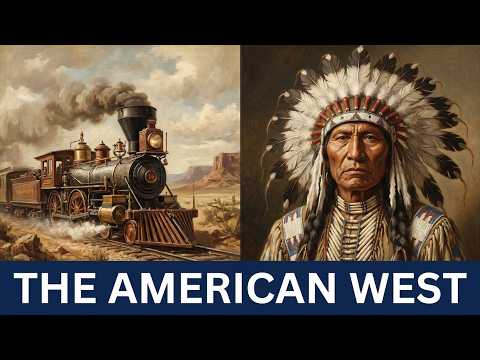
[0:00]Hello everyone. Today we're going to talk about the conquest of the American West. So, I have always thought the topic of the American West was extremely undervalued, particularly for today's students. Right? So, uh, I believe the American West was one of the most significant, transformative periods in American history. However, it is one of the topics that at least I see with most of my students are mostly, you know, unfamiliar with. And they don't seem to have a lot of interest in it, and I believe it is because they don't know too much about it, right? So, uh, for whatever reason, uh, most students or most, you know, young people are more interested in other topics, you know, Civil War, American Revolution, Constitution, uh, you know, even industrial revolution, but they tend to not be very familiar or interested in the conquest of the American West. Which I believe is a disservice, right? Because, um, it is one of the most transformative periods in American history. It is one of the, you know, eras in American history that transformed America to make it, you know, what it is today. You know, we don't have an America today, you know, without the conquest of the American West. You know, it helped shape the attitude of America, you know, it helped transform, you know, our landscape, you know, relationship with uh Mexico, particularly, uh with Native Americans. The conquest of the American West also helped us shape the American mentality of, you know, rugged individualism. Uh, you know, this idea of always finding the next frontier as Frederick Jackson Turner, uh, writes in his, uh, Frontier thesis. So, you know, conquering the West, you know, creates the American mentality, the American attitude that we know today. Right? So, it's extremely important to understand, you know, the America that we know and love today. You know, conquering the American West is pivotal, you know, for understanding this, right? So let's get started. Okay. So to begin with, what is the American West? The American West is the land in the United States, everything west of the Mississippi River. Right? So, uh, you can argue the push for, you know, the Westward Expansion begins in 1803 with the Louisiana Purchase. But we also don't make a really big push Westward until we have this manifest destiny, uh, mentality in the mid-1800s. Right? So, this is when we really start the push towards, you know, from coast to coast, from sea to shining sea. And in a long story short kind of way, the way I explained it in my previous lecture on Manifest Destiny. You know, Manifest Destiny is this American mission, you know, to expand American values. To expand all the progress that Americans believe they represent, you know, these values of democracy, technology, modernization. All these different things that Americans see as progress and making things better. It even becomes a kind of like a religious, you know, movement, right? This idea of we're God's tools to make a more perfect society. Right? So, we need to keep on expanding West, you know, to make things better. Right? So, this is kind of like when we begin this push to the West, right? So, it can best be understood through manifest destiny, right? But we don't make, you know, as big of a, of a breakthrough in really expanding West until, you know, the completion of the railroad. Right? So, the railroad is going to be incredibly important for the conquest of the West. It's going to be incredibly important in shaping American history really, but in speaking particularly about conquering the West, you know, you can't talk about it without the railroad. So, what is the role of railroads in conquering the American West? The railroad replaces trails, for example, the Mormon Trail, the California Trail, the Oregon Trail. Right? So, uh, let me explain what these are first, right? So, these are basically routes that settlers took when trying to move Westward. Right? So, these are not official roads or they're not a structured path. It's just the road, it's just the path that settlers take, you know, but they tend to be very slow, they tend to be very dangerous. Uh, for example, the Oregon Trail would take you a whole six months to travel. Uh, you know, so, they're very dangerous, there's a lot of, you know, dangerous as in, you know, Native American attacks, diseases, uh, you know, the climate, you know, a lot of people died in this in these trails too, right? So, they tended to be dangerous, they tended to be slow, and, you know, again, these are just the path, the route, the first settlers took to to move West.
[5:37]Right? However, in 1869, with the completion of the transcontinental railroad, the railroad replaces the, the trails, right? So, now it becomes very easy, you know, this trip that used to take you six months. Now you can do it in two weeks, right? So, railroads become this, you know, incredible tool for migrating West. Right? It facilitates the access for the early settlers, these pioneers, to start moving to the West, right? Now, you don't need to think about it too much, this idea of like six months of travel, bringing supplies, bringing, you know, you're really bringing all your belongings and selling everything. But now it's not that expensive, right? Now it's easier to travel these long distances, right? Because the railroad is really connecting, you know, its goal is connecting for the East Coast to the West Coast. Right? So, by 1869, it is completed, right? So, there's several ways the railroad trans, uh, transformed the, right? So, one is, you know, obviously connecting East to West, right? So, now the nation seems linked, it seems connected, so in a way, the nation seems, you know, smaller, right? It shortens distances, six months to two weeks, right? So, it's a very big difference, right? But the other way the railroad is helping conquering the West is that by helping settlers migrating to West, it is helping creating towns. Right? So, let me give you the example of my hometown of Laredo, right? So, Laredo was established in 1755 as a ranching community, a midway point from, you know, between Monterrey, Mexico and San Antonio, Texas. Right? So, all that territory was the new Spain back in the day, right? So, Laredo's the meet point in between those big cities.
[7:46]Okay? So, we were always a ranching community, and by 1881, when the railroad passed through Laredo, we became a railroad station. Right? So, Laredo became a boom city, right? A type of boom city because wherever the railroad became, passed by and had a station, towns boomed, right? Towns sprung up in those places, right? Because it became a place of business, right? So, in my hometown, for example, the railroad station, you know, is established in 1881. And it first links Laredo to Corpus Christi, giving us access to the to the Gulf Coast. Then it also connects San Antonio, you know, linking up San Antonio to Monterrey, and now became becoming the Gateway City as we know it today. You know, this, you know, incredible port for moving things around from Mexico to the U.S. to the Gulf Coast and all over the U.S. Right? So, the point I'm trying to make is that without the railroad, Laredo doesn't become Laredo, right? So, using the example of my city, you can extrapolate it and think about it this way, right? Everywhere the railroad was going, it was also creating towns, right? Towns sprung up because the same way as it happened in Laredo that a lot of businesses started coming to Laredo because it was an opportunity, a lot of entrepreneurs, a lot of immigrants, people looking for opportunities to make money and establish new relationships over here. This is the same way as it was happening, you know, in all these towns all over the West. Right? So, you know, the railroad, it's helping settling the West, creating towns, because wherever people went, towns went, right? Towns appeared, right? And when towns appeared, businesses started, and when business started and money flowed, more people went. And as, you know, this became a loop of a, a kind of cycle, that as more people started migrating to the West, more towns began to sprung up, it's facilitating, you know, this establishing a meaningful presence of American settlers in the West. Okay? So, the other big aspect of establishing the West is the Homestead Act, right? So, what is the Homestead Act? Okay? The Homestead Act is this American commitment to settling the American West, right? So, in 1862, the United States is going to pass the legislation encouraging migration to the West via awarding 168 acres of land to anyone who would settle, uh, improve and work on this land for five years. Right? So, millions of Americans are going to go to the West, you know, to claim their homesteads, right? So, so I believe in total, about 10% of the American territory was given away through the Homestead Act. So, a lot of people take on this opportunity, not everyone succeeds. Uh, I believe only 60% of the people, uh, succeed, so it's going to be a mixed bag. But the point is that a lot of people are moving to the West, right? It is establishing a meaningful presence out there, guys, by establishing communities, establishing town, bringing infrastructures, stimulating the economy. You know, it is making the West, you know, a real possibility for other immigrants that may just go not to be farmers, right? But they may go to establish businesses, right? And again, just settling the West, right? In a meaningful presence to make America the America that we know today. So everything I just mentioned, you know, that the railroad and the Homestead Act are bringing, you know, is positive, right? You know, it is establishing the West, you know, an American present in the West, towns, infrastructure, communities, economy, everything that I just mentioned, it's a positive effect for the United States, right? It, it does have a negative effect for Native Americans, right? The more Americans go to the West, the more towns are created in the West, the more infrastructure, roads, businesses. As migration continues to go to the West, uh, the more we begin realizing that, you know, we have a bigger problem in, in our hands, right? Because all of this seems positive, right? Uh, all the effects of the railroad and the Homestead Act that I've been talking, but it also has this negative effect of we're really encroaching in net in Native American land. Right? So, what is happening is that we're going to begin to have more and more clash of cultures with Native Americans. Right? So, this is when we begin adopting this new policy of assimilation, right? So, we've already gone through this relocation policy, we've already gone through this reservation policy. But now there's no more land to go through, right? So, we're going to go through now this new assimilation policy, right? And this assimilation policy is best exemplified by the Dolls Act. So, the Dolls Act is looking to break up, uh, Native American communal life, right? So, they, rather than being seen as a tribe, the Dolls Act is trying to see them as individuals, right? So, this is my best way to explain to you the idea of why we have this Indian problem, the way they called it, right? In a previous video, I mentioned this idea that Americans see Indians as being in the way of progress, right? What we do in this new assimilation policy is that we try to make farmers out of the Native Americans. We try for them to abandon their old communal way of life, right? So, we begin seeing, uh, seeing that the American way, the, you know, the this rugged individualism way of settling the West, of, you know, hard work and determination pays off way. You know, really contrast with the Native American way of communal living, tribes, right? So, it's an attempt to break up this tribes, right? This communal living because it cannot coexist with the American way of life. Right? So, in this attempt to assimilate the Native Americans, we're going to give away land in the same way we go to the Homestead Act. We give 160 acres to each individual Native American with the idea that they're going to become farmers, just like the people that are claiming homesteads, right? So, this is a big problem, all right? The big issue with the Dolls Act is that most of the Native Americans do not want to farm, they do not know how to farm, and they're giving away the worst land for them to farm. Right? So, it's going to be extremely problematic and really devastating for the Native Americans because they're going to end up losing all their territories. Right? Basically because they're going to not be able to farm it, either because they don't will to, because they're not able to. Because there's going to be very difficult for them to abandon their way of life and assimilate into the American way of life, right? Particularly because the Dolls Act thought that Native Americans could become Americanized in a short period of time, right? But assimilating into this American culture is extremely difficult, especially when you consider that Native Americans have a way of life that is almost opposite, right? You go from the very simple, like names, clothing, language, to the extremely complicated, such as religion, traditions, you know, way of life, your food, your everything, right? So, what the Dolls Act was was trying to do was basically asking Native Americans to forget everything about their old way of life. And it was considered to be wrong, and it was thought that they need to assimilate to this new American way of life. Right? To this become farmers, right? So, the Dolls Act, aside from the problems in the forced assimilation, is going to result in further loss of Native American identity, right? Is going to result in the loss of, you know, their culture, their everything that, you know, makes Native Americans Native Americans. Because the idea is that their culture does not bode well with American values, right? This communal coexistence, it's in extreme opposition to the rugged individualism idea of America that is born in a lot of ways or fostered a lot through, you know, the conquest of the American West. Right? So, um, so the conquest of the West is going to happen through, you know, railroad, Homestead Act, Dolls Act, right? So, in a separate video, I'm going to cover eventually what is called the Indian Wars. Right? So, the Indian Wars are basically this, you know, other layer of conquering the West, which is basically the American government going to war with the Native Americans. To, you know, to finally complete this conquest of the West, that is going to end up with the Wounded Knee Massacre. So, in summary, these are the three most important factors to consider the conquest of the American West, right? The railroad, the Dolls Act, and the Homestead Act, right? So, each of them in their own respective manner help facilitate the conquest of the American West. Very unfortunately, it's going to be at the expense of, you know, the loss of land, the loss of culture, the loss of identity of the Native American cultures, of the territories.
[21:13]So, let me know what you think, guys. Do you agree with Frederick Jackson Turner in his, you know, Frontier Thesis that, you know, conquering the West and always finding this new frontier is what shaped the American identity as we know it today, that, you know, we, we're always striving for the next challenge, for the next frontier. It shaped the American identity of rugged individualism, of, you know, self-sufficient Americans, people who are self-reliant, who don't need anything. Do you agree that this is what really shaped the American identity? Let me know what you think, guys. Uh, I don't want to take much more of your time. I'll see you around and be safe.


