[0:00]Hey gang, your brain needs fiction to function. Your brain is the most valuable resource you have. And in order to maximize your brain's potential, you've got to exercise it. You've got to work out that skull muscle. All right, technically the brain is not a muscle, it's an organ, but it's kind of like a metaphorical muscle. Just like we encourage people to stretch or work out as they get older to maintain mobility and flexibility, you've got to do that stuff for your brain too. And fiction stretches your brain. It excites your imagination, it encourages self-reflection. When you read fiction, you are solving puzzles, encountering interesting characters. So in this video, I'm going to outline the benefits of reading fiction and I'm going to recommend some books. Maybe you're a person who reads, but you don't read much fiction. You feel like you should read more fiction. Or maybe you are a person who reads fiction and you'd just like to know what good things all that fiction reading is doing to your brain. We'll talk about all of that, and I will suggest some books that will get you excited about reading fiction. Now, reading fiction is going to help you build a better brain. Various studies in human psychology emphasize the benefits of reading fiction. Some studies even suggest that reading fiction affects your brain differently than other kinds of reading. For example, one study by Kidd and Castano identifies a correlation between reading literature and a more developed theory of mind. Theory of mind is the thing that allows successful navigation of complex social relationships and helps to support the empathic responses that maintain them. In simple terms, reading fiction may help you understand other people better. It helps you understand their feelings, their motivations, what drives them, their hopes and their fears. Another study from 2021 suggests that the way that literature does that is by encouraging us to engage with complex characters. So that people we meet in fictional worlds help us understand people in the real world. To some of us, this is just common sense, but it's nice to know that it's backed up by empirical evidence. Now, just consider the benefits of reading literature on your interpersonal relationships, on your professional relationships. Imagine the positive effects of developing your capacity to understand other people. To get inside their heads to be able to better predict how they will respond to something you say or something you do. How will your actions or your words make another person feel? Now, there's an amazing novel I want to recommend to you, and it's kind of on this subject. This is Audition by Katie Kitamura. Kitamura is an American novelist. This book is relatively recent, came out in 2025. And this book blew my mind. Here's the premise, it's very simple. It begins with with two people in a restaurant, a middle-aged woman and a 25-year-old man. And we don't know what their relationship to each other is. Are they co-workers? Are they are they ex-lovers? Are they co-conspirators? And we have to learn from context clues who these people are and who they are to each other. We we figure out very early that that she's married. The woman is married and this young guy, he he wants something from her, but we don't know what. And as we progress through the story, we have to figure out who these two people are, what they mean to each other, what they've been through. And I won't tell you about the twists. I I would never, I wouldn't spoil it, but but there are there's more than one. And when they happened, my my jaw dropped. I had to I had to call my wife in from the other room and say, listen, I I need to tell you about this book I'm reading. So Audition is awesome. It's about personal relationships and how we navigate them, how we understand each other. It's about memory and performance. It's about how we represent ourselves to other people. It's great. Fiction can provide you with a bigger, fuller life. Reading fiction can provide you with artificial experiences. You can live vicariously through these characters. That's how it works and it's magical. It's maybe the best magic trick we know as human beings. You can be a nobody in a small town where where nothing is going on, and you can pick up a stack of paper. And be transported through time and across the globe to live a life you never could have imagined on your own. It's an amazing thing we do as humans. It's one of the things that makes us human. And these fictional experiences can give you a larger and more robust sense of what human life can be. You can live a more varied life, encounter people and and places and conversations and ideas and arguments that you never would have encountered otherwise. Living vicariously through these experiences is educational. It expands your consciousness, your sense of of what is possible in human life. You learn about the plurality of the human experience, all the different ways there are to be human and that is mind-altering and mind-opening. And it's true that that TV and movies, they they kind of do this too, right? They're they're fictional narratives. But there is something about the way your brain engages with words on a page. Reading a text forces you to do some of the imaginative work. You have to be a collaborator, a co-creator of of the world, what it looks like, what it smells like, what it sounds like. You cooperate in the creation of these worlds with these authors, and that's that's just good for your brain. Studies have shown this that that reading regularly reduces even cognitive decline into old age. Let me give you another book recommendation. This one by Canadian novelist Emily St. John Mandel, and the book is titled Station Eleven. And this novel is about a traveling symphony at the end of the world. That's a place you can go and a thing you can experience in books. Station Eleven is what we call a non-linear narrative. It moves backwards and forwards through time. We we don't go from beginning to middle to end. We we jump back and forth throughout the story. We hear stories from before civilization has collapsed. And there's lots of different characters and they're all kind of loosely connected to each other. Some of them are actors or artists or or they're business people and we find out where they were as everything started to break down. And after the collapse of civilization, we're we're with this this traveling troop of musicians and actors who they are a traveling symphony. And they go around from from settlement to settlement, whatever is left of human civilization on the North American continent, and and they travel around and they perform Shakespeare and and they perform live music. And why are they doing this? Because survival is insufficient. That is the motto. That's the slogan of this this traveling symphony. It's a beautiful motto. And it's true, as human beings, we don't just want to survive. We don't just want to eat and sleep and work all the time. We want to make art. We want to think and create beautiful things and contemplate the meaning of our existence. That that is what it is to be a human being. Arguably, it's a big part of what makes life worth living. And that's what this post-apocalyptic theater troop tries to supply. But part of the drama in the novel is that this this theater troop early in the novel, they they run into like a cult, like a a post-apocalyptic cult. And then some drama ensues. And the book is structurally interesting. We jump back and forth after the world has ended, before the world has ended. And the two timelines are kind of on a collision course as as the book progresses. So it's a book about the fall of civilization and it and it's about attempts to reconstruct civilization and and preserve human civilization. And there's an interesting lesson here in this book because at the end of the day or at the end of the world, what is it that that humans are going to want to preserve? The stuff that we want to remember, that we want to pass down to future generations, what what is that stuff? It's the art, the fruits of human creativity. That's what we want to preserve. You know, fiction also helps you focus. Concentration and focus are very valuable skills. Everybody talks about the attention economy. Everybody's always talking about the attention economy, because everybody and their dog is trying to get you to look this way or that way. And why are they doing that? Because your attention is valuable. Your mind, your brain is a valuable resource. Being able to focus or concentrate is essential to the completion of any task. Whatever work you want to do, whatever goal you want to accomplish, you need to be able to focus. I had occasion this year to to read a bunch of novels. I was teaching a seminar on kind of on the history of the novel. And and I had to teach a novel every week, every other week. Like every week, I had to sit down and and read 150, 200, 300 pages. I had to read a lot of, I had to read a lot of novels. And what I noticed recently is is after doing this for for several months, when I sit down now to read a big chunk of text, it's easier. It's easier than it used to be. Even a few months ago, my ability to focus on the reading has improved with practice. This is just my personal experience, but I think you can improve your concentration and your attention span with practice. Again, the brain is not a muscle, but it's it's kind of like a muscle. It's sort of like a muscle, metaphorically. that's a like that's a simile. Similely, it's a it's similar to a muscle. So you can improve your focus with practice. You can make your your mind stronger with exercise. But the great thing about reading fiction is that it makes the exercise pleasurable. You don't have to sit down and and memorize passages from a textbook. You can lose yourself in in a narrative, a story. It's delightful. Fiction can be beautiful and engrossing and you can learn to enjoy these periods of deep focus and concentration. You can even set challenges for yourself. Read 10 pages without looking at your phone. Read 20 pages without checking your email. Then, see how many pages you can read in an hour. Carve out little pieces of your life for beauty, for art, for your mental health, for intellectual vigor. Now, my last book recommendation is itself a kind of challenge. It's a work of classic literature, maybe a slightly higher degree of difficulty. So if you want to challenge yourself a little bit, try The Trial by Franz Kafka. Kafka is an early 20th century writer. He was born in Prague, and he's interested in absurdity, the strangeness of human life among other things. The Trial is kind of a dark novel, but it's also kind of a dark comedy. It's very funny in places. The premise of the book is that the protagonist, Josef K., finds out he's under investigation. He's been charged with a crime by the state, and there's a trial coming up, but he doesn't know what the crime is, what the evidence is. The charges and the evidence are all secret. He's not allowed to know, and and he has to navigate this opaque and labyrinthine government bureaucracy in order to find out the status of his of his trial. And as I said, it's sort of a dark comedy of errors that also seems to anticipate some of the the nightmarish elements of totalitarian governments of the mid-20th century. Secret police, kangaroo courts, that kind of thing. The whole process that K has to go through is is absurd. It doesn't make any sense. If you've ever heard the adjective Kafkaesque, this is Kafkaesque. This this is what it is. We see institutions and people who are commit doggedly committed, very inflexibly to to rules and procedures and processes that that make no sense. They're they're absurd. It doesn't make any sense. And you know, this happens in real life too. We we experience this with institutions and organizations in the real world. The story of how this book came to be is also fascinating because it wasn't published until after Kafka died. And we might not be reading it in the right way, and Kafka might not have wanted us to read it at all. When he died in 1924, Kafka left all all of his writing, all of his works to his literary executor Max Brod. And he gave instructions to Bro to to burn all this unfinished stuff. And instead, Brod said, no, I'm going to publish it. But the trial was was unfinished, and Brod wasn't sure which chapters were done and which chapters were not done. He didn't even know for sure which order the chapters should go in, so he did his best, and ever since various editors and scholars have have tried to assemble it in the right order. But we don't know for sure if the chapters are in the right order, which is weirdly appropriate for this book. Listen, I've just given you a few recommendations here. There's so much more for you to read. If you want to know how to find more good books to read, you should check out this video over here. Click the link. I'll see you there, and I'll talk to you soon.
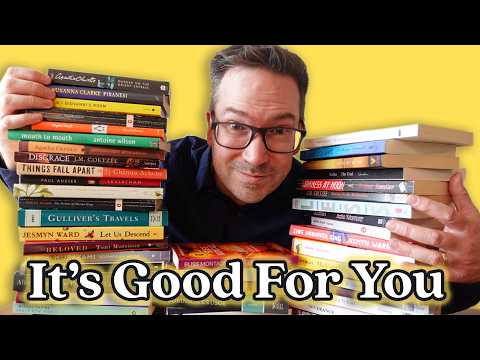
Read More Fiction
Great Books Prof
12m 28s2,348 words~12 min read
YouTube auto captions
Transcript source
YouTube auto captions
This transcript was extracted from YouTube's auto-generated caption track. The transcript below is server-rendered so it can be read, searched, cited, and shared without opening the original YouTube player.
Pull quotes
[0:00]All right, technically the brain is not a muscle, it's an organ, but it's kind of like a metaphorical muscle.
[0:00]Just like we encourage people to stretch or work out as they get older to maintain mobility and flexibility, you've got to do that stuff for your brain too.
[0:00]When you read fiction, you are solving puzzles, encountering interesting characters.
[0:00]So in this video, I'm going to outline the benefits of reading fiction and I'm going to recommend some books.
Use this transcript
Related transcript hubs
Watch on YouTube
Share
MORE TRANSCRIPTS


