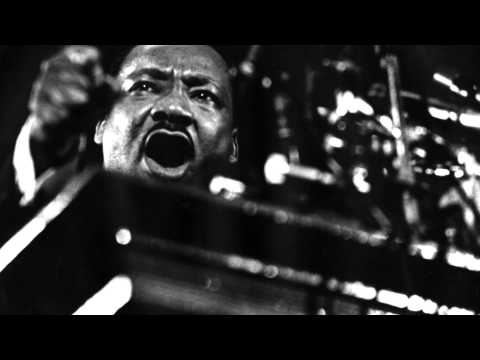
[0:03]Thank you very kindly, my friends.
[0:09]As I listened to Ralph Abernathy and his eloquent and generous introduction, and then thought about myself, I wondered who he was talking about.
[0:34]It's always good to have your closest friend and associate to say something good about you. And Ralph Abernathy's best friend that I have in the world.
[0:57]I'm delighted to see each of you here tonight in spite of a storm warning.
[1:08]You reveal that you are determined to go on anyhow.
[1:19]Something is happening in Memphis. Something is happening in our world. And you know if I was standing at the beginning of time with the possibility of taking a kind of general and panoramic view of the whole of human history up to now, And the Almighty said to me, Martin Luther King, which age would you like to live in? I would take my mental flight by Egypt. And I would watch God's children in their magnificent trek from the dark dungeons of Egypt through rather to cross the Red Sea through the wilderness on toward the promised land.
[2:32]And in spite of its magnificent, I wouldn't stop there.
[2:40]I would move on by Greece and take my mind to Mount Olympus. And I would see Plato, Aristotle, Socrates, Euripides and Aristophanes assemble around the Parthenon.
[3:06]And I would watch them around the Parthenon as they discussed the great and eternal issues of reality, but I wouldn't stop there. I would go on even to the great heyday of the Roman Empire.
[3:28]And I would see developments around there through various emperors and leaders, but I wouldn't stop there.
[3:41]I would even come up to the day of the Renaissance. And get a quick picture of all that the Renaissance did for the cultural and aesthetic life of man, but I wouldn't stop there. I would even go by the way that the man for whom I'm named had his habitat. And I would watch Martin Luther as he taxed his 95 theses on the door at the church of Wittenberg, but I wouldn't stop there. I would come on up even to 1863. And watch a vacillating president by the name of Abraham Lincoln finally come to the conclusion that he had to sign the emancipation proclamation, but I wouldn't stop there.
[4:48]I would even come up to the early thirties. And see a man grappling with the problems of the bankruptcy of his nation. And come with an eloquent cry that we have nothing to fear but fear itself, but I wouldn't stop there. Strangely enough, I would turn to the Almighty. And say, if you allow me to live just a few years in the second half of the 20th century, I will be happy.
[5:36]Now that's a strange statement to make because the world is all messed up. The nation is sick. Trouble is in the land, confusion all around. That's a strange statement. But I know somehow that only when it is dark enough can you see the stars. And I see God working in this period of the 20th century. In a way, that men in some strange way are responding, something is happening in our world. The masses of people are rising up.
[6:31]And wherever they are assembled today, whether they are in Johannesburg, South Africa, Nairobi, Kenya, Accra, Ghana, New York City, Atlanta, Georgia, Jackson, Mississippi, or Memphis, Tennessee, the cries always the same. We want to be free.
[7:00]And another reason that I'm happy to live in this period is that we have been forced to a point where we're going to have to grapple with the problems that men have been trying to grapple with through history, but the demands didn't force them to do it. Survival demands that we grapple with them. Men for years now have been talking about war and peace. But now no longer can they just talk about it. It is no longer the choice between violence and non-violence in this world, it's non-violence or non-existence. That is where we are today.
[8:26]Now I'm just happy that God has allowed me to live in this period to see what is unfolding. And I'm happy that he's allowed me to be in Memphis.
[8:46]I can remember when Negroes would just going around, as Ralph has said, so often scratching where they didn't itch, and laughing when they were not tickle.
[9:16]But that day is all over.
[9:25]We mean business now and we are determined to gain our rightful place in God's world.
[9:40]And that's all this whole thing is about. We aren't engaged in any negative protests and in any negative arguments with anybody.
[10:02]We are saying that we are God's children.
[10:10]And that we are God's children, we don't have to live like we are forced to live. Now what does all of this mean in this great period of history? It means that we've got to stay together. We've got to stay together and maintain unity. You know whenever Pharaoh wanted to prolong the period of slavery in Egypt.
[10:43]He had a favorite favorite formula for doing it. What was that? He kept the slaves fighting among themselves.
[10:57]But whenever the slaves get together, something happens in Pharaoh's court. And he cannot hold the slaves in slavery when the slaves get together, that's the beginning of getting out of slavery.
[11:18]Now let us maintain unity. Secondly, Let us keep the issues where they are.
[11:30]The issue is injustice. The issue is the refusal of Memphis to be fair and honest in its dealings with its public servants who happen to be sanitation workers.
[11:58]Now we've got to keep attention on that.
[12:04]That's always the problem with the little violence. You know what happened the other day and the press dealt only with the window breaking. I read the articles. They very seldom got around to mentioning the fact that 1,300 sanitation workers are on strike. And that Memphis is not being fair to them and that Mayor Lobes is in dire need of a doctor. They didn't get around to that.
[12:49]Now we're going to march again and we've got to march again. In order to put the issue where it is supposed to be.
[13:56]We aren't going to let any May stop us.
[14:03]We are masters in our non-violent movement in disarming police forces. They don't know what to do. I've seen them so often. I remember in Birmingham, Alabama, when we went in that majestic struggle there. We would move out of the 16th Street Baptist Church day after day.
[14:31]By the hundreds we would move out, and Bull Connor would tell him to send the dogs for him, and they did come. But we just went before the dog singing and going to let nobody turn me around.
[14:53]Next would say turn the fire hoses on. As I said to you the other night, Bull Connor didn't know history. He knew a kind of physics that somehow didn't relate to the trans physics that we knew about. And that was the fact that there was a certain kind of fire that no water could put out.
[15:46]And we just went on before the dogs and we would look at them and we gone singing over my head. I see freedom in the air.
[16:04]And then we would be thrown into patty wagons and sometimes we were stacked in there like sardines in a can. And they would throw us in and old Bull would say, take them off. And they did and we would just go on in the paddy wagon singing we shall overcome. And every now and then we'd get in jail and we'd see the jailers looking through the windows being moved by prayer. And being moved by our words and our song. And there was a power there, which Bull Connor couldn't adjust to. And so we ended up transforming Bull into a steer and we won our struggle in Birmingham.
[16:58]Now we've got to go on in Memphis just like that. I call upon you to be with us when we go out Monday. Now about injunctions, we have an injunction and we're going into court tomorrow morning. To fight this illegal, unconstitutional injunction. All we say to America is be true to what you said on paper.
[17:39]If I lived in China or even Russia or any totalitarian country, maybe I could understand some of these illegal injunctions. Maybe I could understand the denial of certain basic first Amendment privileges because they haven't committed themselves to that over there. But somewhere I read of the freedom of assembly. Somewhere I read of the freedom of speech. Somewhere I read that the greatness of America is the right to protest for right.
[18:37]And so just as I say, we're not going to let any dogs or water hoses turn us around. We aren't going to let any injunction turn us around.
[18:54]We're going on. We need all of you. And you know what beautiful to me is to see all of these ministers of the gospel.
[19:08]It's a marvelous picture.
[19:13]Who is it that is supposed to articulate the longings and aspirations of the people more than the preacher?
[19:26]Somehow the preacher must have a kind of fire shut up in his bones. And whenever injustice is around, he must tell it.
[19:36]Somehow the preacher must be in Amos. who said, when God speaks, who can but prophesy. Again with Amos, let justice roll down like waters and righteousness like a mighty stream. Somehow the preacher must say with Jesus, the spirit of the Lord is upon me because he has anointed me. And he's anointed me to deal with the problems of the poor. And I want to commend the preachers under the leadership of these noble men, James Lawson. One who has been in this struggle for many years. He's been to jail for struggling. He's been kicked out of Vanderbilt University for this struggling, but he's still going on fighting for the rights of his people. Reverend Ralph Jackson, Billy Kyle, I can just go right on down the list. If time will not permit, but I want to thank all of them. And I want you to think. Because so often preachers aren't concerned about anything but themselves.
[20:51]And I'm always happy to see a relevant minister. It's all right to talk about long white robes over yonder and all of its symbolism. But ultimately people want some suits and dresses and shoes to wear down here.
[21:15]It's all right to talk about streets flowing with milk and honey. But God has commanded us to be concerned about the slums down here and his children who can't eat three square meals a day. It's all right to talk about the new Jerusalem, but one day God's preacher must talk about the new New York. The new Atlanta, the new Philadelphia, the new Los Angeles, the new Memphis, Tennessee.
[22:03]This is what we have to do. Now the other thing we'll have to do is this. Always anchor our external direct action with the power of economic withdrawal.
[22:25]Now we are poor people. Individually we are poor when you compare us with white society in America. We are poor.
[22:40]Never stop and forget that collectively, that means all of us together, collectively we are richer than all the nations in the world with the exception of nine.
[23:00]Did you ever think about that?
[23:04]After you leave the United States, Soviet Russia, Great Britain, West Germany, France, and I could name others, the American Negro collectively is richer than most nations of the world. We have an annual income of more than 30 billion dollars a year, which is more than all the exports of the United States and more than the national budget of Canada. Did you know that? That's power right there if we know how to pull it.
[23:47]We don't have to argue with anybody. We don't have to curse and go around acting bad with our words. We don't need any bricks and bottles. We don't need any Molotov cocktails. We just need to go around to these stores. And to these massive industries in our country, and say God sent us by here. To say to you that you're not treating his children right. And we come by here to ask you to make the first item on your agenda, fair treatment where God's children are concerned. Now, if you're not prepared to do that, we do have an agenda that we must follow. And our agenda calls for withdrawing economic support from you.
[25:03]Go out and tell your neighbors not to buy Coca-Cola in Memphis.
[25:22]Tell them not to buy what is other brand Wonder Bread.
[25:30]And what is other brand Delsi. Tell them not to buy Hearts bread.
[25:41]As Jesse Jackson has said up to now only the garbage men have been feeling pain. Now we must kind of redistribute the pain.
[26:00]We are to choose in these companies because they haven't been fair in their hiring policies. And we are choosing them because they can begin the process. of saying they are going to support the needs and the rights of these men who are on strike. And then they can move on town downtown and tell Mayor Lobes to do what is right.
[26:34]Now, not only that, we've got to strengthen black institutions.
[26:41]I call upon you to take your money out of the banks downtown and deposit your money in Tri-State Bank.
[26:56]We want to bank in movement in Memphis. Go by the savings and loan association. I'm not asking you something that we don't do ourselves and SCLC. Judge Hooks and others will tell you that we have an account here in the Savings and Loan Association from the Southern Christian Leadership Conference. We're telling you to follow what we are doing, put your money there.
[27:30]You have six or seven black insurance companies here in the city of Memphis. Take out your insurance there. We want to have an insurance in. Now these are some practical things that we can do. We began the process of building a great economic base and at the same time we are putting pressure where it really hurts. I ask you to follow through here.
[28:06]Now let me say as I move to my conclusion.
[28:13]That we've got to give ourselves to this struggle until the end. Nothing would be more tragic than to stop at this point in Memphis.
[28:33]We've got to see it through.
[28:41]When we have our March, you need to be there. If it means leaving work, if it means leaving school, be there.
[29:43]Now it doesn't matter now.
[29:47]It really doesn't matter what happens now. I left Atlanta this morning and as we got started on the plane, there was six of us.
[30:57]The pilot said over the public address system, we are sorry for the delay. But we have Dr. Martin Luther King on the plane. And to be sure that all of the bags were checked. And to be sure that nothing would be wrong on the plane, we had to check out everything carefully. And we've had the plane protected and guarded all night. And then I got into Memphis. And some began to say the threats or talk about the threats that were out. What would happen to me from some of our sick white brothers. Well, I don't know what will happen now. We've got some difficult days ahead. But it really doesn't matter with me now because I've been to the mountain top. I don't mind.
[32:09]Like anybody, I would like to live a long life. Longevity has its place. But I'm not concerned about that now. I just want to do God's will. And he's allowed me to go up to the mountain. And I've looked over. And I've seen the promised land. I may not get there with you. But I want you to know tonight that we as a people will get to the promised land.
[32:52]So I'm happy tonight, I'm not worried about anything. I'm not fearing any man. My eyes have seen the glory of the coming of the Lord.


