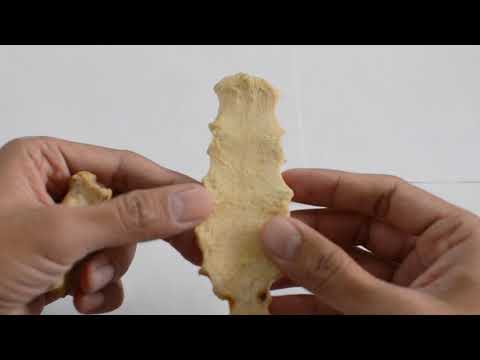
[0:00]Hello everyone. In this video we are going to discuss about sternum. Now it's an example of flat bone and this is forming middle portion of anterior thoracic wall. This is basically made up of three components: manubrium, body, and xiphoid process. Now this is also termed as pro-sternum, this is meso-sternum, and this is meta-sternum. Now if we see sternum as a whole, it looks like a small sword. And this manubrium represents the handle, this represents the blade, and the xiphoid process represents tip. So as the name given is sternum, the literal meaning is short sword. Now when we see the sternum from side, there is formation of an angle between manubrium and body. Here, this is termed as sternal angle or angle of Luis and that is approximately 163 degrees. And that increases a bit during inspiration and decreases during expiration. So the movement will take place at manubrio-sternal joint, which is secondary cartilaginous joint. So in anatomical position this rough surface is facing in front, and basically the sternum is facing downward and forward if we see it from side like this. And obviously this upper end should be broad, which is made up of manubrium, and lower end should be tapered and pointed, which is made up of xiphoid process. So if we see it from side, this is how in anatomical position it is oriented. Now let's see first the manubrium. It is roughly quadrilateral, it is very thick and as we have discussed it represents handle of the short sword. It is having two surfaces, anterior and posterior, plus four borders, superior, inferior, and two lateral. The anterior surface is rough and that is providing attachment to sternal head of sterno-cleido-mastoid over here and below inferior-laterally, it provides elongated origin of sterno-thyroid.
[2:20]In lower half it is related to arch of aorta and in upper half it is related to branches of arch of aorta, that is brachiocephalic, left common carotid, left subclavian, plus it is also related to left brachiocephalic vein. So basically this posterior surface is forming anterior boundary of superior mediastinum and posteriorly it is related to the structures of superior mediastinum. The manubrium itself is situated at the level of body of third and fourth thoracic vertebrae. Now the superior border in the midline is having a notch and this is termed as supra-sternal notch. Now along its anterior and posterior margin it provides attachment to deep cervical fascia, which is basically splitting to enclose a space in between that is termed as supra-sternal space or space of Burns. And itself this supra-sternal notch is providing attachment to interclavicular ligament. Now on either side of superior border it shows very deep notch and these are termed as clavicular notch. Obviously it is in contact with medial end of clavicle, which is separated by an articular disc and over here there forms sterno-clavicular joint which is a saddle variety of joint. Now lower border is tapered. It is smooth, it is having an oval articular facet and this will articulate with corresponding articular facet on the body of sternum. Over here you can see and together they are forming manubrio-sternal joint, which is secondary cartilaginous joint. Now, as we have discussed, there forms an angle in between, that is termed as angle of Louis or sternal angle, which is having some clinical importance. On either side, along the lateral border, there are two facets for costal cartilages. The upper is complete facet for articulation of first costal cartilage and there forms first chondro-sternal joint, which is primary cartilaginous joint. Whereas the lower facet is basically a demi-facet and when we join body again, along the lateral border of body, there is also another demi-facet and together they form a complete facet for second costal cartilage. So half of the second costal cartilage is attached to the lateral border of manubrium and half to the lateral border of body. So over here, exactly at manubrio-sternal joint, there is attachment of second costal cartilage. So this upper complete facet is attached with the first costal cartilage and lower demi-facet is attached with the second costal cartilage. Now the lateral border in between these two is forming anterior boundary of first intercostal space and over here it is providing attachment to anterior intercostal membrane and intercostalis internus muscle. Now next is body of sternum or meso-sternum. It is thin, elongated, bony plate, and which is approximately double the length of the manubrium sterni. See this. Now it is having two ends, upper end and lower end, two surfaces, anterior and posterior, plus two lateral borders. Now the upper end is connected to lower border of manubrium sterni, that is what we have discussed and together they are forming manubrio-sternal joint, which is secondary cartilaginous joint. And in front it is forming a rough transverse ridge which can be palpated from surface and again it is forming approximately 163 degrees angle with manubrium sterni, that is angle of Louis or sternal angle, which is clinically very important. The lower end is pointed and that is connected to the xiphoid process and together they are forming xiphisternal joint which is primary cartilaginous joint. Now next are lateral borders, which are having costal notches. See over here. So on either side there are four complete costal notches for articulation of third to sixth costal cartilages. So over here there articulates third, fourth, fifth, and sixth costal cartilages and they are forming chondro-sternal joints which are plane synovial joints. Additionally at upper and lower end there are demi-facets. So over here you can see there is a demi-facet. Now similar demi-facet is found along the lateral border of manubrium sterni and together it provides attachment to second costal cartilage and over here there forms second chondro-sternal joint, which is again plane synovial joint.
[7:10]Similarly the lowermost demi-facet is for the seventh costal cartilage and over here there forms seven chondro-sternal joint, which is again a plane synovial joint. So another demi-facet or demi-notch is situated on either side of the xiphoid process and together it forms a complete notch over here. Now in between these costal notches, the lateral borders are forming anterior boundary of intercostal spaces and it provides attachment to anterior intercostal membrane and intercostalis internus muscle. Now anterior surface, which is bit convex, it is rough and specifically it shows three transverse ridges. Now these three transverse ridges are showing line of fusion of sternal segments, which are four in number and individual sternal segment is termed as sternibra. So there are such four sternibra during development or sternal segments, which gets fused and they form this body of sternum. Now sometimes we may find a gap specifically between line of fusion of third and fourth sternal segment and it is seen in the form of a small foramen, which is termed as sternal foramen. Let me show you in another sternum. So over here you can see there is a foramen. Now this is a developmental defect, this is termed as sternal foramen. See over here. Now this anterior surface on either side provides origin to pectoralis major muscle, whereas the midline portion, this portion is subcutaneous. Now the posterior surface, it is smoother as compared to the anterior surface. It is bit concave, it is also showing three transverse ridges, but they are very faint. Now in lower third, on either side, it provides attachment to sterno-costalis muscle. Now the right half of the posterior surface throughout its extent is related to right pleura and right lung, whereas left upper half only is related to left pleura and left lung. The left lower half is directly in contact with pericardium. Now last is xiphoid process or meta-sternum, it is representing tip of the short sword and it is the most viable part of the sternum, both in terms of size and shape. So it may be bifid, it may be pointed, it may be anteriorly deviated, it may be perforated. So the variations are found in individual bones. And over here you can see it is having upper end which is attached to the lower end of the body to form xiphisternal joint, which is primary cartilaginous joint, that is what we have discussed. The tip is providing attachment to uppermost part of linear alba. The anterior surface is providing attachment to rectus abdominis muscle and aponeurosis of external oblique abdominis. On either side it provides attachment to aponeurosis of transversus abdominis and internal oblique abdominis muscle. Whereas the posterior surface of xiphoid process it provides attachment to sternal head of diaphragm. Now sometimes this sternal head of diaphragm may be absent and in that case it may be seen in the form of a large foramen, which is termed as foramen of Morgagni. Now it is a potential site of diaphragmatic hernia, retro-sternal diaphragmatic hernia. So that is about xiphoid process. Now let's revise all the features and attachments in diagram. So here this diagram shows anterior surface of sternum, showing manubrium, body, and xiphoid process. Now the manubrium is situated against the body of third and fourth thoracic vertebrae. Over here this is supra-sternal notch. These are clavicular notches, forming sterno-clavicular joint with medial end of clavicle, which is saddle variety of synovial joint. Now next to it, anterior surface of manubrium is showing sternal attachment of sterno-cleido-mastoid. Below to that, up to sixth costal cartilage, both manubrium and body, their anterior surface is providing origin to pectoralis major muscle. Now on either side you can see attachment of first costal cartilage. So here there is formation of first costochondral joint, which is primary cartilaginous joint. Now along the lower end over here at the level of disc between T4 and T5 there forms manubrio-sternal joint or secondary cartilaginous joint. And on either side, both manubrium and body of sternum, they are showing demi-notches or demi-facets for second costal cartilage, which is plane synovial. Now on either side the lateral borders in the body of sternum, it shows four complete costal notches for third, fourth, fifth, and sixth costal cartilages. And they are forming third, fourth, fifth, and sixth chondro-sternal joints, which are plane synovial joint. Similarly the demi-facet at lower end of lateral border of body of sternum and on either side of xiphoid process, they are providing attachment to seventh costal cartilage. So over here there forms seventh chondro-sternal joint, which is again plane synovial joint. Now lower end of body and upper end of the xiphoid process, over here it forms xiphisternal joint, which is primary cartilaginous joint. And it is situated at the level of disc between T8 and T9 vertebrae. So entire body is situated against body of fifth to eighth thoracic vertebrae. Now anterior aspect of xiphoid process is providing attachment to rectus abdominis and aponeurosis of external oblique. On either side it provides attachment to aponeurosis of internal oblique and transversus abdominis. The tip is providing attachment to linea alba. Similarly this diagram shows posterior surface, so posterior aspect of manubrium is providing attachment to sterno-hyoid and sterno-thyroid muscle. And this portion is related to the superior mediastinum and its contents. Similarly posterior aspect of the body as we have discussed, throughout the extent, the right half of body is related to the right pleura, right pleural reflection and right lung. Whereas left upper half is related to left pleura and left lung. The left lower half is related to the pericardium, so this is the area of cardiac dullness. Now lower third of posterior surface, as well as part of posterior aspect of xiphoid process are providing attachment to sterno-costalis muscle. And posterior surface of this xiphoid process is providing attachment to sternal head of diaphragm. So this is regarding general features and attachments of the sternum. Hope you understood well. Thanks for watching.