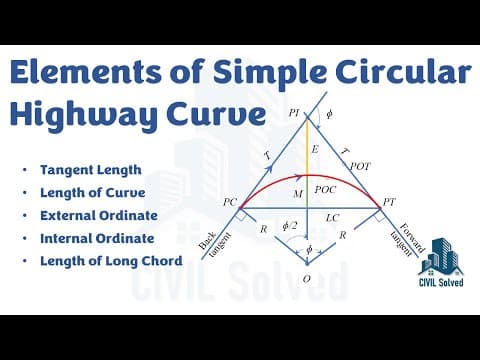
[0:00]Hello everyone. In this video, we are going to discuss about the elements of simple circular highway curve.
[0:09]Let's say that we are having a road which is straight road and we want to continue this road, but due to obstruction, we cannot move ahead. Because of the obstruction, we need to change the direction of the road. So whenever we are changing the direction of the road, the best solution is to provide a highway curve. So let's say that we are providing a simple circular highway curve over here and let me define that what we mean by simple circular highway curve. Simple circular highway curve is actually a curve which have constant radius. It means it's actually a part of a circle. So if it is a curve and there is a line that touches to that curve. So that is called tangent. Since this is just a part of the circle, so the curve is ending over here. So let's say that we are having another line which touches this curve and that is this line. So therefore we can name them as back tangent and forward tangent. So it means then the route of transit would be from here and then on the curve and then on the forward tangent. This would be the movement. Now as this video is all about the elements of simple circular curve, now let's discuss different elements of simple circular curve. So the point where the back tangent and the forward tangent are crossing each other is being named as point of intersection, which is also being named as vertex. And the point where the curve is starting, we can name them as PC, the point of commencement, which is actually the start point of the curve. And the point where the curve is ending, we are naming that as PT, the point of tangency, which is actually the end point of the curve. As we know that this is a part of a circle, so then circle will be having a center. So let's say O is the center and the distance from O to any point on the curve would be the radius. So in this case I'm showing the distance between point O and the start and end point of the simple circular curve and that is being represented with capital R. And from the basic subject geometry, we know that the radius and the tangents, whether it is a back tangent or the forward tangent will be making an angle of 90° or they are perpendicular to each other. The distance from PC to PI are the distance from PT to PI is being named as tangent length. So this distance I'm talking about, PC to PI are PT to PI, that's actually the tangent length. And the distance between PC and PT in a straight line is being named as long curve, which is being represented with capital LC. Moving on further, the distance measured along the curve between PC and PT, that is this distance is called length of curve. Let's mark a vertical line between O and PI, then we can have more elements of simple circular curve. The distance from PI to the mid of the radial line is called external ordinate. So this distance and that is being represented with capital E. The distance between midpoint of the long chord and midpoint of the radial curve, the dis distance is being named as middle ordinate and that is being represented with capital M. We can have any point on curve, that will be represented with POC. are also we can have any point on tangent, so that can be represented with POT. Now this angle. This angle is very important and this angle is usually being named as deflection angle. Why this is being named as a deflection angle? That we can see that initially the root of project was this, but later on the root of project has been changed to this. It means the root has been deflected to this angle. So therefore this is, this angle is being named as deflection angle and there are various symbols are there to represent the deflection angle. And then we will be having a internal angle, this is the angle I'm talking about. So that is usually being represented with capital I, that is angle of intersection and the addition of angle of intersection and deflection angle makes 180°. So from the basics of geometry, if this angle is phi, deflection angle, so this angle will also be the phi, the central angle subtended by the simple circular curve will also be the phi, deflection angle. And as this is exactly at the mid, so then this angle would be half of the deflection angle and the remaining will also be there half of the deflection angle. So this is all from this video where we have discussed the different elements related to the simple circular highway curve. In next videos, I'm going to discuss how we can calculate these distances like how we can calculate the tangent length, how we can calculate the length of the curve, external ordinate, middle ordinate, long chord with the help of radius and deflection angle. So that's it. Thank you for watching this video.


