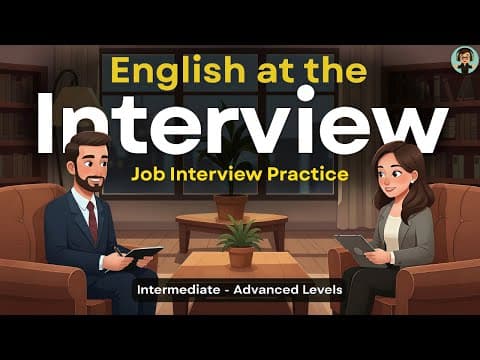
[0:06]hey everyone welcome back to the chill English channel. I'm Sophia. And I'm Jake. Today we're gonna show you how to answer job interview questions in English confidently with a real example. I actually have an interview coming up for a front end developer position. So we'll practice together. Perfect. Let's start from the beginning. In any interview, the first question is usually, can you tell me about yourself, right? Right. That question always feels simple, but it can be tricky if you don't know what to say. Many learners overthink and try to include everything about their life. The key is to be short, professional, and relevant. For my interview, I plan to say something like, my name is Sophia. I have two years of experience as a front end developer and I enjoy creating interactive user friendly websites. That's excellent. It's clear, confident and professional. You're highlighting experience and interest in the job. And I'll add a little about my motivation. I really enjoy learning new technologies and improving user experience, which is why I'm excited about this position. Perfect. That shows enthusiasm, which is very important. Okay, let's practice. Imagine the interviewer just asked me, can you tell me about yourself? Go ahead, Sophia. Sure, my name is Sophia. I have 2 years of experience as a front end developer, and I enjoy creating interactive user friendly websites. I really enjoy learning new technologies and improving user experience, which is why I'm excited about this position. That was smooth. You sounded confident, clear and natural. Thank you. Now, what about the next question? Why do you wanna work here? That's a common one. You need to show that you understand the company and that your goals match theirs. For example, I can say, I'm impressed by your company's focus on modern web applications and innovative design. I wanna contribute my skills to create excellent user experiences for your clients. Very good. It's specific and shows that you've researched the company. Now let's go deeper. I wanna tell a short story about my last project to show my experience. That's perfect, because storytelling is a great way to answer behavioral questions. Okay. In my previous job, I worked on redesigning a website for a small e-commerce company. The site had slow loading times and outdated design. I suggested a new responsive layout, optimized images and added interactive product features. Excellent. How would you put that into a short interview answer? I can say, in my last role, I redesigned a small e-commerce website to improve user experience. I created a responsive layout, optimized performance and added interactive features. The project increased user engagement by 30%. Perfect, short, specific and results oriented. That's exactly what interviewers like to hear. And if they ask, what challenges did you face, I can continue the story, right? Right. Tell them a problem and how you solved it. That shows problem solving skills. For example, one challenge was ensuring the site loaded quickly on all devices. I tested multiple solutions and implemented lazy loading for images, which improved speed significantly. That's excellent. It's structured, clear and shows your skills and initiative. Now, what about questions like, what are your strengths and weaknesses? For strengths, focus on skills relevant to the job. For example, you could say I'm strong in HTML, CSS and JavaScript. And I have experience creating responsive user friendly websites. And for weaknesses, it's important to show awareness and improvement. I can say I'm still improving my react skills, but I have been taking online courses and applying them in small projects. Perfect. That shows honesty and a willingness to learn, which employers love. Okay. Let's combine it into a short story flow. Imagine the interviewer asks, tell me about yourself, then why do you wanna work here and describe a project you worked on. Go ahead, Sophia. Sure, my name is Sophia. I have 2 years of experience as a front end developer, creating responsive, user friendly websites. I'm impressed by your company's focus on modern web applications and innovative design, and I wanna contribute my skills to create excellent user experiences for your clients. In my last role, I redesigned a small e-commerce website to improve user experience. I created a responsive layout, optimized performance and added interactive features. The project increased user engagement by 30%. That was perfect. It's concise, confident and it covers all the key points. I can already imagine saying this in the interview and feeling more relaxed. That's exactly the point. Practice makes it natural, and when it's natural, your English will flow without translating in your head. Next we should cover tricky questions like, where do you see yourself in five years and why should we hire you? Absolutely. Those are common questions that require thinking ahead and connecting your skills with the company's goals. Okay, Jake, let's continue. The next common question is, where do you see yourself in five years? That one always feels tricky. It can be tricky if you overthink it. The key is to show ambition while staying realistic and connected to the job. For my front end developer interview, I can say in 5 years, I see myself growing as a senior front end developer, contributing to innovative projects and mentoring new team members. Perfect. It shows you have goals, but they're aligned with the company's growth and the role you're applying for. And if they ask why should we hire you, I can combine my skills, experience and attitude. For example, I have 2 years of experience creating responsive websites and improving user experience. I am motivated to learn new technologies, solve problems efficiently and contribute to the team's success. That's exactly right. You're selling your skills while showing your willingness to grow. Let's add a short story to make it even more natural. Imagine the interviewer says, tell me about a time you faced a challenge at work. Go ahead, Sophia. Sure, in my last role, we had a client who wanted their website redesigned in a very short time. The challenge was that the site had many outdated components and the deadline was tight. I created a plan to focus on the most critical pages first, optimized the code and collaborated with my team efficiently. We delivered the project on time and the client was very happy. That's excellent. You're showing problem solving skills, teamwork and results. And I can summarize the lesson I Learned. This experience taught me how to manage time effectively, communicate clearly with clients and prioritize tasks under pressure. Perfect. Interviewers love hearing lessons Learned because it shows reflection and growth. Another question that often comes up is, what is your biggest strength? You wanna highlight strengths that match the job. For example, for a front end developer, my biggest strength is attention to detail. I notice small design issues that can impact user experience, and I make sure everything looks perfect before launch. That's great. And for weaknesses, I can say something like, I used to struggle with time management, but I've started using project tracking tools and planning tasks more carefully, which has improved my efficiency. Excellent. Always pair a weakness with how you're improving it. Let's do a full example story combining multiple questions. Imagine the interview goes like this, go ahead, Sophia. Sure, my name is Sophia. I have 2 years of experience as a front end developer, creating responsive, user friendly websites. I enjoy learning new technologies and improving user experience. I want to work here because I admire your company's innovative projects, and I believe my skills can contribute to your success. In my last project, we redesigned an e-commerce website. The challenge was a tight deadline, but I prioritized tasks, optimized code and worked closely with my team, which resulted in a 30% increase in user engagement. My biggest strength is attention to detail, and my area for improvement has been time management, which I've addressed by using planning tools effectively. In 5 years, I see myself growing into a senior front end role and mentoring new team members. That's a perfect example. It flows naturally, answers multiple common questions and shows both competence and personality. And the best part is that this format can be adapted for any role. You just change the skills, projects and examples to match the position. Exactly. You don't have to memorize scripts. You need a framework, then practice telling your story naturally. And the more you practice, the fluent your English will become. You'll stop translating in your head and start speaking naturally. Another tip is to practice small mock interviews with friends or even alone in front of a mirror. Speaking aloud helps your brain get used to the flow of English in real situations. I like to record myself answering questions and then listen back. That helps me notice areas where I can improve grammar, pronunciation or clarity. And even if you make mistakes while practicing, that's normal. Making mistakes is part of learning and it builds confidence. For tricky questions like describe a time you failed, I suggest using the star method. Situation, task, action, result. Can you give an example, Sophia? Sure, in one project, I was responsible for creating a new website feature. I underestimated the time it would take, so we were behind schedule. I discussed the problem with my team, reorganized tasks and focused on the most important features first. In the end, we delivered the project on time, and I Learned how to manage time effectively, communicate clearly with clients and prioritize tasks under pressure. That's perfect. Star answers are concise, structured and show problem solving skills, and telling stories make your answers memorable. Interviewers remember examples much more than generic statements. Absolutely. It's not just about your English. It's about showing you can handle real work situations confidently. Another tip is to use transition phrases during your answers. For example, in my previous role, one challenge I faced or as a result of my actions. Those phrases make your answers smoother and more professional. They also give you a little extra time to think in English. And when you practice, try to combine your skills, projects, challenges and results into one short story for each question. That's right. It's like building a small portfolio in your answers, showing not just your experience, but your approach and mindset. In the next part, we'll cover handling unexpected questions, body language tips and ways to stay calm and confident in English interviews. Okay, Jake, now let's talk about the questions that can catch you off guard. Sometimes, interviewers ask things you didn't prepare for, right? Right. These questions test how you think on your feet and handle pressure. They're not meant to trick you, just to see your thought process. For example, they might ask, if you could improve one thing about our website, what would it be? That's a good one. The trick is to stay positive and constructive. Don't criticize harshly. Focus on opportunities for improvement. For my interview, I can say I really like the website design. One improvement could be optimizing the homepage loading speed. It would make the user experience even smoother. Perfect. That shows observation skills, technical knowledge and a positive approach. Another unexpected question could be, how do you handle tight deadlines or stress? Always give a specific example. You can use a short story from your experience. For instance, I could say in a previous project, we had a tight deadline for a new feature. I prioritized the key tasks, communicated clearly with my team and stayed focused on the most important elements. We completed the work successfully and Learned how to manage time more effectively. That's excellent. It shows problem solving, teamwork and resilience. Sometimes they even ask personal questions like, what motivates you or why did you choose front end development? That's your chance to show passion. Be honest and personal. It's not about impressing them with complicated words. I can say I enjoy front end development because I love creating designs that people interact with daily. Seeing users enjoy a website I built motivates me to keep improving. That's great. Clear, passionate and natural. Interviewers love authenticity. Another tip is body language. Even if your English is good, nervous gestures can distract the interviewer. Sit straight, smile and use natural hand gestures. Maintain eye contact without staring. It communicates confidence. Breathing is also important. Take a deep breath before answering each question to calm your nerves. And pause briefly if you need time to think. It's better than rushing and saying something confusing. During my actual interview, I plan to use these strategies. I'll stay calm, tell my story clearly and use examples from my experience. Let's imagine you're in the interview room now. The interviewer asks, tell me about a time you faced a problem and how you solved it. Okay. In my last project, we had to redesign a website quickly for a client. The main challenge was that the original website had outdated code and some features were broken. I analyzed the priorities, fixed the most important issues first, and implemented new interactive features. I worked closely with my team and we delivered the project on time. As a result, user engagement increased by 30%, and I Learned how to manage deadlines and communicate effectively under pressure. Excellent. That's a complete structured answer. Star method in action. Now the interviewer might ask, do you prefer working independently or in a team? A safe approach is to show flexibility and teamwork. I can say I enjoy both. I can work independently to focus on specific tasks, but I also value teamwork because collaborating allows me to learn from others and achieve better results. Perfect. That shows adaptability, which every employer wants. One last scenario, the interviewer asks, do you have any questions for us? This is important. Always prepare a question to show interest in the company. For example, I can ask, what tools or frameworks does the development team currently use? Or how does the company support employee growth and learning? Excellent. That shows engagement and curiosity. And now let's imagine the interview is ending. I can summarize everything smoothly. Thank you for the opportunity to discuss my experience. I'm excited about the possibility of contributing to your team and learning from the talented professionals here. Perfect. Polite, confident and leaves a strong final impression. So to recap everything we practiced, start with a concise introduction, answer common questions with stories, highlight your strengths, address weaknesses honestly, use star for challenges, show passion, maintain confident body language, and always have a question prepared. Exactly. Following this structure, your English will flow naturally and you'll feel prepared for almost any interview scenario.
[19:20]That's the goal. With practice, every interview becomes easier and your English becomes stronger. And remember, every interview is a learning opportunity. Even if it doesn't go perfectly, you gain experience and improve for the next one. That's right. Keep practicing, stay confident and use English as a tool to share your skills and personality. Soon interviews won't feel scary anymore. They'll feel like an opportunity to show what you can do and who you are. And that's exactly what we want for every English learner, confidence, clarity and success in real life situations. So go ahead, apply these tips, practice your stories and watch your interview skills and English grow together. Good luck with your interviews and keep speaking English naturally every day. You've got this.


