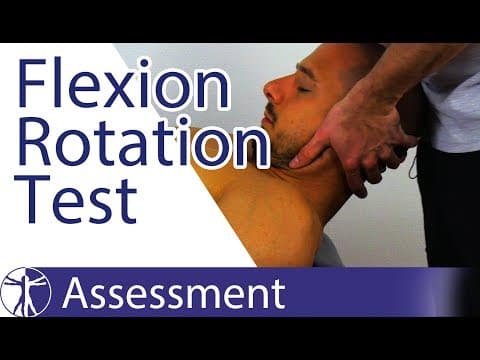
[0:00]In this video, I'm going to talk about the flexion rotation test to detect hypomobility in the upper cervical spine.
[0:14]Hi, and welcome back to Physiotutors. The flexion rotation test is a useful tool to assist in identifying upper cervical movement impairment. This is especially important for patients that experience cervicogenic headache due to impaired upper cervical joint dysfunction. According to Hall et al in the year 2010, the FRT has an almost perfect intra-rater reliability of 0.95 to 0.97 and a minimal detectable change of 7 degrees. Ogins et al also describes a high sensitivity of 91% and a specificity of 90% in identifying individuals with cervicogenic headache in the year 2007. To perform the test, have your patient in supine lying position and bring the cervical spine into maximal flexion. Then rotate your patient's head to the left and to the right until you reach end range, which is usually reached at an average of 44 degrees in healthy individuals. Range of motion can hereby be limited by either pain or firm resistance encountered by the physio. This test is deemed to be positive in clinical practice if there is a reduction of a visual estimate of 10 degrees from the anticipated normal range of 44 degrees, which is slightly higher than the minimal detectable change.
[1:42]Okay, I hope you enjoyed this video. Make sure to watch our video on high cervical manual examination to figure out which upper cervical segment is causing the limitation in upper cervical rotation and before you leave, give this video a like. Don't forget to subscribe to our channel and if you haven't, follow us on various social media. I'll see you in the next video. Bye.