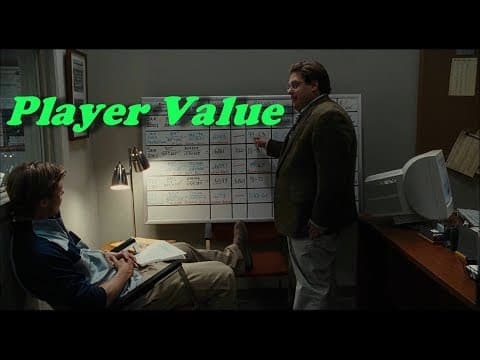
[0:00]Good morning, Suzanne. Coffee on? Yes. Great.
[0:06]Peter Brand. Billy, how are you? How you doing? Nice to see you. Good to have you here. Well, you're moving fast. Yeah, yeah. I got here early this morning. Wow. All moved in. Yeah. Yeah. Hey, Billy. I wanted you to see these player evaluations that you asked me to do. I asked you to do three. Yeah. To evaluate three players. Yeah. How many did you do? 47. Okay. Actually, 51. I don't know why I lied just then.
[0:57]Why don't you walk me through the board?
[1:02]Thank you.
[1:29]So, using this equation in the upper left right here, I'm projecting that you need to win at least 99 games in order to make it to the post season. We need to score at least 814 runs in order to win those games and allow no more than 645 runs. What's this? This is the code that I've written for our year-to-year projections. This is building in all the intelligence that we have to project players. Okay. It's about getting things down to one number. Using the stats the way we read them, we'll find value in players that nobody else can see.
[2:12]People are overlooked for a variety of biased reasons and perceived flaws: age, appearance, personality. Bill James and mathematics cuts straight through that.
[2:28]Billy, of the 20,000 notable players for us to consider, I believe that there is a championship team of 25 people that we can afford. Because everyone else in baseball undervalues them. Like an island of misfit toys.
[2:48]Billy, this is Chad Bradford. He's a relief pitcher. He is one of the most undervalued players in baseball. His defect is that he throws funny. Nobody in the big leagues cares about him because he looks funny. This guy could be not just the best pitcher in our bullpen, but one of the most effective relief pitchers in all of baseball. This guy should cost $3 million a year. We can get him for $237,000.
[3:40]Billy.
[3:43]Got it? Yeah.


