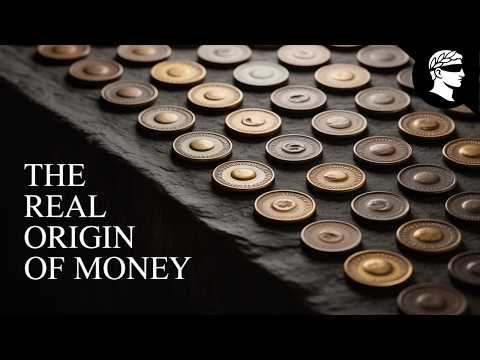
[0:00]Most people are taught a simple story about money. Long ago, humans struggled with barter. A farmer had grain but needed shoes. A shoemaker had shoes but wanted meat. Trade was clumsy, inefficient, and awkward. So eventually, someone had a bright idea, money. Coins appeared, trade became easier and civilization moved forward. It's a clean story, logical, comforting, and mostly wrong. Money didn't emerge because barter was inconvenient. It emerged because power needed a tool, and once that tool existed, it never stopped shaping who controlled value, labor, and violence. Welcome to the Financial Historian, where money, power and history collide, and nothing is ever as simple as it looks. Before money, most human societies didn't operate on barter at all. Inside small communities, people didn't constantly negotiate exchanges. They relied on memory, obligation, and trust. You gave because you belonged, you received because you were known. Debts weren't written down, they were remembered. Value wasn't abstract, it was social. This worked remarkably well, as long as society stayed small, but scale changes everything. As populations grew, villages turned into cities. Trade expanded beyond kin and neighbors. Strangers arrived with unfamiliar customs and no shared history, and with them came a new problem, trust didn't scale. Memory broke down, obligation faded, violence became more frequent, and rulers faced a challenge that barter could never solve. How do you feed an army that doesn't know you? How do you tax people you'll never meet again? How do you extract value from a population spread across vast territory? That's where money enters the story, not as a convenience, but as infrastructure. For value to move across distance, it needed a body. Something durable, portable, divisible, something that could be counted without conversation and trusted without memory. Food spoiled, livestock wandered, land didn't move, labor vanished the moment it was used. Metal solved the problem, copper, bronze, silver, these weren't chosen because they were shiny. They were chosen because they behaved well under pressure. They didn't rot, they could be melted and reshaped, they could be divided into precise amounts. And most importantly, they were scarce enough to matter, but common enough to circulate. Metal didn't just store value, it made value mobile. But it wasn't merchants who turned metal into money, it was rulers. Early states in Mesopotamia, Egypt, and the Eastern Mediterranean didn't need money to trade among themselves. They needed money to command. Armies can't fight on promises, soldiers don't march on goodwill, they need payment, and payment needs to be standardized, recognizable, and enforceable. Metal made that possible. Once states demanded taxes payable in metal, everything changed.
[2:35]People who once lived largely outside markets were forced into them. Subsistence became obligation, harvests turned into liabilities. To get metal, peasants had to sell their goods, their labor, or their time. Markets didn't emerge organically. They were pulled into existence by taxation and power. Money didn't free people from rulers, it made rulers vastly more efficient. This is the part of monetary history that rarely makes it into textbooks. Money wasn't neutral. It wasn't invented to help trade flow smoothly between equals. It was designed to measure, extract, and redeploy value at scale. And once value could be extracted, it could be stored. Once it could be stored, it could be accumulated, and once it could be accumulated, it could be turned into force. That's why early financial centers weren't marketplaces, they were temples and palaces. Priests and kings tracked grain, metal, and labor long before merchants traded freely. Accounting came before coinage. Ledgers came before markets, the system was built from the top down, not the bottom up. Then came the next leap. Metal was useful, but stamped metal was revolutionary. When early states began minting coins, marking pieces of metal with official symbols, weights, and authority, they weren't just standardizing trade, they were stamping trust itself. A coin said something powerful. You don't need to trust the person handing this to you, you need to trust whoever put their mark on it. Authority replaced relationship. In Lydia, in Greek city-states, and later in Rome, coins carried faces, gods, emblems of power. They weren't just economic tools, they were political messages. Every transaction reinforced who ruled. Every payment reminded people whose system they were inside, and once rulers realized this, temptation followed quickly. If you control money, you control how much exists. You control its purity, you control its circulation. Early governments learned that they could stretch their resources by reducing metal content, clipping edges, or issuing more coins than reserves justified. Spending became easier, consequences were delayed. Inflation wasn't discovered in modern times. It was invented the moment money became adjustable. Prices rose, trust weakened, soldiers demanded higher pay, markets adapted. And yet, the system endured, because once money existed, societies couldn't go back. The tool was too useful, too powerful, too deeply embedded in how value moved. And this is the critical realization. Money didn't evolve away from power, it evolved with it. The bronze coins of ancient empires may be gone, but the logic they created never left. We still use standardized units. We still rely on authority to define value. We still accept abstraction in place of trust. We still live inside systems designed to move value efficiently, upward, outward, and across time. The materials changed, the incentives didn't. Once metal became money, societies crossed a line they could never uncross. Because money didn't just measure value, it reorganized behavior. When value could be stored in metal, power no longer depended on constant coercion. It could be accumulated quietly. Armies could be raised before wars began. Bureaucracies could grow even in peacetime. States no longer needed to extract everything at once. They could smooth control over time. Money made authority patient, and patience is a form of power. This is why monetary systems tend to outlast rulers. Kings fall, dynasties collapse, borders shift, but the logic of money remains. Quietly absorbing new symbols and new faces, while preserving the same structure underneath. Coins once carried gods, later, emperors, eventually, national emblems. The imagery changed, but the message stayed intact. Value flows through authority. As economies expanded, metal money spread far beyond its original purpose. What began as a tool to pay soldiers and collect taxes became the backbone of trade, credit, and social hierarchy. Wealth could now be accumulated across generations. Debt could be recorded and enforced. Obligations could be transferred. And inequality could be preserved long after its original cause disappeared. This is where money stopped being a tool and started becoming an environment. By the time empires like Rome reached their height, money was everywhere. Markets thrived, trade networks stretched across continents. Coins passed through countless hands, carrying no memory of who mined the metal, who was taxed to extract it, or who suffered when its value was manipulated. Abstraction did its job. The system felt natural, invisible, inevitable. And when pressures mounted, the response was rarely to question the system itself. Rulers debased coins, not because they were ignorant, but because they were constrained. Wars were expensive, administrations demanded payment, raising taxes risked rebellion, so value was quietly diluted. A little less silver here, a little more coinage there. The effect wasn't immediate, inflation crept in slowly, trust eroded gradually. By the time people felt it, the decision-makers were often long gone. Nothing says stable system like solving short-term problems by borrowing from the future. Sound familiar? Modern money no longer jingles in pockets, but it still carries the DNA of bronze and silver. Today's currencies aren't backed by metal, but they are backed by authority, obligation, and enforcement. Taxes are still due, debts are still payable, armies are still funded, scarcity is still managed, not by nature, but by policy. The language has become more sophisticated. Instead of debasement, we talk about liquidity. Instead of clipping coins, we talk about balance sheets. Instead of emperors, we have institutions, but the underlying mechanism hasn't changed. Money is still designed to move value efficiently through a system built around power. This doesn't make modern finance evil, it makes it human. The mistake people make is assuming money evolved to be fair. It didn't, it evolved to be scalable. Fairness has always been a secondary concern, negotiated, contested, adjusted through politics and pressure. But the core design of money has always favored whoever controls issuance, rules, and enforcement. That's not a conspiracy, it's history. Understanding this changes how you see inflation, debt, and financial crises. These aren't anomalies in an otherwise perfect system, they are features of a structure designed to manage large populations, large obligations, and large power imbalances. When stress increases, the system bends. Sometimes it bends quietly, sometimes it breaks loudly, but it never bends randomly. This is why financial education grounded in economic history matters. Not because it helps you predict the next collapse, but because it helps you recognize the limits of the system you're living inside. It teaches you where incentives lie, who benefits from stability, who absorbs volatility, and why certain solutions keep reappearing under new names. Real financial freedom doesn't come from rejecting money or fantasizing about its disappearance. It comes from understanding what money was built to do, and what it was never meant to provide. Money can move value, it can store labor, it can coordinate massive systems, but it cannot replace judgment. It cannot guarantee fairness, and it cannot protect those who mistake structure for security. From barter to bronze, from coins to digits, the story is consistent. Money didn't emerge to make life easier. It emerged to make power portable, and once power became portable, it reshaped everything it touched. The most dangerous assumption isn't that money is corrupt, it's that money is neutral. History doesn't repeat, but the logic it runs on rarely changes. And once you see that logic clearly, you stop asking why the system behaves the way it does. You start asking a better question. Where do I stand inside it? If this gave you a new perspective, hit subscribe. History has the answers, I'll show you where to look.