[0:02]So we're looking at a fetal heart. That's the heart in a baby before the baby is even born. And there are two things I want to point out. First thing is that the blood that's returning to the heart is going to be picking up some important stuff from the placenta. So here we have the placenta where the mother's blood is coming in and when that blood is coming in, it's going to give off two very important things. It's going to give off oxygen and so let's say this is the oxygen molecules. Um so it's going to give off that oxygen and so O2 and it's also going to give off prostaglandins. In the future I'll just call that PG. All right. So it's giving off oxygen, which of course is very important and prostaglandins. And as the blood is picking that up, it is returning to the heart and then it can go be pumped to the rest of the body. The next thing I want you to notice is that we also have an additional connection here, an additional artery that we call the ductus arteriosis. And the reason for that is, well, in the developing embryo, in the in the developing fetus, we don't have the lungs being fully functional. It's not breathing, so it's not taking up oxygen that way. So we don't need a bunch of blood going via these pulmonary arteries to the lungs. Instead, they can come via the pulmonary arteries and then go via this ductus arteriosis so that via this larger vessel, which is your aorta, we can go to the rest of the body. Now, when the baby is born, some important things happen. Um the most important thing where this is concerned is, I'm going to draw one lung here, it's kind of small in this picture. Um the most important thing is that the baby starts to breathe. So it's going to the the lungs, the fluid in the lungs are going to it's going to come out when it starts to cry and it's going to take in that air and all that stuff. And and what we're going to have is now the blood can come to the heart without oxygen and not to the heart, to the lungs, sorry, without oxygen and then it can go back to the heart with oxygen. So it's picking up oxygen in the lungs. Now, once all of these things are happening, what happens is this ductus arteriosis, we don't need it anymore, so it can close. But in some individuals that doesn't close and that's what we call patent ductus arteriosis. The word patent means open so the ductus arteriosis remains open. Now, why would that happen? Well, let's talk about closure. Why does it close? And if we understand why it closes, we'll understand why in some situations it might remain open. So the first thing is that if we have that increase in oxygen because of the fact that the baby is starting to breathe, that is going to be the main factor stimulating this to close. The second one is because of the prostaglandins. A reduction in prostaglandin, uh because of course, when the baby is born, you cut the umbilical cord. It's no longer connected to the placenta, so the prostaglandins that I was getting from the the maternal blood, the mother's blood, it is no longer getting. So those levels are going to decrease. So what would keep it open? Well, we know what would keep it closed. So if for some reason, one of these two factors are compromised, that is going to cause it, or that can cause it to remain open. So let's say the baby was born prematurely, and because of that, the lungs are not fully developed. So the oxygen exchange isn't going to happen as well, and this remains open. Or let's say we have high levels of prostaglandins in the fetal circulation, or an increased sensitivity to those prostaglandins. So they the heart is responding even more to those prostaglandin. That is going to remain open. There's another factor that's unrelated, so I'll write it down here. And that is when mothers are infected with rubella. It's kind of like a type of measles. When that happens, the chances of this staying open, the ductus arteriosis staying open is going to be significantly higher. We don't fully understand the exact mechanism as to why that's the case, but we do know that it does happen. So, how is it going to manifest itself? How do we know that an individual, how does this detected? Uh well, one of the things, one of the first things is, you know, you when the baby is born, um one of the things that they do is they take the stethoscope and they go and listen to the heart. And in this case, when they listen, you can hear, of course, if blood is flowing through this place where it's not supposed to to flow, you're going to hear that squirting through that tube. And that is one of the things that they listen for. Some of the other things that we see is what is called a widening pulse pulse pressure. So if I were to draw a graph over here, um so that we can look at blood pressure, this is my graph, and we have pressure over here, I'll just put press. Um pressure over here and time over here. And we were were to look at a graph of the blood pressure, of course, we're going to have something that looks like this. It's it's going between high and low. This top point is your systolic pressure, or your SP, let's let's put SP, and this part here is your DP, which is your diastolic pressure. This is during contraction and this is during relaxation. Now, if you have blood that's leaving the the normal circulatory path going to the body, and it's going back to the lungs, the the the pressure in the arteries um throughout the body, um the diastolic pressure is going to be less, because you're pushing more out. So you have more leaving, so that diastolic pressure goes down. And because this is an inefficient system, eventually what happens is the heart is going to have to do more work. And as the heart is doing more work, that's going to increase that systolic pressure. So the difference between systolic and diastolic or the pulse pressure is going to be larger. So you're going to have a wider pulse pressure, the difference between systolic and diastolic. Not only that, okay, so let's say we have this situation where blood now can leave via this ductus arteriosis in a newborn baby. We have significantly higher pressure on the left side, because that's doing much more work, sending the blood all throughout the body. And because of that, we're going to get blood that is leaving via the ductus arteriosis and then going back to the lungs. So we get significantly more blood going to the lungs. If you get significantly more going to the lungs, that can then cause respiratory problems. You can get problems with the respiratory system with the lungs and their function. Also, because now the heart is doing more work to to to push through this inefficient system, you can end up with an enlarged heart, where the muscles are getting larger because they're doing significantly more work. So the question is, how do we treat this? So let's do that in a brand new color. So let's do it in green. So treatment. Now, there are some medications that can be used. One class of drugs that's often used to treat individuals that have patent ductus arteriosis is called N says, N said, and what that stands for is nonsteroidal anti-inflammatory drugs. And what that does is it inhibits prostaglandins. All right, so we have an inhibitory effect to these prostaglandins, reducing their levels, and that is going to cause it to close. And then we can have some surgical treatments. And there are two main types. The first one is going to be called PDA ligation. What we're basically doing in that case is we're going to tie this off at the beginning and at the end. And by tying it off, you are cutting off the blood supply here and then that's eventually going to deteriorate. The second option is what we call coil occlusion. And with that, it's kind of the similar principle, but we're using a different system. So what we're going to do there is we're literally going to insert a coil through that ductus arteriosis that blocks the blood flow. And then that is going to cause it to be occluded or stopped up so that blood cannot travel through, and that in effect eliminates the problem of blood leaving through that ductus arteriosis. So those are the ways that it can be treated. We either target the prostaglandins, or we try to surgically close the ductus arteriosis off.
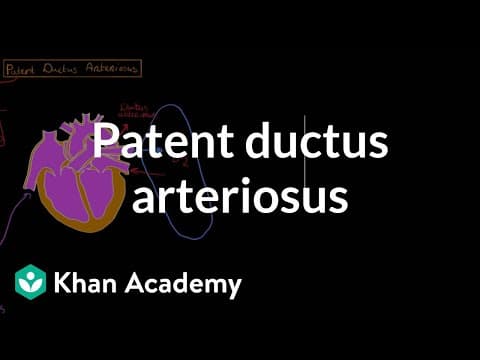
Patent ductus arteriosus | Circulatory System and Disease | NCLEX-RN | Khan Academy
khanacademymedicine
10m 3s1,532 words~8 min read
Auto-Generated
Watch on YouTube
Share
MORE TRANSCRIPTS