[0:00]Alright, so, with Tan we went forward 180 or pi radians every time, right? We cosine we did something a little bit different. We got just enough time to do sign.
[0:16]No, no time for a question this time. Uh, let's just do the same angle. Okay.
[0:51]Okay. Now, I picked the same angle here just so we can get on with seeing what kind of pattern do I have, right? And this is the trickiest of the lot, that's why I left it till last. So, it's the same angle, the same related angle. Okay? So pi on 6 is still going to be my first solution. Okay? So, you can see in there, pi on 6. Now, think, normally, you know, we're going from 0 to 2 pi. So, what's your other solution within that domain?
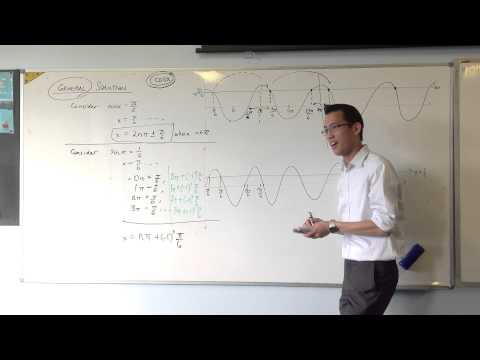
[1:23]We're in radians, so it's going to be Now, look, see, you can see again there's symmetry coming into play, right? Here's pi radians. Okay? No, it's not. It's not. Pi on 6 I went forward, right? When I go from pi, I go backwards, just that little, you can see how it's the same, little that smidgen, right? So, that's what gets me to 5 pi on 6. There are my first two solutions. Okay? Yeah? Is it, like, 90 plus, minus? Okay. Now, I'm going to get to hopefully I'm going to answer it. Let me let me try and see what's happening though as I keep going, right? I went 0 pi plus my angle. Then I went 1 pi minus my angle. What happens to my next pair of solutions? Well, it's 2 pi, that's where my intercept is, plus that little angle, right? 2 pi plus pi on 6. So, again, that's going to be 13 pi on 6, right? Uh, yeah. So, 2 pi forward. Now, to get my next solution, I've got to go 3 pi and backwards. So, 3 pi is 18 pi on 6. So, if I go back, that's going to be 17 pi on 6. Hmm. Now, let me try and list out these solutions and put it into a form which, um, will show the pattern a little more clearly. Okay? I've got this pi on 6, right? Um, I've got 0 lots of pi and then I go forward. Pi on 6. There's solution one. Now my next one, I get 1 lot of pi, but then I have to go backwards.
[3:04]Right? Pi on 6. That's what lent me 5 pi on 6. Then my next time, I get two lots and I have to go forward. That got me to 13 pi. And then I need 3 lots, and then I go backwards. Okay. Now, at this point, I think we're starting to see pattern. But the tricky thing is, well, how do you write it? Um, you could write it as two different parts. You could say, look, all the even ones, right? You go forward. So, it's a bit like cosine without the minus. And then all the odd ones, you go backwards. Okay? Now, file that away for later. Um, we are going to do that later on. It will actually become useful. But what we're trying to get at this stage, it's just one line, like this. That just nicely nicely sort of says the whole set. So, how do I get this whole set? Sometimes it's got plus, and sometimes it's got minus. Now, um, some of you have met this before, okay? Some of you have seen this heads up. I'm trying to get across to you why the answer is actually a really ingenious way to go about it, rather than just some weird awkward thing to remember. Okay? As I go from one to the next, okay, I want to go plus, minus, plus, minus, plus, minus. Okay? So, I'm going to introduce something which changes sign every time I go up by one. Okay? It's called, I'll just I'll just write it next to it. Okay? Ah, it's called a switching factor. Okay? So, here's the way it works. If I want to have a plus here, I'm going to add on -1 to the power of whatever lot of pi I've got. So, in this case it's 0. Okay? Now, you're like, huh? What does that mean? Well, just stay with me, okay? Anything to the power of 0, it's just 1, right? So, this so far checks out. It's going to be 0 pi plus 1 lot of pi on 6. Thumbs up. Now, what happens when I take this switching factor into the next line? I've got 1 lot of pi, okay? So, I'm going to add on 1 lot of this switching thing. Okay? You see that -1 to the power of it goes back and forth as I go up each number. Okay? So, what am I going to get here? 1 lot of -1, which is what I wanted. What happens next line? 2 pi plus 2 lots of this switching thing. You're starting to see what's going on, right? Because of this double negative, I go back to plus, right? And this is 3 pi. Yeah, it is so smart, except, you know, a lot of people the first time they learn it, it's just like, here's here's some forms. Go memorize them. And then go off and and, you know, be fruitful and multiply. So, I know about that, right? And you have no sense in This is actually an ingenious way to, um, succintly express something that's really a mess, right? So, what's the what's the final solution at the end? I'm going to use this green way of writing it. Okay? And it's going to be x is equal to. Now, what is this? At the front, I've got my my counter. So, that's my n. n lots of pi, right? Then I add this switching thing, which sometimes takes me forward, sometimes takes me backward, whatever I need based on it. Uh, times my little related angle, pi on 6, right? Just like I had here and just like in our tan example was pi on 4. Okay. So, in a nutshell, those are the journal solutions. Now, I promised I would give you a nice neat table, which um, shows you how they all I didn't need that. How they all fit together and in general terms, rather than in these specific examples. Okay? So, draw yourself up a 2 by 3 table, two columns, uh, I better just draw it for you because we'll we'll get the wrong number. Sorry.
[7:00]Okay. So, this table I'm going to give you, it's all of the formulas, this is a part that people have to memorize, okay? Um, for all of this, I'm going to give it to you in radians and I'm going to give it to you in degrees as well, because sometimes the question will be in degrees. Right? But, you know, we've got to use them. Okay? So, let's do it for, um, tan was first, then we need cosine and then we did sine, which is kind of funny. You usually do it in reverse order. Can you see now why I did tan first? Because it's the easiest kind of general solution. We'll do radians first and then we'll do degrees. Okay? So, what was it? We said that you get your little related angle. I'm going to call that theta. You know, it's pi on 4, here it's pi on 6. I'll use pi on 6 again. Okay? So, I'm going to say, it's n pi plus theta. Okay? Where theta is that first solution, the smallest solution, the acute solution that you get. So, therefore, if we convert it to degrees, what are you going to have? It'll be 180 n degrees plus theta degrees. That's not so hard, right?
[8:03]Okay. Move on to cosine. What what how did cosine work? Every even lot of pi, 2 pi, 4 pi, 6 pi, 8 pi, you take that and then you go backwards and forwards. Okay? So, I'm going to get 2 n pi plus or minus whatever that related angle is, pi on 6, pi on 4. Convert that over. Yeah, sorry. I didn't know when to use plus and when to use minus. So, if I'm asked for the general solution, you use both. This is the general, that's the general solution. You put in both. Oh, got it. These sort of catches, it's a way of, it's a faster way of writing pi on 6, 11 pi on 6, 13 pi on 6, rather than listing them all out. If I put in different values for n, I'll get every single one out. Okay? So, it's both. Right here. Remember 2 pi is actually 360. So, this is 360 n degrees plus or minus theta degrees. Last one for sine, the weird but really clever one. Okay? We start with n pi, then we have to add this switching thing which takes you backwards and forwards, right? And then you multiply that by the little angle, pi on 6 in this case. How does it work over here? It's just going to be 180 and sorry, there's an n in there. Same way. Okay? And don't forget for all of these because we've introduced this n, right? You you must say what n is. And later on, you'll see, I'll give you reasons why sometimes you introduce a second letter. Um, but you need to actually say what they are. And the fact that they're integers is crucially important. Okay?


