[0:11]Even if you've never been to Italy, you've never visited Pompey. Or seen the Colosseum in Rome, you probably know a few things about the Romans. At its most powerful, the Roman Empire covered an area of over 5 million square kilometers. Under the rule of Emperor Trajan in AD 117, over 20% of the world's population lived under Roman control. Today, you can still see Roman architecture across Europe. From the Imperial Baths of Trier in Germany, to the amazing aqueduct of Segovia in Spain. This aqueduct once carried water over 15 km, and is nearly 29 m high. In Turkey, you can visit the huge Roman Stadium of Afrodisius, which could hold 30,000 people. And in Libya, at the Southern Edge of the Roman Empire, you can see the incredible ruins of the city of Leptis Magna. Before the Romans invaded Britain in the year AD 43, most ancient Britons were farmers living in small villages. The invading armies brought the Roman culture, roads, stone architecture, taxes and the Latin language to Britain. They developed large, important cities like Londinium, now the city of London. The Romans stayed in the land they called Britannia for nearly 400 years, and left ruins across the country that are still amazing sites for visitors today.
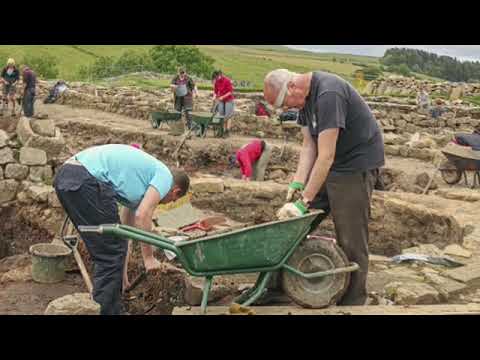
[2:55]One of the most impressive reminders of Britain's Roman past is located in the North of England. This is Hadrian's Wall. Hadrian's Wall marked the northwest edge of the Roman Empire. It was 80 miles long, around 117 km, and ran from Newcastle in the east to Carlyle in the west. It took around six years to build. Today, many parts of the wall are still standing. The remaining parts of Hadrian's Wall attract thousands of visitors every year, with many people keen to learn more about the lives of their Roman ancestors. But archaeologists have learned more about Roman Britain from the forts that the soldiers built near the wall, than from the wall itself. And one of the greatest sources of information is Vindolanda, a fort located a few miles south of the wall. There was a Roman Fort here at Vindolanda for decades before Hadrian's Wall was built. Historians believe that over a period of about 300 years, the Romans built nine different forts here. Today, you can clearly see the different areas of the fort, including the areas with underfloor heating. Vindolanda is a live archaeological site. Every summer, archaeologists return to this area, and discover more and more Roman items under the earth. They've already found hundreds of items, from shoes, to jewelry, coins, and combs. The items are displayed in the museum. It's incredible that some of these items have been underground for nearly 2,000 years. Since 1973, archaeologists have found more than 700 Roman letters at Vindolanda. These letters, known as the Vindolanda Tablets, give us a picture of what life was like in Roman Britain. Experts have translated the letters and today you can read them online. Archaeologists believe that it will take them more than 100 years to discover all the Roman items hidden under the ground at Vindolanda. Who knows what else we will learn from this amazing site?
[6:25]The city of Bath is in the southwest of England. Today, Bath is most famous for its 18th century architecture, with beautiful buildings like the Royal Crescent. The city is a world heritage site and is very popular with tourists. Bath is also home to the hottest natural spring in Britain. Water comes out of the ground here at around 45 degrees Celsius. Through the 17th and 18th century, people came to Bath for the spring water. The Pump Room where visitors came to drink the water opened in 1706.
[7:20]Then in 1878, they discovered a Roman Bath under another building. When the Romans invaded Britain, there was already an iron age village here. The Romans built a town called Aquae Sulis, with many temples and public baths. In the Roman baths, the natural hot water traveled through lead pipes into many different pools and heated rooms. People traveled from around the country to bathe here. But after the Romans left, people didn't use the baths. They flooded and eventually people forgot about them. Today, historians have restored the Roman baths and they are one of the most popular tourist attractions in the city. However, you can't wash in this water or drink it. It's not safe anymore. But today, you can relax in the natural hot spring water again, just like the Romans did. In this beautiful new building, there are two natural thermal baths. An open air rooftop pool and an indoor pool. There are amazing views of the city from the rooftop pool. Obviously, the city looks very different today than in Roman times. But these pools are using the same hot spring water the Romans used. And in the city of Bath, Britain's Roman past feels very present.


