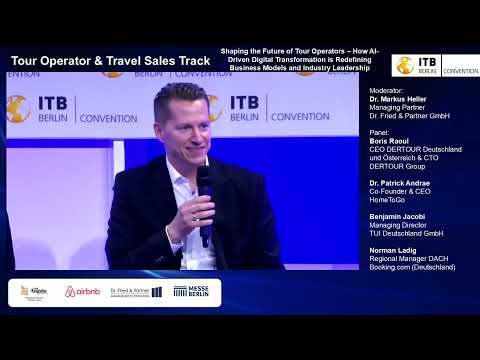
[0:03]I'm the CEO of the Tour Organization in Germany and Austria and I have also a parallel role. I'm also the group CTO of the whole Tour group. And as Markus didn't share his presentation, so I didn't know what to expect. So, I will take some of these pieces and to work it into my presentation. First of all, have you ever heard about the acronym Fobo? Yes. I think everyone knows Fomo is the fear of missing out and the new one is Fobo, which means the fear of becoming obsolete. And that's exactly how I usually start internal conversation to say, what is the purpose of a tour operator in our age when we have seen recently on the UK US capital market, um that companies that have been valued for times in years with 25 to 30% uh 30 times multiples, um they have been really being shocked by what AI is doing. Um and I think all of you, you know that we always talk about walled gardens. So and we all thought that these companies have walled garden and therefore, analysts pay 25 to 30 times the EBITDA multiple, meanwhile, it's 10, 15. So, AI is eating up software and therefore I think we should really ask ourselves, what's what would happen if we would not exist anymore next day? Would that change the life of our customers? Yes or no? And I think the answer is at least in the German market is given, there have been two major exits in the next in the couple recent years. And I think no one have, you know, uh has missed those brands, a part of the employees, of course, that have worked for these companies, but from a customer perspective, there was no big miss. So that's I think a good point where I want to set this scene for the discussion we will have later on with the panelist. And why is it so? Because if you look at from a customer perspective, um the customer today sees two big different platforms. We call it the UI platforms and the sync platforms. What do I mean by that? The do it yourself platforms are verticals um having one specific product, which they offer, very customer centric. Um and then you have the sync tool operators, which we call the tool operators, who are bandling offers um and also offering that to a customer. And today, the customer has to choose or can choose between the two. And if we do not really look for a really competitive advantage in the sync business in the tour operator business, people will tend to go to the do it yourself operators. And I think you mentioned it in your numbers, there is a grow not in volume, but by price. But if you look at the UI operators, they all grew in the last years. So, the customer has already a clear tendency what to choose. And the question is, how do we tour operator position ourselves in the future? Because the UI operator have a very clear advantage towards the sync operators. Because sync operators, they normally offer a product that is consumed every once time in a year. While do it yourself operators are offering a product where they have a much higher customer frequency and therefore a much better chance to stay in the mind of the customer. And if you look at them, they are operating as a platform. Tour operators are mostly working with old legacy platforms where, you know, code is a little bit different written um than in a very modern tech stack. When it comes to data management, they are very well organized and you know, data was solved from the beginning, whilst the tool operators with the legacy strategy mostly started, you know, from a product point of view and never from a customer point and never from a data point of view. Um if I look as well, how they work? Very agile. They do it yourself operators versus two operator, mostly still in a waterfall. Why? Because also, the IP does not belong to them. Mostly IP is purchased by a third party vendor, and that's the case for most of the two operators even if they are uh big. So, there are very clear advantages, um from that point of view and therefore, if you look as well the capex, so what do these company invest into technology? very, very big difference between what the UI operator are spending in technology and development instead of the tour operators. And also due to the text stack, they are able um to then also put 70 to 80% of their capacity into growth and innovative innovative initiatives. Why is it the tour operator, mostly uses 50 to 70% of the IT resources to maintain the business. And also believe or have a thought about um how with which platform you can attract talents. Is it more the UI versus um the all to operator legacy system? So there are very clear advantages uh towards the UI, um but also there are much of advantages uh when it comes to the sync operator and why? And um, I think the UI, we can also describe them as oh as um component specialists and they are super in what they are doing. Um and they are trying now to also bandle their services with other services, but it feels a little bit like virtual interlining, you know? Have you ever used virtual interlining, you know, when one flight comes late and the second one, you know, doesn't work the way. So we as a sink, yeah, we are more the virtual interlining part. So whenever something happens, as recently in in these days, you know, we take care and manage the whole oration of the customer. And therefore, we have also seen that we need to adapt what uh the UI are doing or doing much, much better than we as a tour operator, but also using the strengths that we have um as a tour operator and that's, I think, leads to the discussions you wanted to start. Thank you very much Boris. Thank you very much, take your place here, take your seat here, thank you very much. It's Boris, CEO of DER Tour Deutschland, Österreich and the CTO DER Tour Group. So, with me and with us on the stage, we will have um Patrick Andrea, co-founder and CEO Home To Go. Warm welcome. And Norman Ladig, he is Regional Manager uh at Booking.com for the DACH Region. So, so due to the slight time delay, we will talk a little bit longer than probably started uh to to go to. Um so, thank you very much Boris. It was uh great insights and the was very good uh impulse. So, let me just start with uh the first questions. What are the structural factors um that most strongly in in the um strongly influence the speed, the speed of innovation? So we talked about this already a little bit. If you want just to make the first point and then we just go to the round. If you want to talk about innovation, so could you please pass the word to this colleagues? That's we have two two innovators and two. No, first I want to start with our industry as a tour operator, and I I want to be a little bit sarcastic and critical, uh and don't, you know, take it wrong and don't feel insulted. But I think, um, the last innovation, uh, you know, the industry did, uh, is that we introduced flex prices, you know, that was more or less the last really, uh, innovation that, uh, the industry, uh, proposed towards customer. Um, so, you know, the industry as such is not really behaving in a way, um, a modern industry should do. When it comes to us as DER Tour, I think my colleagues have, uh, you know, worked already on very, um, uh, few things to innovate, and will, uh, also change a little bit the structure to embrace as well the change, and, uh, from a structural point of view, uh, you know, what we will do is, we to implement agile working methods. Um, today we are still in a waterfall method. So, and as you know, I'm coming from an OTA where the heartbeat is that every second or week, something is shipped.
[9:42]And, um, and in legacy traditional, uh, uh, companies, uh, you know, it's more one to three months release time. So, yeah, that's something that we will change also from a structural point of view. Great. So, when we talk about innovations, um, Benjamin, perhaps also, you can make your point about TUI. What what are you innovating? Yeah, I mean, overall Boris is of course very right. I mean, two operators sit on a pile of legacy systems and it's not easy to just, let's say, take them out over midnight and come up with fancy new stuff. So it's uh, it's uh, it's uh, it's good that we need to learn on the one hand what, um, especially in the distribution part, what happens day-to-day and how we can catch up with the speed of, um, the platforms that are driving a lot of energy and, uh, also attracting a lot of customers to their way of distributing. But also we have to make sure that, of course, we keep doing our homework, right? Because we also have to make sure that we do inventory management, that we do proper capacity planning. So a lot of things sometimes, I would say in the tour operator are a bit in the iceberg model underneath, uh, the surface, and, um, whilst it's very fancy to roll out new features for distribution capabilities to customers, it's also in crisis situations, for example, like right now, it's really important to know where your customers are and what they have booked, what flight they are on and these type of things. So it's a, it's a, we need to do both, let's say, uh, uh, uh, renovate the legacy systems and become a bit more agile, uh, but also make sure the stuff still works at the end of the day. I see a big smile from Patrick. Um, you know the name, the word legacy system. Are you familiar with something like this? Yeah, in the end, uh, at some point everything will get a legacy, right? Like, uh, I think, uh, that just depends on the, uh, on the age of the system, obviously, but like, um, uh, for us, uh, at HomeToGo, obviously, like, we have at the same time always a lot of AB tests running, right? Like, uh, up to 100 sometimes, yeah, and ship basically sometimes daily, yeah? Um, and and deploy anyway, like daily, uh, several times, right? Like, uh, uh, uh, smaller things and so on. So, uh, I think that's obviously a different starting point, but we also started later and don't have like, um, the reliance on, on certain, um, other systems. Nonetheless, um, we as HomeToGo as a group are anyway structured from having this do it yourself, but we also have Interhome in the group, which is like more of a tour operator model, somehow, you can say, right? Like, because they also take care of the customer, um, in the destination. Nonetheless, we can connect all this and also like provide, um, services, which is part of of HomeToGo, right? Using our technology that we build for the marketplace and, um, and also for, um, for our software and and service businesses to also offer it to our partners. So like two is for instance a partner, DR is a partner, Amadeus is a partner. So like, um, I think there is a lot of these things where you can also like converge, um, these topics and also provide new systems or new ways of doing it to the industry. Something specific, uh, two operators can learn from, from you or from the platform industry. I think, um, yeah, I I don't want to be like, uh, sounding like this. I think like any company anyway has to find their own way, right? Like I think, uh, usually, um, you can look at what others are doing and then you can see what what works for for you and, um, maybe you can learn from what, what also doesn't work. But in the end, obviously, like one thing that we, we do is we have a very, uh, tech-focused approach, yeah, like, uh, Boris just like, uh, mentioned in his, um, initial, uh, talk, where, um, we basically, um, look at what we can do with the technology. We always try to move very fast also into AI, right? Like we had the first AI product, that was actually called AI mode, and Google, uh, stole our name. Um, yeah, um, but like no, um, in in 2023, right? Like so, and and rolled it out and simply tested it. We can obviously, as a, as a, um, uh, technology first company, maybe also be a little bit more aggressive around it, right? Like in people also maybe a little bit more forgiving towards, uh, do it yourself, um, uh, like software, if you tell them look like this is beta, we are testing it and, and, and so on. But if you test it early, you can also like then have an advantage down the road. Norman, um Booking.com also a little a bit longer in the in the market already now, you still feel as a startup? Sometimes it feels actually, yes, because what we see is um moving from the conversational AI what we have at the moment to move to the move of the um agentic AI, yeah, at the beginning of introducing AI tools like the smart filters we have online where everyone could in a free text um and we have the product um output there and and the offers we we build on our platform. We are now testing um agentic AI which will solve a lot of frictions in the future. That means, for example, that if you stay um in a hotel or do have some frictions due to a cancellation that we explore how an automatic agent will help you to solve um any any friction your payment, be it um a rebook your flight or um an arrival date automatically, yeah. And this is something what we explore step-by-step at the moment and and that is um feels like a bit of revolutionary um and um and it's a good feeling yeah so. Okay, we heard about the legacy system. So you are not facing problems like this. You have a older infrastructure. You are quite keen that um your infrastructure is smart enough and modern enough to to get along with AI and agentic AI. Yeah, I mean, we we grew with um using um machine learning models since ages. Yeah, we started very early, uh very early as well with our language translation up to 40 languages and so on. Um so so that is what we know and also very very very strong and what we believe will help us also in the future is using our proprietary datas um to understand customer intent much better and now plug this in into the new um AI world yeah. Great. Let's move a little bit further on to the business models and um Benjamin, just asking you, what is the competitive advantage um of two operators like TUI or DER Tour, um, still to compare, um until to to to, yeah, to be stronger than just a platform or are you also moving on to a platform model? Yeah, I mean, overall, of course, everybody's trying to go places where other competitors are, so obviously, we're also trying to become more of a platform and offering more product, but also, of course, what we are doing is we function as a vertically integrated group. So, what we do is, we, um, we always look at creating also our own product and making sure that, um, that we can sell these, uh, as a bundle. So, having own airline, uh, own hotel product available, own reps in the destinations, own service agents in travel agencies in in Europe. That's a stronghold. I mean, that's something that we've done successfully for years and we continue, uh, to do this. But obviously, things evolve, right? And we need to make sure that this is up-to-date and up to speed and whilst I in some cases agree with what you said, I think traditional to operating has also continuously always, um, continuously always, um, develop and catch up with functions that maybe others have invented. But obviously, we need to be relevant for the customer, and if we don't offer functions, um, that, uh, our competitors also in the, um, let's say, component business, uh, offer to customers, then we become irrelevant. And that's why I think it's important to catch up and and monitor, but of course, being, um, able to offer the the airline product, the hotel product, and all sorts of services around it, is still quite a comprehensive business model that doesn't, uh, uh, doesn't, uh, uh, doesn't sell it by itself. So we need to especially be very attentive on the distribution part. Norman, once more about your your platform, about Booking.com. Do you see that uh the you you need other um or different customer needs, uh, then the tour operator platforms, for example? What we see is um while we white our mission is to create the connected trip, where we look into how to bring flights, um attractions, rental cars and, um, um, the traditional, um, um, stay business of accommodations into into one stop shop, yeah, and and and solve the friction, um, between all these elements. Um, it's it's the big opportunity for us, um, to make this um from the inspiration, um, of of the travel until the payment, the instay, but also um the post um stay, um, as as frictionless as possible, yeah. And that looks um very promising at the moment. Yeah, if we look at the flight business, for example, that um um we sold last year 68 million in flight tickets that grew over um 30% last year. So, so we see that these elements do coming together and help us, um, yeah, to to build the connected trip we want to travel for me. This is exactly what I was waiting for, the connected trips. Boris, once more, do you see the two business models growing together, like you're involved, evolving to this kind of models as well? Um, two answers. Um, the first is, we we try always to think from a customer point. So, what does a customer need? And, uh, we know that the customer does not only need a platform for vacation, because this customer, the same customer, has other needs as well for services, flight, hotels, uh, excursions, trips, fam trips, family trips or related trips, sports related trips, whatsoever. So, we try to think about, does a customer naturally want to change every time the platform and to find out, uh, who has the best offer for his specific wish? Um, and we, we believe very much and we conducted also some surveys. No, the customer wants to have, ideally, a ecosystem where he finds everything. And if you look at DER Tour, really, you will be surprised, you nearly find everything. And I would make a bet with you here, if all of you, you would have a bucket list, I'm pretty sure 95% of all what you have on your bucket list can be fulfilled by DER Tour. So, we took that as, you know, as a ground to say, wow, we have a such a huge inventory, um, and which is unique, which is also global. So, how can we monetize that best for the for the sake of our customer? And therefore, yes, will we move into a platform? Yes and no, because we still believe that, um, one very important driver for using our platform is to have as well the security, um, as, uh, we talked about it. And and not only the security, but also the synchronization of the services. Because and again, I I repeat myself, if you have ever tried, and I I love this company, I have to say Kiwi, uh and you have booked a virtual interlining, something goes wrong, you are really, you know, it's not really convenient, to be honest. Um, and we, we are super convenient because it's our responsibility to make sure that if something doesn't work, we have to make it work, and it's our, you know, obligation, and we do it. And therefore, for a customer, it's it's a no-brainer to use the service of such a group. And therefore, we will, you know, move a little bit into the direction, and also utilizing the strengths of the do it yourself operators, because they have, of course, very customer-centric, therefore, degressive, uh customer acquisition costs, yeah, whilst a normal tour operator normally has linear distribution costs. So, yeah, we we think that we have to go into the that direction. Yeah. Sounds very good to me. Thank you very much for this very, very interesting round.
[27:21]Norman, once more about Booking. Um, connection is all, as I heard. Yeah, as I hear, um, what are you your next, uh, steps in terms of AI, connecting people, but connecting also products, um, what do you have in in mind? Yeah, we are constantly looking into um how we also help not only um customers, but also our partners um to support with the with the AI. An example is what is customer facing is a new Q&A bot, which we use and in the future that will help, for example, not only searching and optimizing your instay experience, like parking available and so on. So where we see these these features help to reduce for the small, medium enterprises operational workload that can does not come via phone call or via email to to to the property anymore, for example. So that reduces of also costs and operational workload. But also what we look is into is is into um features like upselling features, yeah, where we really have an agent that makes an um upgrade more um possible, um that helps you to change without um even we giving your credit card details or whatever in in two um the agent as well and and changes some trip in doing the trip um the experiences. Yeah, and all these things um have a better customer experience um and um and um that that um that looks really promising at the moment. Where we also look into is um similar like what you mentioned is also like internal efficiency, yeah, using AI in the step of customer service that reduced all already like 10% of um of the inbound um also giving the answers directly to the customer um and also the time spent um per ticket per inbound call and so on um with a much clearer answer because the agent already knows due to the AI AI conversation um upfront um the agent who picks it up already knows the details, what fact to choose in the process and so on. So, which is um of course um very profitable business there. Cool. Boris, just uh I think my last question now. Can looking on the time because we we started a little bit late. We have to to hurry up a little bit. Mariana is already here, but Boris, coming back to your keynote. Um coming back to your keynote once more, um what do you see? What kind of time frame do you see, um, the two models or specifically the the big integrated tour operator models need to to to close up to the entire platform industry? If you would forgive me and you know to also answer the question of my colleagues, and um I also agree with Patrick said because um sometimes we talk about AI and data, but what we found out in our company in DER Tour, we have over 400 professionals that have been working 20, 30 years in this industry and they have a huge knowledge how all these things are combined. They know every destination, every hotel from the ground, everything. So that will that's I consider that really as an asset and to make that available as well to specific LLMs that only we will use. So, and therefore I agree the structural I I see there is a structural advantage for us as a tour operator as an operator, not as a platform, just as a intermediate, but as an operator and, you know, combining all these things and making really sure uh uh who will give our content, because we have not yet talked about the agentic. We have talked about efficiency and everything, but in my point of view, there will be, um, a huge change in our industry, as you mentioned, the demand channels will change, and that that will be an incredible, um, time for all of us being in this industry.


