[0:00]Good day, investors. Today we are going to cover Ambev 2025 full year results and with that also revisit the thesis, or what they do. Do they have any competitive advantages, who is management, who owns the company, and finally what's the value, especially in light of the new numbers. That said, if you are curious, check out my YouTube membership where I discuss what I buy, hold or sell. And of course some updates every week on Saturday, as actually Ambev is one of my holdings and I've been holding it at least more than a year. So, looking at the numbers, you can see the company has a, well, a pretty demonic but a high dividend yield. And of course, this is the Brazilian Real shares, so that's what we're going to use because the company is keeping their accounts in that, but you can buy the stock on the New York Stock Exchange in ADRs, I believe I hold also ADRs. So, the company is trading around, this is roughly 50 billion USD market cap, so you just do the math. It had a pretty good year, so I bought it at the kind of the lows, so I'm I'm good with that. Now, looking at what the company is from a big picture, it's Brazilian beer heavy EBITDA. Of course, this is a core profit engine, large scale, stable margins drive most of the group's EBITDA. Then you have on the second, you have LAS, which is Latin America South, so fastest growth regions, strong pricing but more volatile margins. This is Central America and the Caribbean, high margin, resilient markets with improving consumption trends. You have Canada also, mature, premium led markets, steady growth with consistent margin expansion. And last but not least, this is Brazil NAB, so that is non-alcoholic beverages. Smaller but fast growing non-alcoholic and soft drinks, so this is an improving stability profitability part of the business. Here you can see some of the modes of the business, so you have scale, distribution, so you have massive logistics, like a Coca-Cola. Capital intensive relatively to build out that logistics, so it's it's costly for new entrance, so that is a barrier to entry. Market share is really dominant, so if you think about their 24, uh or or most recent reports, they they quote around 69% of the Brazilian market. And other LATAM markets are also relatively high. Of course, they have strong brands and then here you can just pause the video and look through. So, you they get beer brands local and global. Uh of course, because they are, I haven't yet said that, but they are majority owned by Anheuser Busch. So, they are selling their brands. Of course, and then they have some soft drinks, even Pepsi and Gatorade, they have licenses to sell. They are basically distributing it in that region. Now, if you look at the stock price and the underlying, it tells two different stories. So, that's what I really like about this setup. Just to put these next to each other, you can see the stock is up and down, up and down, meanwhile, red is the free cash flow, it just keeps getting better and better. 25 a bit lower, although their net profit is a bit higher. You can check out that in their investor presentation. I don't have to put it in here. I'm focused on free cash flow. What you can clearly see, the stock goes high, goes low, and then the cash flow just keep pumping. So, this is the good thing about capital markets, stock market, is that you can just take advantage of these oversold areas and just buy if the underlying business fundamentals in place. And then as you can see, they are mostly doing buy dividends and not really buybacks, shares are kind of flat over the period. That's because you are owned by Anheuser Busch, so you just upstream dividends, that's the business model. Now, if you look at their debt structure, you can see total debt is down and then anyway, it's only sitting at 4%. Imagine, can you imagine that, like 4% debt to equity, so it's highly, highly, it's it's a really strong balance sheet. If you look at their coverage ratio, 26 times, insane, and then their intangible assets as of total assets is 36%. So they still have some uh some relatively large amount of assets, not just goodwill and intangibles in the air like a tobacco company. But their uh maintenance CAPEX is actually pretty low, so they don't have to spend much to to just maintain the business. Uh top of my head, I think I have to jump back here. So you see the free cash flow, let's say 16,000, below 16,000. Wait, no, like 20,000 Real, I this is 20 billion Real. Um and they spent like 5 billion on CAPEX or something like that, so the total operating cash flow is 25, they spent 5, so 25% of everything goes to maintenance CAPEX. That's pretty low. Of course, a tobacco company like B80 spends 5% on on maintenance CAPEX, they spend any 25, but that's still a relatively low number. Now, looking at who are the major shareholders, so as I said, uh you have Anheuser Busch. Uh of course, and Ambev Brew, this is also another Anheuser Busch uh related holding entity, so basically these two is more than 60% of the stock Anheuser Busch. And then the others is basically you the float. So, on the management stock ownership side, you can see that, uh like nobody has more than 1%, and in total they hold this many commons across 528. That's the most detail I got. Uh directors hold less than 1% of shares. Now, the incentive structure seems to be logical, so you have EBITDA operating performance, revenue growth, profitability metrics and return and value creation. So, I haven't seen any uh ESG, I don't know, gas emission misery, so that's a good point. And then they have a solid dividend policy of paying at least 70, 40% of net profits, may distribute more. Uh of course, and then because this is basically a subsidiary of Anheuser Busch. Looking at the 26 outlook, they are this is Brazil beer, but given that's the majority of their uh business, like 48% of the business. They are projecting this growth uh versus last year. I'm going to just go with 4 and a half. Actually some other parts of the business are projecting higher growth. So I could just average out all the projections and use the lower end guidance, but this is more or less accurate. So I'm just going to be relatively conservative using the less uh the lower growth area of the business and the lower end. Looking at their numbers, this is where I really like. Uh I don't if you follow this channel, you you probably know that I'm not a big fan of, I mean, I like the stories but I'm focused on the numbers. I like to go into sometimes into a business where I don't even know the story. I just want to get the story from the numbers and those numbers usually don't lie, especially the balance sheet can tell you uh funny things over years. So, here you can see return on equity average 20%, 25 it's actually 2020 uh 22%, really high return on investment, extremely high and return on tangible assets 21%, insanely high. And if you look at the debt structure, 4% debt to equity, basically non-existent, 26 times coverage, very good. This is a fortress balance sheet. Now, let's look at their free cash flows in the future. I'm going to use a 4%, 4 and a half% growth rate on top of the 25 number. Compound it out and I get, and I use a 10% discount rate. What I get is roughly 15 per share. Today it's selling for 16 per share. When I bought it, it was like 11 or 12 per share, so I did a good entry. But still, uh this is a relatively stable business. And uh price could be higher. They are not going to do buybacks, so that's not going to help your per share metrics really, but it's going to pay you a nice dividend. Now, if you look at the risk side, of course, uh you have volume and consumer demand pressure, so beer and soft drink volumes are sensitive to income, inflation, especially in Brazil and the Latin American countries, less so in Canada. Uh and of course you have shifting tastes. So there is there is a, like with tobacco, with alcohol, there is this sense of like people are going to drink less, this next generation. If you look at some studies, Gen Z is drinking less than the previous generations. Uh I'm not sure. So I'm more like a cyclical and not linear guy. So I think we're going to see a resurgence in a couple generation later. As we see actually with tobacco, it's getting it's coming back as cool. Uh with some brands and some uh just just a feel in the social environment. Now, input costs. So you have input costs and FX volatility, so commodities like their aluminum, barley and sugar. And of course currencies, things can pressure margins despite pricing actions. Regulatory and tax risk. So changes in excise tax, alcohol regulation or Brazil's tax reform, which can impact pricing and demand and cash return. So these are your risks. Now, doing a final judgment. Of course, I hold Ambev, uh more than a year now, so keep that in mind. Ambev is a Brazil uh heavy beverage company with beer dominance, complemented by some non-alcoholic beverages and geographic diversification. Uh it's a subsidiary basically of Anheuser Busch and its focus is on dividends rather than buybacks. The business is simple, relatively mature and relatively predictable. On the mode side, so the company benefits from a strong and durable mode. Unmatched scale, distribution and dominant market position, particularly in Brazil. Iconic local and global brands reinforcing pricing power and consumer loyalty. These limit new entrance obviously. This is reflected if you look at their returns, so return on equity of 22%, return on tangible assets 21% and return on investment 14%. This is a very stable, very profitable business. It's a stable like demand, and of course the company has no debt. 4% debt to equity. Now, management quality is solid, shareholder oriented, of course, if you have 61 or 2% owned by Ambev, uh you have to be shareholder oriented. Uh with incentives tied to relatively good financial performance like profitability, EBITDA, revenue growth and value creation. And they have also a clear uh dividend policy of paying at least 40% of net income as dividend, they can do more. However, the KPI is less transparent from the management side, aside, so there is no clear scorecard like, hey, this is your targets and this is uh what you did, so that is your bonus percentage relative to the maximum. I haven't found that for this company. Probably they have it in house, so keep that in mind. And of course, the company is Anheuser owned 62%, and only a 27% float on the public markets. Valuation. So, I estimate the value using a 10% discount rate, 4 and a half% growth to be around 15. Today it's selling at 16. So, if you want to get a 10% return, probably not the best price to buy it. Although if the growth rate is higher than I expect, uh this could actually outperform. While if you think about Brazil, they have a uh policy rate of the Central Bank around 15%. So, in theory, if they would cut, that would stimulate, although I could argue against that. But asset prices in Brazil could also rise faster as we've seen in the last well, one and a half months now, Brazilian stocks been doing great. But limited margin of safety, although the business is really high quality, so one could argue to use a lower discount rate. Uh I'm just going to use 10% here. Now, this is where you have Ambev relative to others. So as I said, it's kind of below fair value if you use my assumptions and 10% discount rate. But I'm a happy holder. It pays me more than a 6% dividend yield, close to 7, and I got into really cheap. That said, uh let me know what you think about Ambev, and uh thanks a lot for watching and take care.
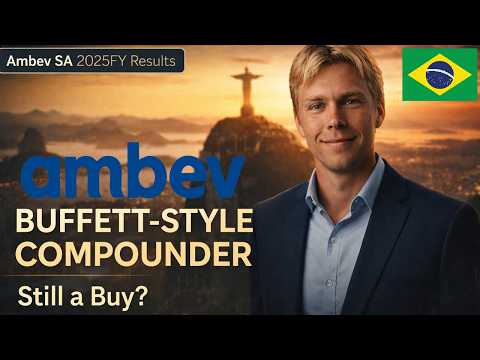
Ambev SA FY25: A Classic Buffett-Style Long-Term Compounder
Peter Lukacs Research
12m 26s2,130 words~11 min read
YouTube auto captions
Transcript source
YouTube auto captions
This transcript was extracted from YouTube's auto-generated caption track. The transcript below is server-rendered so it can be read, searched, cited, and shared without opening the original YouTube player.
Pull quotes
[0:00]Today we are going to cover Ambev 2025 full year results and with that also revisit the thesis, or what they do.
[0:00]Do they have any competitive advantages, who is management, who owns the company, and finally what's the value, especially in light of the new numbers.
[0:00]That said, if you are curious, check out my YouTube membership where I discuss what I buy, hold or sell.
[0:00]And of course some updates every week on Saturday, as actually Ambev is one of my holdings and I've been holding it at least more than a year.
Use this transcript
Related transcript hubs
Watch on YouTube
Share
MORE TRANSCRIPTS


