[0:00]Hello. So today I want to talk about something that literally saved me the last couple of years because my ADHD got so much worse. Like the kind of worse where your attention span is so tiny that you can't sit through anything for longer than five minutes. I would start something, get distracted immediately, forgot what I was doing and then start something else and forget that too. Suddenly it's 6:00 PM and I've done nothing except stress about how I've done nothing. And the thing is, I didn't even know I had ADHD back then. I just thought that I was lazy or incapable of sticking to anything. But there was one method that I kept coming back to whenever everything felt impossible. One thing that actually worked and that thing is called interstitial journaling. If you've never heard of it before, it may sound a bit complicated, but it's the simplest thing ever. And somehow it fits ADHD brains perfectly. So I want to walk you through how I do it, what it looks like and why it works so well for people like us. So I've tried so many productivity methods over the years, all the planners, all the habit trackers, Pomodoros, time blocking, notion templates. All of it. And I swear some of these are built by people who have perfect time awareness, perfect executive function and perfect lives. Because for me, nothing ever stuck. If a system is too strict, I suffocate. I instantly feel like I'm in a box and then I rebel and stop doing it after two days. But if a system is too loose, then I forget about it completely. And if it requires planning things in the future, then it's even worse. My brain has absolutely no understanding of future. If you ask me what I'm doing in three hours, I don't know. I barely know what I'm doing in three minutes. So I needed something that works in the moment. Something that doesn't require planning or predicting or scheduling or mapping out an entire day. Something I can pick up in the middle of the mass and it gives me clarity immediately. And that's exactly what interstitial journaling does. So what even is interstitial journaling? The name sounds fancy, but it's literally just this. You write down what you're doing as you're doing it in between tasks. That's it. You don't plan, you don't write a to-do list, and you don't try to guess the next 10 things. You simply document what you're doing right now in the moment and the next tiny thing you're going to do. It can look like this. Little entries, short sentences, just you narrating your day as you move through it. It feels stupidly simple, but it works for an ADHD brain. You always know where you are. You always know what you just did. You always know what you're going into next. No guessing and no what was I doing confusion. So why this works so well for ADHD? ADHD makes you forget things instantly. Like you walk into a room and suddenly you're like a lost toddler in a mall. You don't even know why you walked in there. You're like, what was I doing? Why am I here? And here is why interstitial journaling helps. It resets your brain every time you pause. Instead of spiraling into distractions, the journal pulls you back to the present moment. It's like a built-in checkpoint. And it creates micro accountability. And not in a stressful way. It's just that when you write, I'll do laundry, you are 10 times more likely to actually do it. You know that feeling when you feel like you are suddenly behind on everything, but you can't even list what you were supposed to do. When you journal your steps, the fog lifts and you see your day clearly. And it teaches your brain the one thing that it struggles with, which is time awareness. ADHD time is weird. Everything is either now or not now. With time stamps, your brain starts understanding what an hour feels like, what 20 minutes feels like, and so on, without even trying. And it keeps you moving. Even if you get distracted, you can always look back at your last entry and go, oh right, I was working on this project. And then you just continue working on that. And lastly, it reduces shame. Because you can see that you actually did things, even on days when you felt like you didn't. Okay, so how I personally do it. My journal isn't aesthetic, it's not cute. It is literally time, sentence, time, sentence. Sometimes I write one line per hour, sometimes I write 20 lines in a day. Sometimes I forget for days and come back to it when everything is collapsing. On days when I feel super scattered, I write more often because it helps my brain stay anchored. On calmer days, I barely touch it. And sometimes I use a notebook and sometimes I use the notes app on my phone, it doesn't really matter. What matters is the habit of checking in with yourself in between tasks. So interstitial journaling is insanely good when you feel overwhelmed and frozen. Because ADHD paralysis comes from two things. One, not knowing where to start, and two, feeling like everything is too big. But journaling forces you to shrink everything down to the smallest next step. You don't write work on the project. You write, open the project folder, just look around. And that tiny step naturally pulls you into the next one. No pressure, no perfection, just movement. It also works when your mood is weird. One thing people don't talk much about is emotional dysregulation with ADHD. Some days, you wake up and everything feels wrong. I am actually on one of those days right now and I am actually using my interstitial journal to help me film this video. On such days, you can't focus, you are irritated and you feel guilty for no reason. And journaling actually helps with that too. Because you can see your patterns. You can see, oh, okay, every time I don't sleep well, my brain is useless until noon. Or every time I skip breakfast, my productivity dies. Patterns you never noticed in your brain suddenly become obvious on paper. And you don't need discipline for this. People always assume productivity requires discipline. But with ADHD, discipline burns out fast. What actually works is systems you can fall back into even after you forget about them. And interstitial journaling is exactly that. You can drop it for a week and then come back to it on a random Tuesday at 4:00 PM. Write one line and you're back. It still works. And it's not like trying to make a perfect bullet journal, it's completely the opposite of that. So how to start if you have never tried it? Here is the simplest way. Grab a notebook, write the time, and write what you're doing now. When you switch tasks, write the next one and repeat whenever you feel your brain drifting. That's literally all you need. If it helps, you can also add how you feel. This helps because you see what drains you and what helps you. You can also write much longer entries if that's what you feel like doing. Some mornings I start by writing down what I want to do that day as my first line. Other times it turns into something more like a morning pages entry. You can also switch up how you do it. You can write what you did or you can write what you will do or a mix of both, just whatever works for you. Why I think ADHD people love it. Because it's not planning. It's not productivity culture. It's not strict or aesthetic or high maintenance, it's just a way to stay connected to yourself. So ADHD brains need three things. Structure, flexibility and instant feedback. Interstitial journaling gives all three at the same time. It keeps you organized, but not restricted. And it feels like having a little friend walking through the day with you. So yeah, this is the one method that actually helped me stay functional when everything else failed. I didn't even know it was ADHD friendly when I started doing it. I just knew that when I write down things in the moment, I stop losing my days to distractions and chaos. If you feel stuck or constantly overwhelmed by the smallest tasks, try this just for a day. You will feel the difference immediately. Write down the tiny steps, write down the smallest tasks. I opened my laptop, I opened my emails, I took a water break, I made my bed. It really makes a difference. That's it for this video, and I hope you will try this method. I genuinely recommend it to you if you have ADHD and thanks for watching this video, and I'll see you next time. Bye.
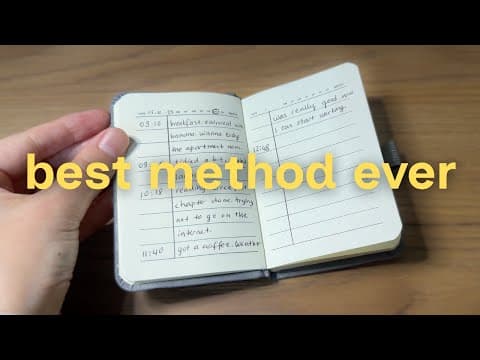
The BEST Productivity Method Ever for ADHD | Interstitial Journaling
Novie by the Sea
9m 7s1,519 words~8 min read
YouTube auto captions
Transcript source
YouTube auto captions
This transcript was extracted from YouTube's auto-generated caption track. The transcript below is server-rendered so it can be read, searched, cited, and shared without opening the original YouTube player.
Pull quotes
[0:00]So today I want to talk about something that literally saved me the last couple of years because my ADHD got so much worse.
[0:00]Like the kind of worse where your attention span is so tiny that you can't sit through anything for longer than five minutes.
[0:00]I would start something, get distracted immediately, forgot what I was doing and then start something else and forget that too.
[0:00]Suddenly it's 6:00 PM and I've done nothing except stress about how I've done nothing.
Use this transcript
Related transcript hubs
Watch on YouTube
Share
MORE TRANSCRIPTS


