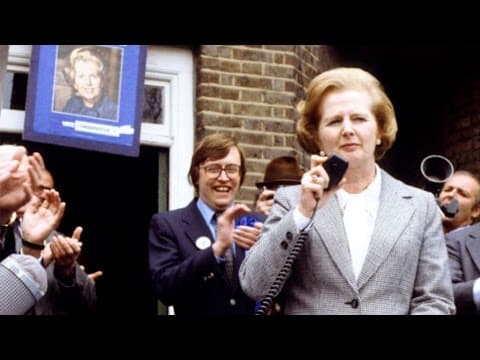
[0:11]Ladies and gentlemen, this is the fourth lecture in a series on significant general elections since the war. And this is on the 1979 general election which saw the largest swing since the war, a swing of over 5% though it's been exceeded since. And it inaugurated 18 years of conservative rule, the longest period of single party rule since the time of the Napoleonic wars. And 11 of those 18 years were dominated by Margaret Thatcher as Prime Minister. But it was more than a shift of parties, it was arguably in 1979 the end of an era because it heralded a change in the role of the state. And a new view of what the state should be doing. And it also marked the end of what can be called the post-war settlement. Now, what do I mean by the post-war settlement? What I mean is that after 1945, some issues in politics seemed to be completely settled and closed so that no one was prepared to open them. For example, that there should be a mixed economy comprising a nationalized sector, public sector and a private sector. That was agreed by the Labor and Conservative parties until 1979. That there should be full employment was generally accepted until 1979 and no party dared break from that consensus. And that full employment should be secured by broadly Keynesian policies of demand management and fine-tuning of the economy. That was also agreed by both parties. And both parties had come to agree from the time of Harold Macmillan in the early 1960s that to secure full employment, you needed an incomes policy. Either a voluntary policy agreed with the trade unions or a statutory policy. And that to complement that, most major items of policy, particularly domestic policy, there should be discussions and consultations with the trade unions which were in a state of the realm. Both Labor and Conservative governments agreed with that. This is a legacy of Ernest Bevin's time at the Ministry of Labor during the war. And that was the consensus. It's now, as you will know, all gone. We don't have a nationalized sector anymore, a very small one. Full employment as it was understood up to 1979 has gone. Full employment was understood as a level of unemployment higher than 3%, that has gone. Keynesian policies of economic management and fine-tuning have gone. And of course, incomes policies have gone. The last one was by the Callahan government, which was defeated in 1979. I think no government now will dream of an incomes policy. And I think even if a Labor government is returned in the election this year, they will not be involved in very close consultation with the unions of the type that used to exist. Now, the collapse of this settlement is generally attributed and not unfairly, I think, to Margaret Thatcher. But it was heralded by the Labor government that preceded her. And in particular, by a speech made by James Callahan as Prime Minister to the 1976 Labor Party conference in which he seemed to be repudiating Keynesian measures of demand management. He said this. We used to think that you could just spend your way out of recession and increase employment by cutting taxes and boosting government spending. I tell you in all candor that that option no longer exists, and that insofar as it ever did exist, it worked by injecting inflation into the economy. And each time that happened, the average level of unemployment has risen. Higher inflation followed by higher unemployment. That is the history of the last 20 years. And in the early 1980s, the conservative Chancellor of the Exchecker, Nigel Lawson, was to say that post-war governments had made a mistake in trying to control unemployment by Keynesian methods. And to control inflation by macroeconomic methods and incomes policies. He said they got things the wrong way round. He said they should deal with inflation by macro measures, primarily control of the government of a money supply and then the exchange rate. Not by incomes policies. And Margaret Thatcher was in fact the first Prime Minister since Anthony Eden not to have an incomes policy. And at the way to secure higher unemployment, though perhaps not full employment, was through supply-side policies increasing the efficiency of the market. And that is broadly the system under which we now live and the aim was to get unemployment down through trade union reform, greater labor market flexibility and better education and better skills. So, 1979 also was to mark the end of the post-war settlement. More specifically, it marked a crisis for the Labor party and for social democracy. And in 1978, rather precedently, a year before the election, the Marxist historian Eric Hobsbawn, who was in fact a member of the Communist Party, wrote a pamphlet called The Forward March of Labor Halted. And that was to be the result of the 1979 election. That the whole idea of consultation with the trade unions went, the whole idea of an organized working class working with the Labor Party went as well. It was a crisis for Labor and socialism no longer seemed as it had for much of the 20th century the wave of the future. Now, just before the 20th century, in 1894, a liberal Chancellor of the Exchecker, Sir William Harcourt, first introduced death duties. And in response to criticism, he replied, we are all socialists now. In other words, everybody believed in a much greater degree of state intervention. But you may say that what happened in 1979 showed the need for reform of the Labor Party and Tony Blair's new Labor. So that Labor could only get back in 1997 by saying, we are none of us socialists now. So I think that 1979 is a highly significant election, a watershed between two eras. Now, the last election that I discussed in my last lecture, February 1974, the outcome, a Labor victory, a narrow Labor victory surprised many people. And was arguably determined by the campaign. It was a highly uncertain election, as of course, the one this year is being, I think anyone who predicts it is being rather foolish, I think, I think it's the most unpredictable election we've had. I think it's an election that's not possible to predict, though I'm not certain of that prediction.
[7:40]But the 1979 election was not a surprise. Almost everyone thought the Conservatives were going to win. It confirmed what people thought. And the causes of the conservative victory lie not in the campaign itself, but in the history of the previous five years and in particular the six months before the election. Now, the conservative victory had not seemed likely when Labor took office as a minority government in March 1974 defeating Edward Heath. And the Labor Party went to the country in October, it was seven months apart, and secured a very narrow majority of three, a narrow overall majority of three. And that government was led by Harold Wilson. But in April 1976, Harold Wilson retired and was succeeded by James Callahan. But at the same time, that government had become a minority government due to by-election losses and defections. And as you will see, the Scottish Nationalist did very well. They got 30% of the Scottish vote, which is higher than they got in 2010 when they got about 21% of the Scottish vote. They got nearly a third of the votes in Scotland, and the Welsh nationals also did fairly well. And the Labor government secured itself in office by offering the nationalists devolution. A policy of devolution. And they secured the support of the Northern Ireland parties by promising to increase the number of seats in Northern Ireland from 12 to 17, which was reasonable because Northern Ireland had been underrepresented while it had devolution, the Stormont system. And now it didn't have devolution, it was ruled directly from Westminster, so it was reasonable to make the balance of seats in proportion to population. But that secured the position of the Labor government. Now, 1974, it was a very traumatic year because with the defeat of Edward Heath, it seemed to many that the control of trade union power was a central issue of politics. And many people were looking to the abyss and and thought perhaps Britain was ungovernable. And even many in the establishment thought that. And there was a remarkable episode towards the end of the Heath government when Sir William Armstrong, the head of the Civil Service, was found lying on the floor in his office, chain-smoking and screaming about the world coming to an end.
[10:10]And he was led away for treatment. And Heath's private secretary rang him up, rang up Heath, and said that the head of the Civil Service had been locked up, those were the words he used. And Heath said he was not surprised. He said he thought William was acting oddly the last time I saw him. And Sir William Armstrong had to retire early in the Civil Service, but in 1975 he became chairman of the Midland Bank.
[10:41]But the Labor party had an answer to this problem, which put the conservatives on the defensive. And the Labor party's answer was the social contract, which was an agreement with the trade unions. That they would agree to wage restraint in return for certain benefits which the government gave them. And Labor said that would deliver peace and quiet, and the only alternative was Heath and confrontation. That Labor would secure the consent of the trade unions, which was essential to running an advanced industrial society, whereas a conservative government would mean endless strikes and industrial upheaval. Now, it seems to me Labor misunderstood the verdict of these two elections in 1974. That although they got a majority, they hadn't really won the election. It was just that they'd lost fewer votes than the conservatives. You see they had under 40% of the vote, which was unusual then, we'd become used to it now. And there was no real basis for saying that Labor had a mandate for the social contract and more particularly for increasing the powers of the trade unions. Now, every single opinion poll during this period showed that the vast majority of people felt that the trade unions were not too weak, but too powerful and they wanted their powers restricted. But the Labor Party proceeded to heap new responsibilities, privileges and immunities upon the trade unions. They firstly repealed the Conservative government's Industrial Relations Act. They restored all the trade union immunities that the act had curtailed. And they gave new legal protection to picketing. So they gave the trade unions tremendous rights. They also get put in law a statutory right to belong to trade union, that everyone could belong to a trade union. But no corresponding right not to belong to a trade union. And they gave statutory force to the idea of the closed shop. So the unions had much greater powers. And the question was, what would the trade unions give in exchange? Now, the Chief Secretary to the Treasury in the Labor government was Joel Barnett, who died recently. And he wrote a book of reminiscences, a very interesting book on the period, called Inside the Treasury. And he said the social contract was a matter of give and take, and the government gave and the trade unions took. But that, I think, was not wholly fair. Because in 1975, the trade unions did accept the need for an incomes policy for voluntary restraint. Unlike Heath's incomes policy which had been statutory. And that worked for three years until 1978. Now, the Labor party further strengthened its position in 1977 when it agreed to a pact with the liberals. Now, this would now be called a confidence and supply agreement, if it may happen after the next election. But the liberals didn't join the government, but they agreed they would support the government in all votes of confidence and in financial matters, supply the budget and so on. And this guaranteed the government against defeat. They still had nationalist support, they still had the support of the Northern Irish. Now, the pact ran out in the autumn of 1978, and there's a general assumption that there would be an election. After many difficulties, the economy was now beginning to improve. In 1975, inflation had reached the huge level of 26%, but it was now falling to what was thought of, as in those days, as an acceptable level. In the summer of 1978, it was 7.8%, which was lower than France and Italy, but higher than Germany. And opinion polls were also showing that Labor, having been a long way behind, was beginning to catch up with the conservatives as inflation was falling. And the conservatives seem to have another advantage because the new conservative leader was Margaret Thatcher, who seemed at the time inexperienced. And James Callahan tended to defeat her in parliamentary debate and questions. And Margaret Thatcher's main political ally was Sir Keith Joseph, who was proposing policies that many people thought would lead to much higher unemployment and industrial dislocation. And they thought he'd be rather extreme. And the effect, you can see, when he became minister secretary of state for Industry under the Thatcher government, Michael Foot, who was at the time Labor's deputy leader, but then became the Labor leader, made a brilliant speech showing the effect of conservative policies, which they were also predicting in the 1970s. And if the IT people have got it, we can hear Foot speech, we can't unfortunately see him, but we can hear the speech if the IT people have got it.
[15:45]I would like to miss out the right honorable gentleman, the Secretary of State for industry who's had such a tremendous effect upon the government and our politics altogether. And as I see the right honorable gentleman walking around the country, looking puzzled and forlorn and wondering what's happened.
[16:10]I'm, I've often tried to remember what, what he reminds me of, and the other day, I hit upon it. Because I recall that in my youth when I used to go in Plymouth. Yes, I know, quite a time ago. We'll come to that one in a moment, too. But I used to go when I lived in Plymouth every Saturday night, along to the Palace Theater, and the favorite I always used to watch there was a magician, conjurer. And they used to have in the audience, dressed up as one of the most prominent alderman in the place, a person who was sitting at the back of the audience. And the magician conjurer would come forward and say that he wanted to have from the audience a beautiful watch. And he would go amongst the audience, he'd go up to the alderman and eventually take off him a marvelous gold watch. And he'd bring it right back onto the stage. He'd infold it in a beautiful red handkerchief. He placed it on the table there in front of us. He took up his mallet and he hit it, smashed to smithereens. And then on his countenance would come exactly the puzzled look of the right honorable gentleman.
[17:36]And he would step forward.
[17:42]And he would step forward right to the, he'd step forward right to the front of the stage and he'd say, I'm very sorry, I'm very sorry, I've forgotten the rest of the trick.
[18:03]And that's the situation of the government, they've forgotten the rest of the trick. Well, that, that was a very good joke, although the joke turned out to be on James Callahan and not on anyone else.
[18:22]But the comedian Roy Hud wrote to Callahan and said it wasn't Mario Lloyd, it was Vesta Victoria. And Callahan said he knew that, but he thought that no one knew who Vesta Victoria was, but some of the older people amongst the TC would remember who Mario Lloyd was, so he sang that song. Now, Callahan decided he wasn't going to have the election in autumn 78. And that meant there was no way to get out of the 5% commitment. And it may be the cabinet would have rebelled more strongly against it if they'd known there wouldn't be an election. And there were various difficulties with that 5%. That it meant, given the rate of inflation was higher, it meant a real fall in the standard of living for most workers. And the trade unions told Callahan, they could not hold the line, they could not deliver it. Even worse, and here there's some signposts today, I think, the 5% did not apply to senior civil servants or the heads of nationalized industries. Nor to many of the managers in private industry. It's a, and they said, they used the argument, they couldn't attract talent unless they played a lot more than 5%. And so, it was seemed unfair, and perhaps particularly unfair to the low-paid. Now, the trade unions felt they'd been teased and cheated by Callahan there, that he deceived them about the election. And they were rather annoyed at being treated in that way. And they were now, as I've explained, much more powerful as a result of the legislation that Labor had introduced, in particular closed shop. At that time, trade union membership was much more extensive than it was today. It reached its peak in 1979 with 53% of the labor force, and particularly strong in the public sector. But the main problem facing Callahan was the same one facing Edward Heath. The trade unions were not there to police wages in the interest of government policy, but to do the best they could for their members. If they didn't, there would be a revolt on the shop floor, and that is what happened, and when it came, it was militant and on occasion violent. And Callahan could not deal with it. It was outside his experience. He'd grown up in the shadow of Ernest Bevin and was psychologically unable to appreciate that the trade unions would not cooperate with government. Now, the leader of the Transport and General Workers Union said to Callahan, who are you to say that my members cannot have the increase I have negotiated for them? The answer until autumn 1978 was it was TC policy to accept wage restraint, but it wasn't after 1978 because the TC had rejected it. And problems immediately arose with the Transport and General Workers Union, which were at that time the largest union. And the problem first problem arose in the private sector just before Christmas. That in the Ford Motor Company, the TGW, the Transport and General Workers Union put in a claim for 30%. And they said, this was justified because the firm had large profits, and the chairman had just had a salary rise, it wasn't 5%, but 80%. Ford offered 5% in accordance with the government guidelines. And there was then a strike which lasted for nine weeks, an official strike. And that meant, while this was going on, Ford was losing money, of course, to its competitors. So they eventually settled at 17%, which of course, was far beyond the guidelines of the government, but became the going rate in the motor industry because Voxol then said people were working in Voxol, looking for to getting it, we must get it too, or there'll be a strike there. And Callahan says in his memoirs, he realized at that point the election was lost, but much worse was to follow. Now, the government's policy was that if this sort of thing happened, there would be sanctions, not on the union, but on the firm. And the firm would not be given any government contracts, and they wouldn't be given any export credit guarantees. And that needed a vote in parliament. But the trouble was the left wing of the Labor party was opposed to the 5%, and they had abstained on the vote. They included John Prescott at that time, they abstained on the vote, and they joined together with the other parties opposed to it, primarily the conservatives, of course. To defeat the government on the question of sanctions for Ford. And perhaps wrongly, Callahan refused to make it an issue of confidence. David Owen said it was the foreign secretary said it was that moment he realized Labor had lost the next election. There was then a strike in British oxygen, where again the management were defeated. And this showed the government could not implement its policy in the private sector. And so, there was to be a pay policy only in the public sector. So you were to have free collective bargaining in the private sector, but a 5% incomes policy in the public sector. And that wasn't going to work, because it was natural that those in the public sector would seek comparability. It was becoming clear 5% could not hold. And the next strike was very clever, it was by BBC technicians. Now, the BBC had just purchased the Sound of Music to show over Christmas to compete with ITV, which was at that time getting ahead of them in the ratings. And the technicians threatened to strike over Christmas. And they had the support of the Board of Governors who said there was a great pay disparity with ITV, which was in the private sector. And there was a problem with comparability. Now, the government feared the worst thing would be if there was a strike of the TV technicians over Christmas, and people couldn't see the sound of music. And then all watched ITV. And if there were no BBC programs over Christmas. So there was a settlement which the government did not resist at 15%. And that led everything loose as it were. There were then walk-out strikes and militant picketing on the part of large numbers of workers in the private sector. Oil tanker drivers, lorry drivers, ambulance drivers, water and sewage workers, local government manual workers. And they put forward claims of between 20 and 40%. And the culmination was a day of action so-called in January, which one and a half million public sector workers were on strike. And all this coincided as luck would have it with a terrible winter. Snow and cold and so on. And at this time, James Callahan, through some misfortune, really, he was at a summit conference dealing with strategic arms limitation in the sunny climb of Guadeloupe in the West Indies. And there were photographs of him in the press sunning himself while everybody else was shivering in the coals with strikes. And many of the right-wing papers emphasized that by publishing pictures of very attractive young women in swimsuits also sunning themselves near James Callahan. And he came back from the summit to a temperature in Britain of minus 7 degrees. And very unwisely gave the following press conference, which the IT people will, I hope, show us. Not at the moment, no. We've been on the brink of it, I think, once or twice during the last week, and but we've stepped back from it. There's no point in declaring a state of emergency. We've had I think six states of emergency in the last few years. A state of emergency means that the government intends to keep the essential life of the community going, and of course, that is our first responsibility and we shall do so. As you may know, plans for that are always ready. Those contingency plans when we could see troubles looming ahead were made before Christmas so that there was nothing except of course putting touches to them, and you've always got to add to your preparations, there was nothing new or exciting that we had to do in that field. What about your reaction to the criticism that you shouldn't have been away from the country during these past four or five days? I'm sure everybody would have liked to have been with me, but I don't think anybody except a few journalists are very jealous of it. I think that they feel that we've been working hard, as indeed we have, and you know, I actually swam. And I know that's the most exciting thing of the of the of the visit, but no, I, I think you should put all that kind of criticism in perspective, and one mustn't allow jealousy to dissuade you from doing what you know is the best thing. What is your general approach in view of the mounting chaos in the country at the moment? Well, that's a judgment that you are making, and I promise you that if you look at it from outside, and perhaps you're taking a rather parochial view at the moment, I don't think that other people in the world would share the view that there is mounting chaos. You know, we've had strikes before. We've come close to the brink before. There's need for a great deal of industrial self-discipline in this country. I hope we shall gradually learn it, and that we shall avoid hurting each other. But please don't run down your country by talking about mounting chaos. Does the government's pay policy stand firm, Prime Minister? I don't think I want to discuss pay policy just in this moment, but you can take it that I have not wavered one iota from my views about what is the best way for this country to proceed in order to keep employment up, and in order to make sure that inflation doesn't rise. And whatever happens on the industrial front can't change that view, that stands, and we shall have to continue to follow it up. Now don't you think that's sufficient after an 11-night hour flight overnight? Thank you very much, thank you very much. And no breakfast.


